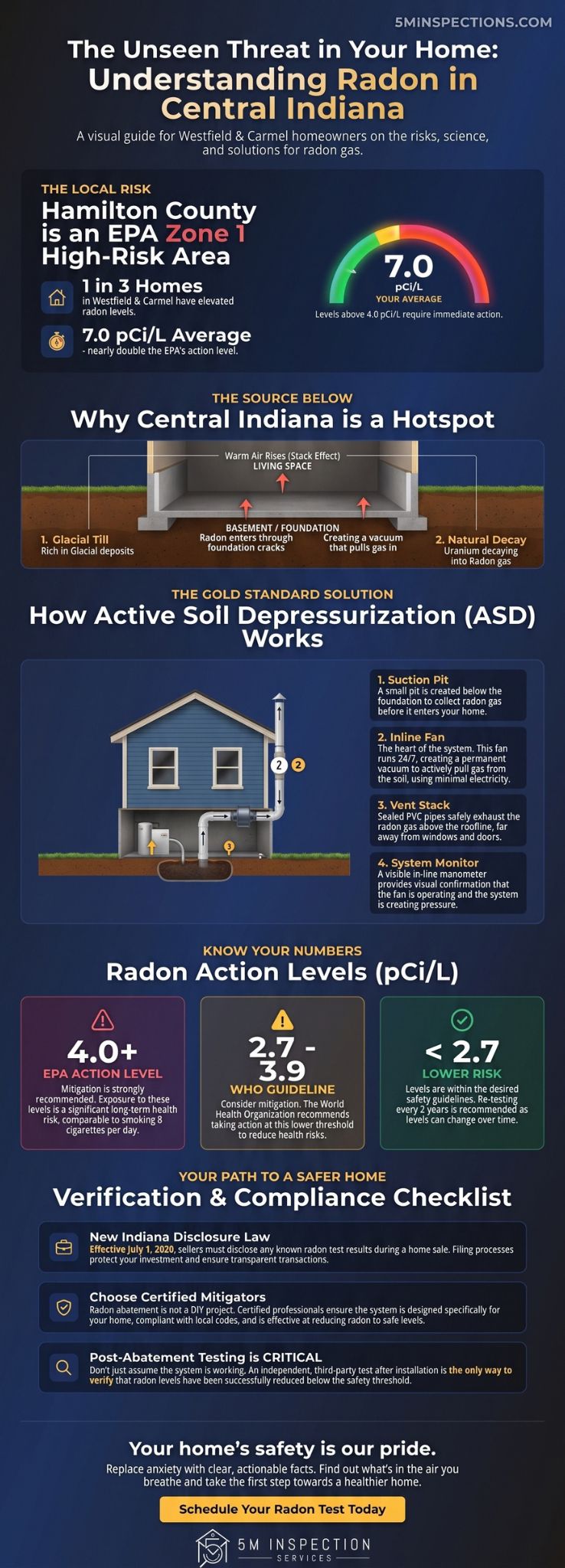
In Westfield and Carmel, 1 in 3 homes contains radon levels that average 7.0 pCi/L. This is nearly double the EPA’s recommended action limit. You likely view your home as a sanctuary. Discovering an invisible, odorless gas is threatening your family’s health is incredibly stressful. It’s normal to feel overwhelmed by technical jargon or the potential cost of radon abatement, especially since Hamilton County is a high-risk Zone 1 area.
At 5M Inspection Services, your home’s safety is our pride. We’re here to replace that anxiety with clear, actionable facts. This guide explains how modern mitigation systems use precision ventilation to redirect gas from Central Indiana’s glacial soil away from your basement. You’ll learn about the new Indiana disclosure laws effective July 1, 2026, the mechanics of sub-slab depressurization, and how to ensure your home stays below the strict 2.7 pCi/L WHO safety guideline.
Key Takeaways
- Understand why Central Indiana’s glacial soil creates a unique need for professional radon abatement in Westfield and Carmel homes.
- Learn the technical components of active mitigation systems and why they are the standard for effective gas removal in our region.
- Identify the specific safety thresholds that signal when it’s time to move from testing to corrective action.
- Discover how to navigate local building codes and choose certified mitigators who follow industry best practices.
- Gain peace of mind by learning why independent, post-abatement testing is the only way to verify your system is working correctly.
What is Radon Abatement and Why is it Critical in Central Indiana?
Radon abatement is the process of reducing indoor radon gas concentrations to safe levels. While it sounds like a general home repair, it’s actually a precision-engineered solution. Radon abatement is a specialized ventilation strategy for sub-soil gas. In our part of the country, this isn’t just an optional home upgrade; it’s a vital health intervention. Radon is the leading cause of lung cancer in non-smokers, contributing to more than 21,000 deaths across the United States every year. Because you can’t see, smell, or taste this gas, the danger often remains hidden until a professional inspection reveals the truth.
Central Indiana sits on a unique geological foundation. During the last ice age, glaciers deposited soil rich in uranium across our region. As this uranium naturally decays in the earth, it releases radon gas. Our local limestone and shale formations act as a conduit, allowing that gas to rise toward the surface and into your living space. Protecting your family starts with understanding that the ground beneath your feet is constantly producing this radioactive byproduct. Your home’s safety is our pride, and that begins with identifying these invisible threats.
The Science of Sub-Slab Suction
Radon enters your home through a phenomenon called the “stack effect.” Warm air rises and escapes through your home’s upper levels, creating a vacuum in your basement or crawlspace. This pressure difference literally sucks radon gas through foundation cracks, construction joints, and sump pits. Modern homes in Westfield are built with incredible energy efficiency. While this saves you money on utilities, these airtight envelopes can trap gas inside, leading to dangerously high concentrations. Various Radon mitigation techniques exist to reverse this pressure, but sub-slab suction remains the most effective way to intercept gas before it ever crosses your threshold.
Radon Levels in Hamilton County: What the Data Says
The EPA designates Hamilton County as a Zone 1 area. This is the highest risk category possible. Data shows that 1 in 3 homes in our area have elevated levels above the 4.0 pCi/L action limit. You cannot rely on your neighbor’s results to gauge your own risk. Soil permeability and foundation integrity vary significantly from one lot to the next, even on the same street. If you haven’t checked your levels recently, scheduling professional radon testing Carmel Indiana is the only way to get the unbiased data you need to make a confident decision for your family’s safety.
How Active Radon Abatement Systems Protect Your Home
A professional radon abatement system is more than just a pipe in the floor. It’s a carefully balanced mechanical network designed to outsmart physics. The primary components include a suction pit carved beneath your foundation, heavy-duty PVC venting, and a specialized inline fan. This fan creates a permanent low-pressure zone under your home. Because air moves from high pressure to low pressure, the radon gas is drawn into the pipes and exhausted safely above your roofline rather than seeping through your floorboards.
In many new Westfield developments, builders install passive systems. These rely on natural convection but often struggle to handle the high gas concentrations found in Hamilton County. Active systems, which include a powered fan, are almost always necessary here to achieve consistent safety. If you’re unsure which setup your home has, you can schedule a professional assessment to verify your protection levels. Aesthetics matter in Carmel’s upscale neighborhoods. You don’t have to settle for an unsightly pipe on the side of your house. Systems can often be routed through the garage or an interior closet and vented through the attic. This keeps the mechanical components hidden while ensuring the discharge point remains well away from windows and doors.
Active Soil Depressurization (ASD)
ASD is the gold standard for radon abatement. By creating a continuous vacuum under the concrete slab, the system intercepts gas before it enters your living space. These fans are designed to run 24/7. They are remarkably efficient, typically consuming about as much electricity as a standard 60-watt light bulb. You can monitor the system’s health using a manometer. This small U-tube filled with colored liquid provides a visual pressure check to prove the vacuum is active. For more technical details on system design, you can consult the EPA’s guide to radon reduction.
Addressing Crawlspaces and Sump Pumps
Not every home sits on a solid slab. If you have a crawlspace, mitigators use sub-membrane suction. This involves covering the earth with a high-density plastic liner and sealing it tightly to the walls. The system then pulls gas from beneath this barrier. Sump pump pits are another common entry point. Specialized airtight covers allow the pump to function for drainage while preventing radon from escaping into the basement. In some cases, the system can even utilize existing interior drain tiles to collect gas from the entire perimeter of the foundation. This integrated approach ensures no corner of your home is left vulnerable to gas accumulation.
The 4.0 pCi/L Threshold: When is Abatement Necessary?
Understanding your test results starts with a technical term: picocuries per liter (pCi/L). This unit measures the rate of radioactive decay in the air. The EPA has established 4.0 pCi/L as the official action level. If your home tests at or above this number, the government recommends immediate radon abatement. This threshold is essentially a line in the sand for public health safety. However, this is not a strictly black-and-white issue. The World Health Organization (WHO) takes a more cautious stance, suggesting that homeowners take action if levels reach 2.7 pCi/L. This stricter guideline reflects the reality that lower exposure leads to lower long-term health risks.
In the competitive real estate markets of Westfield and Carmel, these numbers carry significant weight. Savvy buyers often view a 4.0 pCi/L reading as a major red flag during the inspection period. Even if a home is otherwise perfect, a high radon reading can stall a closing or lead to aggressive price negotiations. Addressing these levels before you list your property ensures a smoother transaction. Your home’s safety is our pride, and providing clear, unbiased data helps you navigate these high-stakes decisions with total confidence.
Interpreting Your Radon Test Results
Most real estate transactions rely on short-term tests that last 48 to 96 hours. These provide a reliable snapshot of current conditions. Long-term tests, which stay in place for over 90 days, offer a better look at your average exposure throughout the year. You should be aware that radon levels often spike during Indiana winters. When you seal your home against the cold, you also trap rising gases inside. It’s vital to remember that no level of radon is ‘safe,’ only ‘reduced.’ If you’ve just received an elevated reading and aren’t sure of your next steps, our detailed guide on what to do if your radon test is high walks you through a clear, actionable plan for 2026.
Radon Mitigation vs. Remediation: Choosing the Right Path
You might hear several terms used interchangeably, but there are subtle differences between Radon Mitigation vs. Remediation. Mitigation and radon abatement focus on the active reduction of gas through mechanical systems. Some homeowners mistakenly believe that simply sealing foundation cracks is enough to solve the problem. While sealing is a helpful secondary step, it rarely works as a standalone strategy. Gas is under pressure and will eventually find its way through microscopic pores in the concrete or around the perimeter of the slab. A professional system that addresses soil pressure is the only way to ensure your family’s long-term protection.
Planning Your Radon Reduction Strategy in Westfield & Carmel
Once you identify elevated gas levels, the focus shifts to professional radon abatement. You shouldn’t hire just any general contractor for this task. Effective mitigation requires a licensed professional certified by the National Radon Proficiency Program (NRPP) or the National Radon Safety Board (NRSB). These experts understand the specific sub-soil conditions of Central Indiana. In Westfield and Carmel, the typical cost for a professional install ranges from $800 to $2,000. For a standard home with a basement, a sub-slab depressurization system usually costs between $1,000 and $1,500. These figures are an investment in your family’s long-term health and your property’s future resale value.
If you’re moving into one of the newer developments in Westfield, your home might already feature Radon-Resistant New Construction (RRNC). These homes include passive vent pipes and sealed foundations from the start. However, a passive system doesn’t always guarantee safety in Hamilton County’s high-risk Zone 1 environment. You should still conduct a professional test to see if you need to “activate” the system with a specialized fan. Your home’s safety is our pride, and we recommend re-testing your air every 2 years or after any major structural renovation. Fans typically have a lifespan of 5 to 10 years, so regular monitoring is essential to ensure the vacuum remains strong.
Questions to Ask a Radon Mitigation Contractor
Before signing a contract, verify that the professional is licensed by the Indiana Department of Health. Ask if they perform a diagnostic “communication test” before they begin drilling. This technical step ensures the suction pit is placed in the optimal location to pull gas from the entire area beneath your slab. You should also confirm the warranty terms. A reputable mitigator will offer a multi-year warranty on the fan and a guarantee that the system will keep your home below the 4.0 pCi/L action level.
Post-Installation: What Homeowners Should Expect
Modern systems are designed to be unobtrusive. You can request “low-sone” fans that operate with minimal noise, ensuring your basement remains a quiet living space. To maintain the curb appeal of your Carmel residence, many contractors can paint the exterior PVC pipes to match your siding or trim. The most critical step occurs after the installation is complete. You must verify the results. Never rely solely on the installer’s word for safety. To get unbiased proof that your system is working, schedule your independent radon test with a certified third-party inspector.
Verification: Why Post-Abatement Testing is Non-Negotiable
Installing a radon abatement system is a major step toward a healthier home, but the process doesn’t end when the fan starts spinning. You need proof that the system is actually doing its job. A common mistake homeowners make is allowing the mitigation contractor to perform the final safety test. This creates a significant conflict of interest. The person who installed the equipment shouldn’t be the one to grade their own work. To ensure your family is protected, you need a neutral, third-party professional to provide an unbiased verification of the results.
Your home’s safety is our pride. We believe every Hamilton County resident deserves clear, documented evidence that their indoor air quality meets safety standards. Once the system has been running for at least 24 hours, an independent test will confirm if the vacuum is strong enough to keep levels below the EPA action limit. This documentation is also a vital asset for your “home binder.” When the time comes to sell your property in Westfield or Carmel, having a certified report from an independent inspector will give potential buyers the confidence they need to move forward with the purchase.
The 5M Inspection Services Standards for Radon Safety
We don’t rely on basic charcoal canisters that can be influenced by humidity or minor temperature shifts. Our team uses professional-grade continuous radon monitors (CRM) to track levels with precision. These devices record data points every hour, allowing us to see how your system performs during different times of the day. Our testing protocols are strictly tamper-resistant, which is essential for maintaining the integrity of real estate transactions. We understand that the Central Indiana market moves fast. That’s why we offer 24/7 text availability for quick scheduling, ensuring you get the answers you need without unnecessary delays.
Beyond Radon: A Holistic Approach to Home Safety
Radon doesn’t exist in a vacuum. It’s often influenced by other structural factors in your home. For instance, there is a strong link between basement moisture and gas entry. High water tables in our region can increase soil pressure, forcing more gas through foundation cracks. Integrating radon testing into a comprehensive Buyer’s Home Inspection allows us to look at the big picture. By checking your sump pump, foundation integrity, and ventilation all at once, we provide a thorough safety net. Our mission is to ensure that every home in Central Indiana is a true sanctuary for the families who live there.
Protecting Your Family in the Hamilton County Radon Zone
Living in Hamilton County means residing in an EPA Zone 1 area where average radon levels frequently exceed the 4.0 pCi/L action limit. You now understand that professional radon abatement is a precision-engineered ventilation strategy designed to protect your loved ones from the leading cause of lung cancer in non-smokers. Whether you’re activating a passive system in a new Westfield build or installing a custom solution in an established Carmel home, the final step is always independent verification. You need proof that the air your family breathes is truly safe.
As an NRPP-Certified and family-owned team, we’re dedicated to providing the unbiased data you need for a confident decision. We don’t perform repairs; our results are always objective and thorough. Our 24/7 text availability makes it easy to fit safety into your busy schedule. Secure your family’s safety. Schedule an unbiased radon test with 5M Inspection Services today. Your home’s safety is our pride, and taking this proactive step ensures your sanctuary remains protected for years to come.
Frequently Asked Questions
How much does a radon abatement system cost in Indiana?
A professional system in Westfield typically costs between $800 and $2,000. For most homes with a standard basement, you can expect to pay between $1,000 and $1,500 for a full installation. These costs cover the specialized fan, PVC venting, and the labor required to seal foundation entry points. Investing in radon abatement now prevents the much higher costs of health complications or lost home equity during a future sale.
Can I install a radon mitigation system myself?
While homeowners can technically attempt a DIY installation, it’s highly discouraged due to the precision required for soil depressurization. Professional mitigators use diagnostic equipment to ensure the suction pit is placed in the most effective location. An improperly installed system can actually increase gas concentrations or cause dangerous backdrafting of your water heater. Most buyers also require proof of a licensed installation during real estate transactions.
Do radon abatement systems run all the time?
Yes, your mitigation system must run 24 hours a day to maintain the pressure vacuum beneath your foundation. If the fan is turned off, the natural “stack effect” will immediately begin drawing radon gas back into your home. These fans are designed for continuous use and are very energy efficient. Most models consume about the same amount of electricity as a standard 60-watt light bulb.
Will a radon system affect my home’s resale value?
A certified mitigation system protects your home’s value by removing a major health red flag for buyers. Starting July 1, 2026, Indiana law SB0061 will require sellers to provide a formal radon warning statement and disclose all known test results. Having a functional system already in place simplifies the disclosure process. It shows potential buyers that you’ve prioritized home safety and maintenance.
How long does it take to install a radon reduction system?
A standard professional installation usually takes between 3 and 5 hours to complete. This timeframe includes drilling the suction point, routing the pipes to the exterior, and installing the fan. More complex home architectures, such as those with multiple crawlspaces or split-level foundations, may require a full day of work. You don’t typically need to leave your home during the installation process.
What happens if my radon levels stay high after abatement?
If levels remain above 4.0 pCi/L, the mitigator must perform a “pressure field extension” test to find air flow blockages. They might need to excavate a larger suction pit or install a fan with higher static pressure. This is exactly why we emphasize independent post-installation testing. It provides the unbiased proof you need to ensure the radon abatement was successful before you pay the final bill.
Is there a specific Indiana license required for radon mitigators?
Yes, all individuals performing mitigation work must be licensed by the Indiana Department of Health. You should always verify that your contractor holds a current license and carries certification from the NRPP or NRSB. These credentials ensure the technician understands the specific geological challenges of Hamilton County’s Zone 1 soil. Hiring an unlicensed worker can lead to system failure and safety hazards.
How often should I test my home after an abatement system is installed?
The EPA recommends re-testing your home at least every 2 years to ensure the system is still performing correctly. You should also schedule a new test if you complete any major renovations, such as finishing your basement or adding a home addition. Soil conditions and foundation integrity can shift over time. Regular testing is the only way to confirm your family remains protected from rising gas levels.