Subterranean termites cause an estimated $5 billion in structural damage across the United States every year. In Central Indiana, these silent invaders, along with carpenter ants and powderpost beetles, can compromise a home’s integrity long before you notice a single sign of trouble. If you’re in the middle of a real estate transaction, you’ve likely heard that a wdi inspection is required by your lender. It’s natural to feel a bit of anxiety when your closing date depends on a report about wood-destroying insects, especially since Indiana mandates these for all VA purchase and cash-out refinance transactions.
We understand that you want more than just a checked box on a form; you want the certainty that your investment is secure. This reference guide walks you through exactly what happens during the inspection process, from the mandatory NPMA-33 form to the specific requirements for FHA loans. You’ll learn how to distinguish a general home inspection from this specialized assessment and gain the knowledge needed to keep your property safe for years to come. Let’s look at how this critical step protects your future home and keeps your mortgage process on track.
Key Takeaways
- Understand that a wdi inspection is a specialized, non-invasive visual exam focused on structural threats, distinct from your standard home assessment.
- Identify the “Big Four” wood-destroying insects in Central Indiana and how their specific behaviors impact your home’s structural integrity.
- Learn to decode the mandatory NPMA-33 form to understand exactly what “visible evidence” means for your lender’s requirements.
- Recognize “conducive conditions” such as wood-to-ground contact that invite future infestations and how to address them proactively.
- See how bundling your termite assessment with a Buyer’s Home Inspection provides a faster, more thorough look at your property’s health.
Understanding the WDI Inspection: Definition and Legal Requirements
A wdi inspection is a specialized, non-invasive visual examination of a property’s accessible areas. It specifically targets evidence of infestation or damage caused by wood-destroying insects. While a standard residential property inspection evaluates the overall health of a home’s systems, like the roof and HVAC, this assessment focuses entirely on structural threats that often remain hidden behind drywall or beneath crawlspaces. In Central Indiana, this report serves as a critical safeguard for your investment. It provides the clear documentation needed to verify that a property is structurally sound and free from active infestations before you finalize your mortgage.
WDI vs. WDO: What’s the Difference?
It’s common to hear the terms WDI and WDO used interchangeably, but they represent different scopes of work. WDI stands for Wood Destroying Insects, focusing on termites, carpenter ants, carpenter bees, and wood-boring beetles. WDO, or Wood Destroying Organisms, is a broader category that includes wood-decaying fungi and dry rot. In the Indiana market, inspectors typically focus on the insect category for standard real estate reports. While we also offer specialized Mold Sampling for those concerned about biological growth, that process is distinct from the insect-focused evaluation required for most loan approvals. Effective pest control management starts with knowing exactly which threat you are looking for.
Lender Requirements in the Indianapolis Market
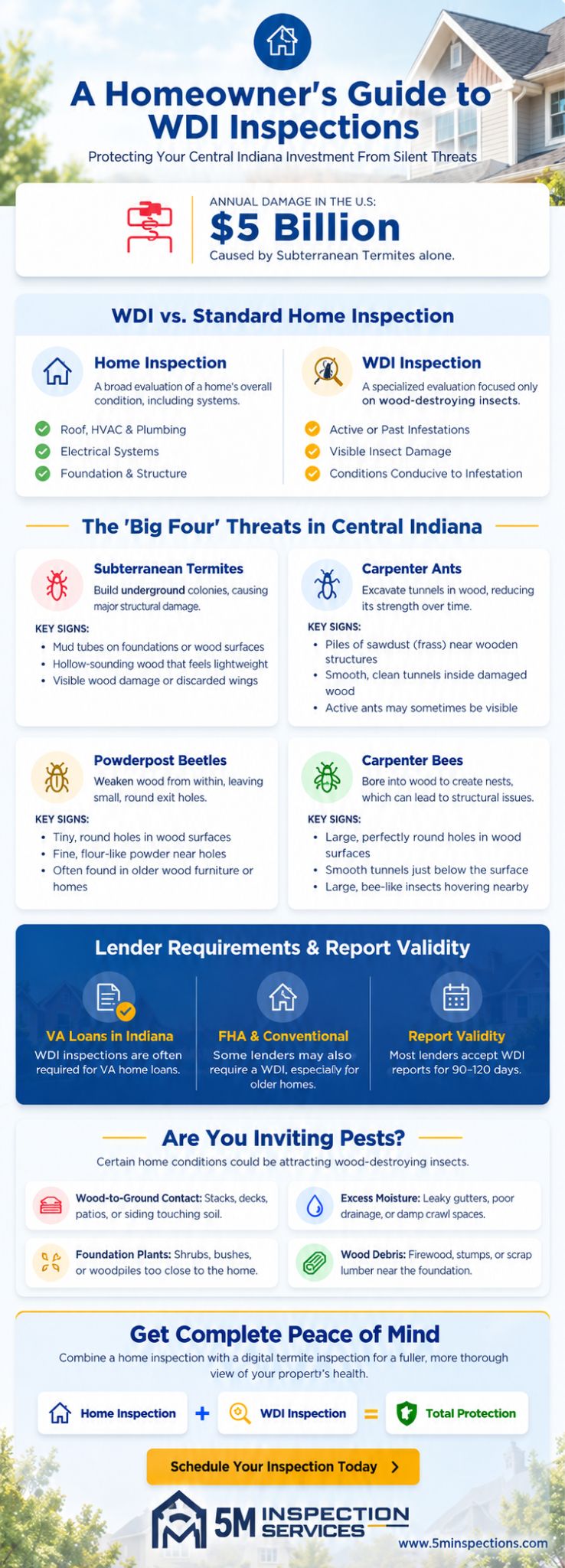
Lenders view a wdi inspection as an essential tool for risk management. For those using a VA loan in Indiana, this inspection isn’t optional. The VA classifies Indiana as a state with a significant risk for termite activity. This makes a clear WDI report mandatory for all purchase and cash-out refinance transactions. Since a policy update in June 2022, VA borrowers are now permitted to pay for this inspection themselves, which simplifies the negotiation process. FHA and conventional lenders also utilize these reports to protect their collateral. If an appraiser notes potential evidence of wood damage, a professional report becomes a requirement for closing. Keep in mind that these reports have a limited shelf life. Most lenders consider a WDI report valid for 90 days. Timing your inspection correctly is vital to ensure the documentation remains active through your closing date.
The ‘Big Four’: Wood-Destroying Insects Common in Central Indiana
In Central Indiana, homeowners face specific biological threats that can quietly dismantle a property’s value. While many general inspectors mention “pests,” a professional wdi inspection looks for the forensic evidence left by the four primary wood-destroying species found in our region. Understanding these insects is the first step in protecting your investment. We don’t just look for bugs; we look for the subtle signatures of structural risk that these organisms leave behind.
Eastern Subterranean Termites in Indiana
The Eastern Subterranean Termite is the most significant threat to Indianapolis area homes. These insects live in the soil and build protective mud tubes to reach the wood in your house. You’ll often see these pencil-sized tubes along basement walls, foundations, or in crawlspaces. During early spring, usually after a warm rain, these colonies produce “swarmers.” Seeing hundreds of winged insects near your windows is a clear signal that a colony is nearby. Don’t assume a newer home in Westfield built on a concrete slab is safe. Termites can enter through cracks as thin as a business card or through utility penetrations in the slab. Our Termite (WDI) Inspection service is specifically designed to find these hidden entry points before they lead to expensive structural repairs.
Secondary Threats: Ants, Beetles, and Bees
While termites eat wood, Carpenter Ants damage it by nesting. They hollow out galleries to house their growing colonies, often leaving behind “frass.” This sawdust-like debris consists of wood shavings, insulation, and insect parts. If you see small piles of grit near your baseboards, it’s a sign of active nesting. Powderpost Beetles are a different kind of “silent” threat. We frequently find them in the structural joists of older Indiana barns and damp crawlspaces. They leave behind distinct “shot-hole” exit patterns, which look like the wood was hit by tiny pellets. These holes are often accompanied by a fine, flour-like powder.
Carpenter Bees round out the Big Four. You’ll identify them by the perfectly round, half-inch holes they drill into fascia boards, pergolas, and decks. They don’t just stay on the surface; they tunnel deep into the wood to lay eggs. Over time, these tunnels weaken the wood and invite moisture, leading to rot. Every finding from our assessment is meticulously documented on the NPMA-33 Wood Destroying Insect Inspection Report. This standard document ensures your lender receives an objective, professional evaluation of the property’s condition. By identifying these specific threats early, you can take action to keep your home structurally sound and pest-free.
Decoding the NPMA-33 Form: What Your WDI Report Actually Means
The NPMA-33 Wood Destroying Insect Inspection Report is the definitive document for your real estate transaction. While other reports might offer general observations, this specific form is what lenders, especially for VA and FHA loans, require to move toward a closing. At 5M Inspection Services, we use this industry-standard document to provide a clear, objective snapshot of a home’s structural health. Section II of this form is the primary focus for most buyers. It indicates whether the inspector found “visible evidence” of an infestation. If this box is checked, the report will specify which of the “Big Four” insects were found and whether the infestation appears active or inactive.
Active vs. Previous Infestations
Distinguishing between an old problem and a current threat is a vital part of a professional wdi inspection. We look for specific markers that tell the story of the home’s history. For example, circular drill holes in a concrete basement floor or plastic caps in the yard often indicate “evidence of previous treatment.” This means a professional pest control company has worked on the property before. A previous infestation isn’t necessarily a deal-breaker for a loan. If the damage was properly treated and the structural integrity remains intact, lenders often accept the report as long as the proper documentation is provided. We meticulously document these signs to ensure you have the full context of the home’s past.
Understanding Report Obstructions
No wdi inspection can see through solid objects. Section V of the NPMA-33 form lists “inaccessible areas” or obstructions that prevented a full visual exam. In many Central Indiana homes, finished basement walls or heavy storage in a garage can block our view of the sill plate and floor joists. Standard residential construction typically places wall studs 16 inches apart. While we probe accessible wood between these studs, we cannot damage finished surfaces to see what’s behind them. If a significant portion of the foundation is covered by drywall or insulation, we’ll note it clearly. This protects you by identifying exactly where the limits of the visual exam were, allowing you to make an informed decision about the risk.
Section III and IV of the report cover “Conducive Conditions” and recommendations. Conducive conditions are environmental factors, like wood-to-ground contact or standing water, that practically invite termites to dinner. Even if no bugs are present today, a lender may require these conditions to be corrected before funding the loan. Our report provides the necessary roadmap, offering clear recommendations for either professional treatment or a more in-depth structural evaluation if significant damage is suspected. This level of detail ensures that your home investment remains secure and your closing stays on track.
Conducive Conditions: Why Your Home is at Risk (Even Without Bugs)
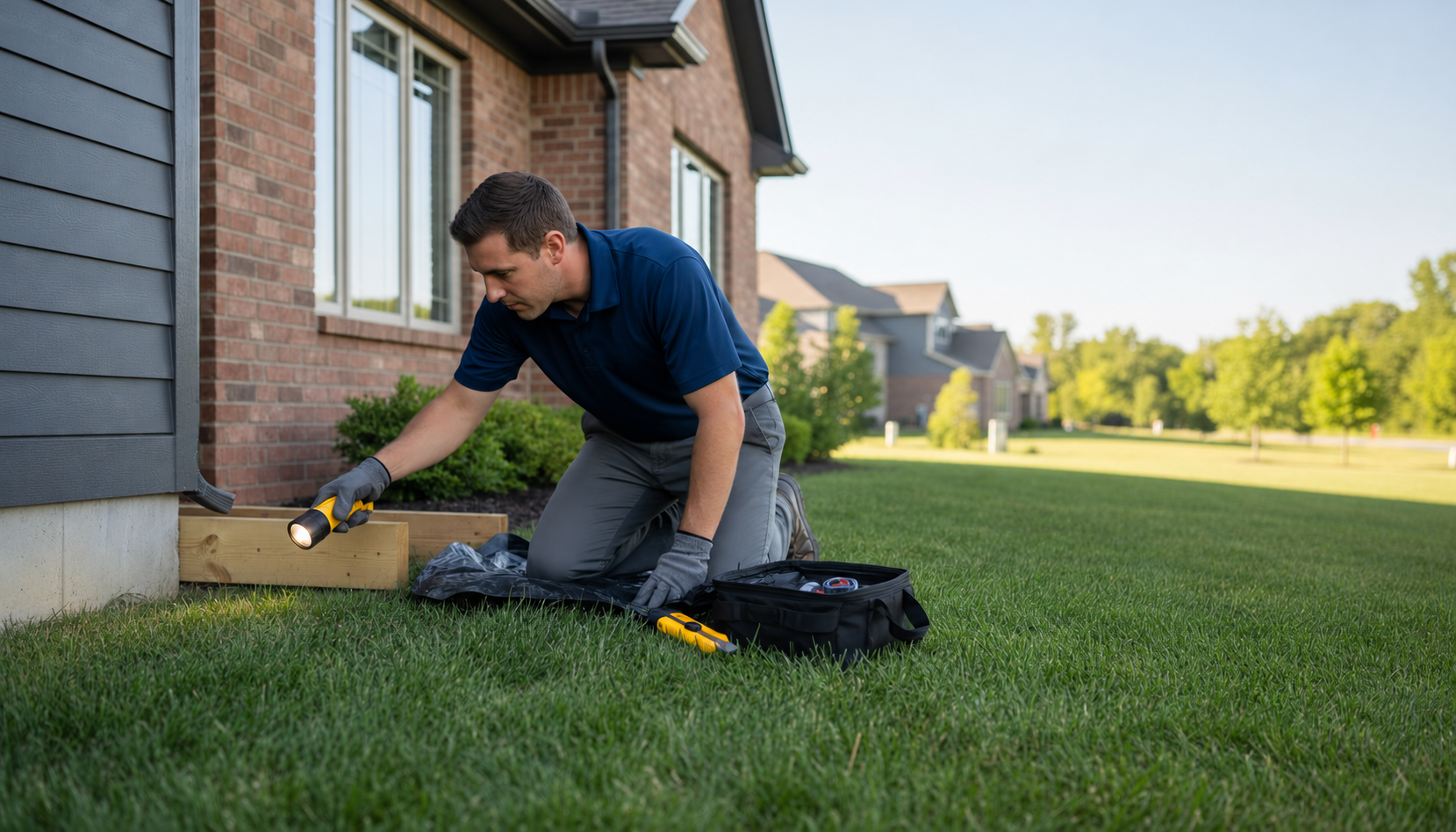
A professional wdi inspection does more than just hunt for active colonies. It identifies “conducive conditions.” These are environmental factors that act as a welcome mat for wood-destroying insects. You might not have an infestation today, but if these conditions exist, it’s often just a matter of time. Think of it as a forensic risk assessment for your home’s future. One of the most common issues we find is wood-to-ground contact. This occurs when siding, porch supports, or door frames touch the soil directly. It creates a literal highway for subterranean termites. They can move from the earth into your home’s structure without ever being seen.
Overgrown vegetation is another major red flag. When bushes or ivy press against your siding, they trap moisture and provide cover. This hides entry points that would otherwise be caught during a visual exam. We look for these hidden vulnerabilities to ensure your property stays protected. It’s about being proactive rather than reactive.
The Role of Moisture and Drainage
Wood-destroying insects are biologically programmed to find moisture. High humidity in a crawlspace softens wood and makes it easier for pests to penetrate. We often suggest a Sewer Scope Inspection to identify underground pipe leaks that could be saturating the soil near your foundation. Constant moisture in the earth creates the perfect environment for a termite colony to thrive. You should also ensure your gutters and downspouts are clear and functioning. They need to discharge water at least six feet away from the foundation to prevent soil saturation. Dry wood is much less attractive to the “Big Four” insects we face in Indiana.
Structural Red Flags for Homeowners
Homeowners often inadvertently create risks during routine yard work. Storing firewood against the side of the house or piling mulch too high against the foundation provides both food and a bridge for insects. Foam board insulation is another concern if it extends below the grade line. Insects can tunnel behind it, completely hidden from view. If you’re planning to sell, a Pre-Listing Inspection can identify these red flags early. Addressing these conditions before putting your home on the market prevents transaction delays and gives buyers peace of mind. If you’re ready to secure your property’s future, schedule your professional wdi inspection to identify these risks before they become expensive repairs.
Integrating WDI with Your Central Indiana Home Inspection Strategy
Closing on a Central Indiana property requires managing a mountain of paperwork and tight deadlines. You shouldn’t have to coordinate with four different companies just to verify the safety of your investment. Bundling your wdi inspection with a comprehensive Buyer’s Home Inspection is the most efficient way to protect your transaction. This integrated strategy ensures that every component of the house is evaluated as a single, interconnected system. When one expert looks at the property, they can see how a structural settling issue might be related to a moisture problem that is currently attracting subterranean termites.
At 5M Inspection Services, we bring a meticulous, family-owned perspective to every assessment. We understand the high stakes of your move. Our goal is to provide the professional certainty you need to sign your closing documents with confidence. We don’t just list problems; we provide context. For example, a “double tapped” breaker in the electrical panel is a safety concern, but finding active carpenter ants in the crawlspace is a structural threat. Seeing both through the same lens helps you prioritize your post-closing to-do list and negotiations.
The Benefits of the ‘One-Stop’ Inspection
Efficiency is the primary driver for most homeowners in our region. Scheduling your general assessment, wdi inspection, and Radon Testing for the same morning saves you from taking multiple days off work. It also provides consistent reporting. When the same professional conducts your New Construction Inspection and WDI check, there is no conflicting information. You receive a unified narrative about the home’s condition. Bundling these services is also more cost-effective than booking specialty environmental testing as separate, stand-alone appointments.
Next Steps After the Inspection
If your report identifies active infestations or significant conducive conditions, don’t panic. You can use the NPMA-33 findings as a powerful tool during price negotiations or when submitting repair requests to the seller. Since we maintain strict professional boundaries and do not perform home repair services, our findings remain completely unbiased and objective. We have no financial interest in finding problems that aren’t there. If treatment is required, we recommend finding a reputable, licensed pest control company to handle the chemical application or baiting systems.
Once you’ve moved in, the work doesn’t stop. Protecting your equity requires a long-term mindset. We suggest scheduling a recurring WDI inspection to ensure that new conducive conditions, like mulch piles or drainage issues, haven’t developed over the years. Staying proactive is the best way to ensure your Central Indiana home remains a safe, sound, and bug-free investment for your family’s future.
Secure Your Central Indiana Home Investment
Protecting your property from wood-destroying insects is a matter of professional diligence and localized expertise. You now understand that a WDI inspection isn’t just a formality; it’s a critical forensic tool that ensures your home’s structural integrity and satisfies strict lender requirements. By identifying the “Big Four” pests and addressing environmental risks early, you can avoid the massive structural costs these silent invaders cause every year.
5M Inspection Services has served Indianapolis, Westfield, Carmel, and Fishers since 2019. We’re a family-owned and operated business led by Chris and Morgan Markham, who are committed to providing thorough inspections and meticulous attention to every property. We deliver a detailed NPMA-33 report with every assessment, providing the clear documentation you need for a smooth closing. Schedule your WDI and Home Inspection with 5M Inspection Services today to gain the certainty your investment deserves. Your future home is a major commitment. We’re here to help you protect it with integrity and precision.
WDI Inspection Frequently Asked Questions
Is a WDI inspection required by law in Indiana?
State law doesn’t mandate these for every residential sale. However, federal lending guidelines make a wdi inspection mandatory for all VA purchase and cash-out refinance transactions in Indiana because our state is classified as a high-risk zone for termites. FHA and conventional lenders may also require one if the appraiser identifies potential wood damage during their site visit.
How much does a WDI inspection typically cost in Indianapolis?
Costs for this service depend on several factors like the size of the home, the presence of a crawlspace, and whether you bundle it with other assessments. While prices vary across the local market, many homeowners find that including it with a standard buyer’s inspection is the most economical choice. Every property’s layout and accessibility requirements are unique, which influences the final fee.
What is the difference between a termite inspection and a WDI inspection?
A termite inspection focuses solely on one species, while a wdi inspection evaluates a broader range of threats. The standard NPMA-33 report covers the “Big Four” common to our region: subterranean termites, carpenter ants, carpenter bees, and powderpost beetles. Choosing the WDI option provides a more comprehensive look at the structural risks facing your home investment.
How long does a WDI inspection take to complete?
Most inspections are completed in 30 to 45 minutes for a standard single-family home. The duration depends heavily on how easily your inspector can access critical areas like the crawlspace, attic, and garage sill plates. If the home has heavy storage or finished basement walls that block the foundation, the process might take longer to ensure every accessible inch is thoroughly probed.
Does a ‘clear’ WDI report guarantee there are no termites?
A clear report indicates that no visible evidence of an infestation was found in accessible areas at the time of the exam. It isn’t a guarantee against hidden pests. Since the process is non-invasive, we can’t see inside solid walls or under floor coverings. We focus on identifying the forensic signs of activity that are visible to a trained professional.
What happens if the inspector finds active termites during the sale?
If active insects are found, we document the location and type of infestation in Section II of the NPMA-33 form. This doesn’t necessarily kill the deal, but it does trigger a negotiation phase. Most lenders will require professional treatment and a follow-up clear report before they’ll fund the loan. You can use our objective findings to request repairs or treatment from the seller.
Can I perform my own WDI inspection for a VA loan?
No, lenders require the report to be completed by a qualified professional. In Indiana, anyone conducting these inspections for hire must be licensed by the Office of Indiana State Chemist (OISC). This ensures the inspector has passed rigorous exams and understands the specific biological threats common to our local environment.
Does a home inspection automatically include a WDI report?
A standard home inspection evaluates the home’s systems but typically excludes a specialized wood-destroying insect report. It’s usually offered as an add-on service. We recommend bundling these together to save time and ensure your inspector views the property as a complete, interconnected system. This approach provides the most thorough protection for your closing.