A high radon reading isn’t a reason to walk away from a home purchase. It’s a predictable technical problem with a 100% effective mechanical solution. If you just received a report showing levels at or above the EPA action level of 4.0 pCi/L, you’re likely feeling a mix of health concerns and transaction anxiety. Knowing exactly what to do if your radon test is high is the first step toward reclaiming your peace of mind. Radon is responsible for an estimated 21,000 lung cancer deaths annually. With one in every 15 U.S. homes testing high, this is a common challenge we’re equipped to handle with professional precision and care.
You deserve a home that’s a sanctuary, not a source of stress. We understand the pressure of navigating new 2026 requirements, such as the Indiana Radon Disclosure Law effective July 1, which mandates clear communication between sellers and buyers. This article provides a clear action plan to interpret your results and navigate the professional mitigation process. You’ll learn how modern sub-slab depressurization systems work and how to ensure your property meets the latest ANSI/AARST safety standards. We’ve simplified the technical details so you can focus on protecting your family and finalizing your closing with total confidence.
Key Takeaways
- Understand the significance of the 4.0 pCi/L EPA action level and how it impacts your family’s long-term health.
- Identify the critical differences between short-term and long-term testing to ensure your data is accurate before investing in solutions.
- Learn exactly what to do if radon test is high to protect your property value and ensure a smooth closing under new 2026 Indiana regulations.
- Demystify the mechanics of sub-slab depressurization systems and why they’re the most effective way to vent dangerous gases.
- Navigate real estate negotiations with confidence by knowing who typically pays for mitigation and how to structure repair requests.
Decoding Your Radon Results: Is 4.0 pCi/L Really the ‘Danger’ Zone?
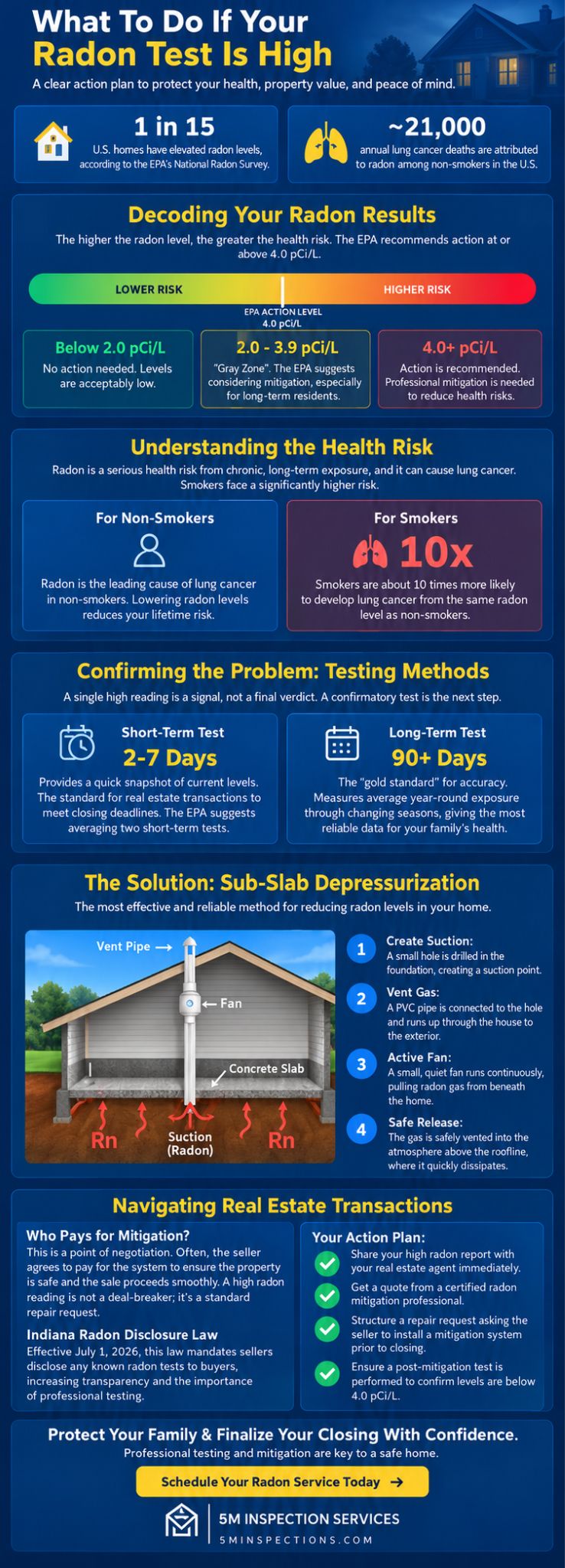
When you receive your lab report, the number listed next to “pCi/L” is the most important piece of data. This unit stands for picocuries per liter of air. It measures the rate of radioactive decay in your home’s atmosphere. Essentially, it tells you how much radiation your family breathes in every second. The EPA has established 4.0 pCi/L as the official action level. If your results meet or exceed this threshold, the recommendation is clear: you need professional remediation. Knowing exactly what to do if your radon test is high begins with understanding that this number isn’t an arbitrary limit; it’s a calculated safety standard designed to reduce long-term lung cancer risks.
Many homeowners find themselves in the “gray zone,” with results between 2.0 and 3.9 pCi/L. While not yet at the mandatory action level, the EPA suggests considering mitigation even at these lower concentrations. There’s no known safe level of exposure. If you’re planning to stay in your home for many years or have young children, lowering these levels provides an extra layer of protection. For a comprehensive overview of radon and its physical properties, scientific resources offer deep dives into how these particles behave in different environments.
Why Radon Levels Fluctuate in Central Indiana Homes
Your home’s environment is dynamic. In Central Indiana, we see significant swings in soil gas movement due to the “stack effect.” During our cold winters, warm air rises and escapes through the attic, creating a vacuum that pulls radon directly from the soil into your basement or crawl space. Heavy rainfall also plays a role. Saturated soil acts as a cap, forcing gas to find the path of least resistance, which is often the cracks in your foundation. A single short-term test is a vital snapshot for real estate transactions, but it might not reflect your home’s average annual level due to these seasonal shifts.
Health Risks vs. Immediate Safety
Radon is a naturally occurring radioactive gas that requires mechanical venting when trapped indoors. While a high reading is serious, it doesn’t represent an immediate emergency like a carbon monoxide leak. The danger comes from chronic, long-term exposure over years or decades. This risk is amplified significantly for smokers, who are about ten times more likely to develop lung cancer from radon than non-smokers according to EPA data. Understanding what to do if your radon test is high means focusing on a permanent, mechanical solution to ensure your air remains clean for the life of the home.
Confirming the Problem: Short-Term vs. Long-Term Follow-Up Tests
A single high reading is a signal, not a final verdict. If your initial report shows elevated levels, the next step in deciding what to do if your radon test is high involves a confirmatory test. The EPA recommends two main follow-up paths: a second short-term test or a long-term assessment. Short-term tests, which last 2 to 7 days, are the standard for real estate transactions in Carmel and Fishers. They provide the quick data needed to meet strict closing deadlines. However, long-term tests lasting 90 days or more are the gold standard. They measure your family’s actual year-round exposure through changing seasons. Since radon is the second leading cause of lung cancer, ensuring your data is accurate is a matter of professional integrity and family safety.
Continuous electronic monitors offer a deeper look than traditional charcoal canisters. These professional devices record hourly variations. This allows us to identify “spikes” that might occur while you sleep or when your furnace cycles. These monitors don’t just give a single number; they provide a graph of the ebb and flow of gas. If we see levels drop when the wind picks up or spike when barometric pressure falls, we can provide a much more nuanced recommendation. This data is invaluable when you are deciding what to do if your radon test is high and want to avoid unnecessary expenses or worry.
Choosing Your Follow-Up Testing Strategy
Accuracy depends on the average. The EPA typically suggests taking the average of two short-term tests before committing to a full mitigation system. Placement is equally vital to prevent false positives. We never place monitors in kitchens, bathrooms, or laundry rooms because humidity and exhaust fans skew the readings. While DIY kits are available at hardware stores, they lack the precision and calibrated reliability of professional radon testing Carmel Indiana homeowners rely on for property safety and transaction certainty.
Environmental Factors That Void a Test
Testing requires strict “closed-house” conditions to be valid. This means keeping windows and outside doors shut for at least 12 hours before the test starts and throughout the entire duration. Opening a window to “air out” the house doesn’t solve the problem. It simply invalidates the data and forces a retest. High-volume exhaust fans, whole-house fans, and wood-burning fireplaces also interfere with soil gas movement. At 5M Inspection Services, we use tamper-proof technology and professional protocols to ensure your results are objective. If you’re unsure about your initial results, scheduling a professional radon test is the most reliable way to confirm your home’s air quality.
How Radon Remediation Works: Sub-Slab Depressurization Explained
Understanding the mechanics of mitigation removes the mystery of what to do if your radon test is high. The most common and effective solution is sub-slab depressurization. This system doesn’t just “clean” the air inside your home. Instead, it changes the pressure dynamics of your foundation. By creating a vacuum beneath the concrete floor, the system intercepts radon gas before it ever enters your living space. It draws the gas into a pipe and vents it safely above the roofline where it dissipates into the atmosphere. This mechanical solution is the most reliable way to ensure long-term air quality.
The anatomy of a standard system is straightforward but requires technical precision. A technician drills a suction pit into the slab to create a collection point. This is connected to a series of PVC pipes that run either through the interior of the home or up an exterior wall. A specialized radon fan, usually located in the attic or outside, provides the continuous suction needed to maintain the pressure barrier. While sealing cracks in the basement floor is a vital prerequisite, it’s not a solution on its own. Sealing simply makes the vacuum more efficient by preventing the fan from pulling conditioned air out of your house. In Indiana basements, these systems are typically tucked into utility rooms or corners to minimize noise and maintain aesthetics.
Types of Radon Mitigation Systems
- Active Sub-Slab Suction: This is the gold standard for Central Indiana. Our clay-heavy soil requires powerful, continuous suction to move gas effectively through the earth.
- Crawl Space Encapsulation: For homes without basements, we use sub-membrane suction. This involves covering the soil with a heavy plastic barrier and venting the air from beneath it.
- Passive System Upgrades: Many new construction homes include passive pipes. These rely on natural convection and often fail to lower levels below 4.0 pCi/L. Adding an active fan is a common and necessary upgrade.
What to Expect During Installation
Professional radon abatement is remarkably efficient. Most installations are completed in less than a day with minimal disruption to your routine. You’ll notice a small device on the PVC pipe called a U-tube manometer. This gauge uses a colored liquid to show that the fan is creating the necessary vacuum. If the liquid levels are uneven, the system is working perfectly. If they’re level, the fan has lost power or requires service. Operating these systems is affordable; a modern radon fan uses about as much electricity as a standard 60-watt lightbulb. Knowing what to do if your radon test is high means choosing a permanent mechanical solution that works quietly in the background to keep your family safe.
High Radon in Real Estate: Negotiating Repairs in Central Indiana
Discovering elevated gas levels during a home inspection is common in Central Indiana, especially in Carmel and Westfield where soil composition varies. It’s rarely a reason to walk away from your dream home. In most Indianapolis home sales, the financial burden of mitigation falls on the seller. Once a professional report identifies levels at or above 4.0 pCi/L, the seller is obligated to disclose this fact to any future buyer. Fixing it now is the most logical path for both parties to keep the transaction moving forward. Knowing what to do if radon test is high during a deal means staying calm and focusing on the technical fix.
You’ll likely face the “Repair or Credit” debate during negotiations. We recommend that buyers insist the seller installs the system before closing. This ensures the technical work is finished and, more importantly, that a post-mitigation test confirms the levels are safe before the title transfers. Taking a credit might seem easier, but it leaves you managing a construction project and the health liability on day one of homeownership. Prioritizing a verified, passing result protects your family and your investment before you ever move in.
Adding Radon to Your Purchase Agreement
Your initial offer should always include a specific radon contingency. This clause sets a performance standard for the home. It shouldn’t just mandate the installation of a system; it must require the system to pull levels below the 4.0 pCi/L EPA action level. 5M Inspection Services provides the objective, third-party data you need to back up your “Response to Inspection.” Our reports serve as the professional foundation for your negotiation, ensuring you aren’t guessing about the air quality in your potential new home.
Disclosure Requirements for Sellers
Indiana law is becoming increasingly strict regarding environmental safety. Effective July 1, 2026, new regulations require sellers to provide a radon warning statement and disclose all known radon concentrations before a purchase agreement is signed. This makes proactive mitigation a smart financial move. If you are a seller, addressing the issue now protects your future resale value and prevents a last-minute closing delay. For more help with this process, see our guide on choosing a radon remediation company.
If you’re currently in the middle of a transaction and need an objective assessment of the property, schedule a Buyer’s Home Inspection today to ensure your investment is safe and your family is protected.
Your Path to a Radon-Free Home: Next Steps and Maintenance
Creating a safe environment for your family requires a structured approach. Once you understand what to do if radon test is high, the path to clean air becomes a simple matter of professional execution. Your action plan should follow five distinct steps to ensure permanent results. First, hire a certified professional to conduct a confirmatory test. This verification ensures your initial reading wasn’t a temporary spike caused by extreme weather. Second, you must obtain quotes from a qualified radon remediation near me. A reputable installer will evaluate your foundation and provide a detailed plan for suction point placement.
The third step involves the actual installation of an active mitigation system. This process should always include a diagnostic suction test. This technical procedure ensures the fan is powerful enough to pull air from the furthest corners of your slab. After the system is running, the fourth step is a post-mitigation test. This is the only way to prove the levels have dropped below the 4.0 pCi/L threshold. Finally, commit to biennial retests. Mechanical components can age and soil conditions can shift over time. Testing every two years is the professional standard for maintaining long-term safety and property value.
Long-Term System Maintenance
Your mitigation system is a quiet, mechanical guardian that requires minimal but consistent oversight. Check your manometer monthly. This small U-shaped tube on the PVC pipe is your visual proof of a functioning vacuum. If the liquid levels are equal, the fan has lost power or failed. If the fan begins to vibrate or produce a loud humming noise, it may be reaching the end of its service life. We also recommend scheduling a retest after any major home renovations. Foundation work, basement finishing, or even adding a large addition can change the pressure dynamics of your soil and may require system adjustments. Knowing what to do if radon test is high after a renovation ensures your home remains a sanctuary.
The 5M Inspection Services Commitment
Our role in your action plan is to provide objective, third-party data. We maintain a strict professional boundary: we test, we do not mitigate. This means our results are completely unbiased and never influenced by a desire to sell you a repair service. We use professional-grade electronic monitors that provide a level of accuracy hardware store kits simply cannot match. Our equipment captures hourly fluctuations and provides a detailed report you can trust for health decisions or real estate negotiations. Contact us today for a meticulous home inspection that prioritizes your family’s environmental safety and your peace of mind.
Securing Your Home’s Future with Clear Action
High radon levels are a technical hurdle, not a permanent barrier to your safety or a successful home sale. By understanding the science of sub-slab depressurization and navigating the 2026 Indiana disclosure laws with confidence, you can transform a potential risk into a resolved safety feature. Knowing exactly what to do if radon test is high ensures that your family breathes clean air and your property value remains protected for years to come.
As a family-owned and operated partner in Central Indiana, we take the responsibility of your property safety seriously. Our certified professionals provide the objective, meticulous data you need to make informed decisions. We deliver detailed, easy-to-read digital reports within 24 hours of test completion. This provides the speed and precision required in today’s fast-paced real estate industry.
Schedule your professional radon test with 5M Inspection Services today to secure your peace of mind. You don’t have to face environmental concerns alone; we’re here to provide the certainty you deserve.
Frequently Asked Questions
Is 4.4 radon level dangerous for my family?
A reading of 4.4 pCi/L is above the EPA’s official action level of 4.0 pCi/L and requires professional attention. While this isn’t an immediate health emergency like a gas leak, it represents an elevated long-term risk that should be mitigated. Taking action now reduces the cumulative exposure for your family and ensures your indoor air meets modern safety standards.
How much does a radon mitigation system cost in Indiana?
In 2026, the national average cost to install a professional radon mitigation system is approximately $1,000 to $1,300. Most homeowners can expect to pay between $800 and $1,500, though complex foundations or very large homes might see costs exceed $2,500. These prices cover the specialized fan, PVC venting, and the labor required to create a functional suction pit.
Can I fix high radon levels myself?
Attempting to fix radon issues yourself is generally discouraged because effective mitigation requires precise diagnostic pressure testing. Professionals use specialized equipment to ensure the fan creates a uniform vacuum under the entire slab. A DIY approach often fails to pull gas from far corners of the foundation, leaving your family at risk despite the effort and expense of the project.
Will a radon mitigation system hurt my home’s resale value?
A professionally installed system actually protects and can even enhance your home’s resale value. It removes a major environmental hurdle that would otherwise appear during a buyer’s inspection. In the Central Indiana market, savvy buyers view a functioning mitigation system as a sign of a well-maintained, health-conscious home rather than a property defect.
Does a high radon test mean I should walk away from a house?
You don’t need to walk away from a house you love just because of a high test result. Radon is a fixable mechanical issue with a 100% success rate when handled by experts. Knowing what to do if radon test is high allows you to negotiate a repair or credit with the seller, ensuring the home is safe before you move in.
How long does it take to lower radon levels once a system is installed?
Radon levels typically drop significantly within 24 to 48 hours after the mitigation fan is activated. Most technicians recommend waiting at least one full day before starting a follow-up test to verify the new, lower levels. This quick turnaround is especially helpful during real estate transactions where closing deadlines are tight and certainty is required.
Does opening windows lower radon levels permanently?
Opening windows only provides a temporary and unreliable reduction in gas concentrations. As soon as the windows are closed, the “stack effect” will once again draw radon from the soil into your living space. True remediation requires a mechanical system that intercepts the gas before it enters the home, providing a permanent solution regardless of the weather.
What happens if the radon fan stops working?
If the fan fails, the pressure vacuum under your slab disappears and radon levels will begin to rise back to their original state. You can easily monitor this by checking the U-tube manometer installed on your system’s piping. If the liquid in the tube is level on both sides, the fan isn’t creating suction and you should contact a mitigation professional for a replacement.