
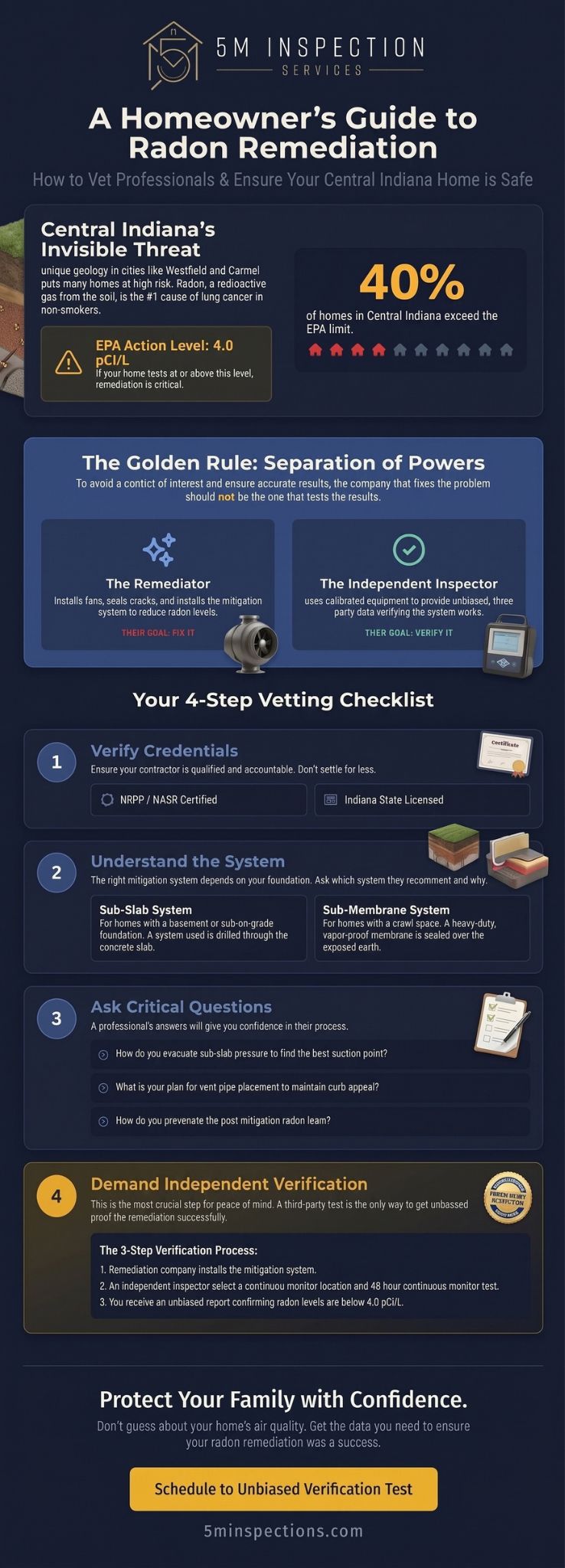
The Indiana Department of Health reported in 2023 that nearly 40% of homes in Central Indiana contain radon levels exceeding the EPA action limit of 4.0 pCi/L, yet many families feel like they are gambling when they hire a radon remediation company. You likely already know that radon is a leading cause of lung cancer, but finding a contractor you can actually trust feels like a high-stakes guessing game. It’s frustrating to face technical jargon and conflicting quotes when all you want is the certainty that your family is breathing clean air.
As a family-owned team, we believe your home’s safety is our pride. You’ll learn exactly how to vet local professionals and ensure your results are verified by an unbiased, third-party inspector. We’ll walk through the 2026 standards for professional installation and provide the specific questions you need to ask to get a fair price and a permanent fix for your property. Our goal is to replace your anxiety with the confidence that your remediation was successful and your living space is truly safe.
Key Takeaways
- Understand why the unique geology of Westfield and Carmel makes professional radon reduction a non-negotiable safety priority for Central Indiana homeowners.
- Learn why the “Separation of Powers” is vital-your remediation team should never be the one grading their own work with post-mitigation testing.
- Identify the critical NRPP/NRSB certifications and Indiana state licensing required to vet a professional radon remediation company effectively.
- Navigate the technical differences between sub-slab and sub-membrane systems to ensure the most effective solution for your specific home layout.
- Master the two-step verification process to confirm your home’s safety through independent, third-party testing that provides total peace of mind.
High Radon Levels in Central Indiana: When to Hire a Radon Remediation Company
Protecting your family starts with understanding the air you breathe. Radon remediation is the specialized technical process of reducing radioactive gas concentrations within a residential structure. In Central Indiana, this isn’t just a precaution; it’s a necessity for many homeowners. Cities like Westfield and Carmel sit atop unique geological formations that make them high-risk zones for gas accumulation. When your home tests at or above the EPA action level of 4.0 pCi/L, you must move from testing to action. You need a qualified radon remediation company to step in and secure your environment. Our local soil composition and Indiana’s fluctuating climate require specific expertise to ensure your living space remains safe and breathable.
The Health Stakes for Indianapolis Families
Radon is the leading cause of lung cancer in non-smokers, contributing to approximately 21,000 deaths every year according to national health data. In Hamilton County, the soil is particularly dense with clay and glacial till, which traps and then releases radon gas directly into your foundation. The stack effect occurs when rising warm air creates a pressure differential that sucks radon gas from the soil into your Indiana basement through foundation gaps. Your home’s safety is our pride, and we recognize that these local geological factors are critical to your long-term health. We don’t take these risks lightly, and neither should you.
Recognizing the Need for Professional Intervention
Many homeowners reach for a $20 hardware store kit, but these often provide a false sense of security. Short-term DIY tests can fluctuate wildly based on humidity, weather changes, or simple placement errors. Professional 48-hour continuous monitoring provides a precise data set that accounts for hourly spikes and environmental variables. Understanding various Radon mitigation techniques is essential before you commit to any structural changes.
Once you receive your detailed 5M Inspection Services report, we help you transition into a clear, actionable remediation plan. Choosing a certified radon remediation company ensures that the system is installed correctly the first time. We focus on these key professional advantages:
- Calibration of high-sensitivity continuous monitors for 99% accuracy.
- Evaluation of sub-slab pressure to determine the best suction points.
- Strategic vent pipe placement to maintain your home’s curb appeal.
- Post-installation testing to verify levels have dropped below 4.0 pCi/L.
Being family-owned means we treat your home like our own. We offer 24/7 text availability so you can get answers when you need them most. Don’t guess when it comes to your family’s safety. Trust the technical experts who live and work right here in Central Indiana to help you make confident decisions.
Testing vs. Fixing: Why Your Radon Remediation Company Should Not Be Your Tester
Don’t let the fox guard the henhouse. This old adage perfectly describes the conflict of interest that occurs when a radon remediation company performs its own post-mitigation testing. While “free” follow-up tests might seem like a cost-saving perk, they often lack the objectivity required for true home safety. A contractor who grades their own work has a financial incentive to ensure the results show a “pass,” even if the system isn’t performing at peak efficiency. This bias can leave your family at risk of continued exposure to high radon levels.
Industry standards from the National Radon Proficiency Program (NRPP) emphasize the “Separation of Powers” in environmental safety. This principle dictates that the party identifying the problem should not be the same party fixing it, and vice-versa. At 5M Inspection Services, we act as the unbiased judge. We don’t sell fans or seal cracks; we provide the data you need to hold your contractor accountable. For a complete checklist of what to look for in a contractor, review the EPA’s Consumer’s Guide to Radon Reduction. This guide confirms that independent testing is the gold standard for verifying a successful installation.
Avoiding the “Sales Pitch” Inspection
Watch for red flags during your initial consultation. Some companies offer a significant discount on remediation if you use their internal “free” test to confirm the results. This is often a sales tactic designed to keep third-party experts away from the project. In competitive real estate markets like Carmel or Zionsville, an independent, certified lab result is a vital asset. It provides a paper trail that protects your transaction and gives buyers absolute peace of mind. Without a third-party verification, you are relying solely on the word of someone who has a vested interest in the outcome.
The 5M Promise: Your Safety is Our Pride
We view ourselves as your “Trusted Partner” throughout the entire mitigation process. Our team focuses exclusively on diagnostics to ensure 100% unbiased data. We use modern methodology and professional-grade equipment to provide a clear picture of your home’s air quality. Because we don’t perform repairs, our only goal is accuracy. If you are currently reviewing quotes from a radon remediation company and feel overwhelmed by the technical jargon, we can help. Our 24/7 text availability allows you to send us questions or photos of your quotes for a quick, expert second opinion. Your home’s safety is our pride! If you need a certified radon test to verify your system’s performance, we are ready to help you make a confident decision.
5 Essential Criteria for Vetting a Radon Remediation Company
Vetting a radon remediation company requires a technical eye. Don’t gamble with your family’s respiratory health. Start by verifying NRPP or NRSB certifications. These credentials prove a contractor understands the complex physics of soil gas. The EPA’s Consumer’s Guide to Radon Reduction confirms that hiring a certified professional is the only way to ensure your system meets national safety standards. Indiana law also requires specific state licensing for all mitigation work. Check the Indiana Department of Health portal to confirm their license is active before they step foot on your property.
Standard system designs often fail in Central Indiana because our geology is diverse. A Westfield basement built in 2022 has different airflow needs than a 1950s crawlspace in Broad Ripple. Demand a custom design rather than a “cookie-cutter” kit. Your contractor must also carry comprehensive liability insurance. This protects you if they accidentally strike a water line or tension cable during the installation. Finally, insist on a transferable warranty. If you sell your home later, a guaranteed system adds immediate value to your real estate listing.
Technical Proficiency and Equipment
Elite contractors don’t guess; they measure. Ask if they perform diagnostic Pressure Field Extension (PFE) testing. This process involves using specialized micro-manometers to calculate exactly how much suction is needed before the main drilling begins. It prevents the common mistake of “over-fanning.” Many homeowners think a larger fan is better, but oversized fans waste energy and create excessive noise. A professional radon remediation company will select a fan sized specifically for your home’s footprint. They should also discuss aesthetics, ensuring the exterior vent stack doesn’t ruin your curb appeal or vibrate against bedroom walls.
Local Reputation in Central Indiana
Check for deep roots in the community. Ask for references from recent projects specifically in Carmel or Noblesville. National franchises often lack the specific knowledge of Hamilton County soil types. Family-owned businesses typically offer higher personal accountability. Your safety is their pride. Use your 5M Inspection Services report as a valuable reference during the quoting process. Our detailed data allows radon remediation contractors to provide more accurate, fixed-price quotes. Our detailed data allows remediators to provide more accurate, fixed-price quotes. This prevents “scope creep” where costs balloon after the work starts. Look for companies that offer 24/7 communication to handle any system alarms that might trigger after a heavy Indiana rainstorm. If you’re still searching for the right contractor, our guide to finding radon remediation near me in Westfield and Indianapolis can help you identify trusted, certified professionals in your area.
Understanding Radon Mitigation Systems in Indiana Homes
Installing a mitigation system isn’t a one-size-fits-all project. Most Indianapolis homes with basements utilize sub-slab depressurization. This method involves a professional radon remediation company drilling a hole through the concrete floor to create a suction pit. A specialized radon fan then pulls soil gases through PVC venting and exhausts them safely above the roofline. This prevents radioactive gas from ever entering your living space. It’s a technical process that requires precision to ensure the vacuum seal remains intact over time.
Basement vs. Crawl Space Solutions
Central Indiana properties often face unique challenges due to a high water table. In homes with crawl spaces, contractors use sub-membrane suction. This process requires covering the entire dirt floor with a high-density plastic barrier, which is then sealed to the walls. Any professional remediation plan must also include sealing cracks and sump pits to prevent the system from drawing conditioned air out of the home. The manometer is a clear, U-shaped tube mounted to the system pipe that uses colored liquid to indicate whether the fan is creating the necessary vacuum pressure. Without this visual gauge, you wouldn’t know if your system failed until your next test. For a deeper look at how these systems are designed specifically for Hamilton County homes, our guide to radon abatement in Westfield and Carmel covers the mechanics of sub-slab depressurization and the new 2026 Indiana disclosure requirements.
Maintaining Your Mitigation System
A radon system is a mechanical installation that requires periodic attention. Indiana’s extreme humidity and rapid temperature swings can be hard on fan motors. While these fans are designed for continuous use, they typically have a lifespan of 7 to 11 years. You should check your manometer monthly to ensure the liquid levels are offset, but call a pro if the levels are even. The EPA recommends that homeowners perform a re-test every two years to confirm the system still meets safety standards. Your home’s safety is our pride!
- Electrical costs: Expect to pay between $50 and $95 annually in electricity to run the fan 24/7 based on local utility rates.
- Component checks: Inspect the PVC exit point for debris or ice buildup during Indiana winters that could block airflow.
- Professional audits: A certified radon remediation company can verify that soil shifts haven’t created new entry points for gas.
Ensuring Success: Post-Remediation Verification with 5M
Installing a mitigation system is only half the battle. You need proof the system actually works. Hiring a radon remediation company involves a significant financial investment, and you shouldn’t take their word for it that the air is now safe. Verification is the final, critical step to protect your family’s health and ensure your money was well spent.
- Step 1: Allow your new remediation system to run continuously for at least 24 hours. This period allows the pressure field under your home to stabilize. It ensures the airflow is consistent before any sensors begin collecting data.
- Step 2: Schedule an independent verification test with 5M Inspection Services. We don’t install systems, so we have no stake in the results. Our only goal is providing an honest, accurate reading of your home’s air quality.
- Step 3: Review the unbiased lab results. We’ll confirm whether your levels have dropped below the EPA action level of 4.0 pCi/L. If the numbers are still high, you’ll know immediately that the job isn’t finished.
- Step 4: File your 5M certificate of completion. Keep this with your permanent home records. It’s a vital document for future real estate disclosures and provides peace of mind for your family.
What if the Levels are Still High?
Sometimes a radon remediation company misses the mark. Common failures include poor sealing of floor cracks or insufficient suction points in the slab. If our test shows levels remain elevated, your 5M report provides the professional leverage you need. It acts as objective evidence to hold the contractor accountable. This report often forces the installer to return and modify the system at no extra cost to you. To ensure the test is valid, you must maintain “Closed House Conditions.” This requires keeping all windows and outside doors shut for 12 hours before and during the 48-hour testing window.
Your Next Steps for a Safer Home
Don’t wait until a property sale is on the line to check your air quality. Contact 5M for an unbiased radon test before you hire a remediator or immediately after an installation is complete. We’re a family-owned team based in Westfield, and we treat every home as if our own children lived there. We’ve built our reputation on being thorough, certified, and deeply committed to the safety of our Central Indiana neighbors. Your home’s safety is our pride!
Take Control of Your Home’s Air Quality
Protecting your family from the 1 in 3 Central Indiana homes that the Indiana Department of Health identifies as having elevated radon levels requires a clear plan. You’ve learned why it’s critical to separate your testing from your mitigation to avoid biased results. When you hire a professional radon remediation company, your final step must always be independent verification to ensure the system actually works according to 2026 safety standards.
At 5M Inspection Services, we prioritize your peace of mind through thorough inspections and professional expertise. As a family-owned business led by Chris and Morgan Markham, we are committed to transparency, attention to detail, and personalized service that puts our clients first. We don’t just provide data; we provide the confidence you need to make safe decisions for your property. If you’re navigating a fast-paced real estate market, our team is available via text 24/7 to handle your urgent needs. Your home’s safety is our pride!
Book Your Unbiased Radon Test with 5M Inspection Services
You deserve a home that’s both safe and sound; let’s get started on yours today.
Frequently Asked Questions
Is radon remediation really necessary if my level is 4.1 pCi/L?
Yes, any home testing at or above the EPA action level of 4.0 pCi/L requires professional intervention. A reading of 4.1 pCi/L exceeds the safety threshold and increases long term lung cancer risks for your family. Our family owned team prioritizes your health by reducing these levels to below 2.0 pCi/L whenever possible. Protecting your loved ones from this invisible threat is our primary goal.
How much does a typical radon remediation system cost in Central Indiana?
Most homeowners in Central Indiana spend between $800 and $1,500 for a professional installation according to national industry averages. Prices vary based on your home’s foundation type and the number of suction points needed to reach the soil. Choosing a certified radon remediation company ensures the system is designed correctly for Indiana’s specific geological conditions. We provide clear details so you can make confident decisions for your property.
Can I install a radon mitigation system myself to save money?
You shouldn’t attempt a DIY installation because improper venting can actually increase radon levels or cause dangerous backdrafting of carbon monoxide. Professional installers use specialized diagnostic testing to ensure the fan is correctly sized for your specific sub-slab communication. As a trusted partner in Westfield, we utilize modern methodology to guarantee the system works perfectly. Saving a few dollars isn’t worth risking your family’s safety with an uncertified setup.
How long does a radon remediation company take to install a system?
A standard professional installation usually takes between 3 and 5 hours to complete from start to finish. Our technicians work efficiently to minimize disruption to your daily routine while maintaining a thorough, technical approach. We handle everything from the initial exterior penetration to the final electrical connections and sealing. Your home’s safety is our pride, so we never rush the critical sealing process that makes the system effective.
Will a radon mitigation system affect my home’s resale value in Westfield?
A certified mitigation system protects your home’s resale value by removing a common hurdle during the inspection contingency period. In the Westfield real estate market, roughly 1 out of every 4 homes tested shows elevated radon levels. Having a system already in place provides immediate reassurance to potential buyers. It demonstrates that you are a proactive homeowner who cares about property maintenance and environmental safety.
Does a radon system also help with basement moisture or odors?
Yes, many homeowners notice a 20% to 30% reduction in basement humidity and musty odors after the system starts running. The fan works by pulling air and soil gases from beneath the slab before they ever enter your living space. This constant airflow helps keep the sub-slab area dry and prevents damp air from rising. While its main job is safety, the secondary benefit of a drier basement is a welcome bonus for Central Indiana residents.
How often should I test my home after a remediation system is installed?
The EPA recommends re-testing your home at least every 2 years to ensure the mechanical system remains effective. You should also test after any major structural changes like home additions or basement remodeling projects. We remain available via text message 24/7 if you have questions about your system’s performance or need to schedule a follow up test. Regular monitoring is the only way to confirm your family stays protected over the long term.
What is the difference between radon mitigation and radon abatement?
There is no functional difference between these terms in the industry as both refer to the process of reducing radon concentrations. Most professionals and government agencies prefer the term mitigation to describe the active venting process. When you hire a radon remediation company, they focus on venting the gas safely above the roofline. Whether you call it abatement or mitigation, the technical goal is providing you with a healthy, breathable environment. Homeowners in Hamilton County can learn more about the specific systems used in their area by reviewing our complete guide to radon abatement in Westfield and Carmel, which details local safety standards and system options.