Close to 50% of sewer scope inspections conducted by Indianapolis professionals reveal a need for immediate maintenance or repair. That is a coin flip you cannot afford to lose when a main line replacement can cost $15,000 after you sign the closing papers. We understand the pressure of navigating fast-paced real estate timelines while trying to decipher city sewer versus private septic requirements. It is a stressful choice, but your home’s safety is our pride, and we are here to help you make a confident decision.
This guide clarifies the septic inspection vs sewer scope inspection Indianapolis debate so you know exactly which service protects your specific property. You will discover the critical differences between a $200 standard sewer scope and a $650 real estate septic evaluation. We provide the technical clarity you need to negotiate repairs and meet Marion County Public Health Department standards. Our family-owned team is even available via text 24/7 to ensure you never feel alone during your inspection period.
Key Takeaways
- Determine if your property uses municipal lines or an on-site tank to choose between a septic inspection vs sewer scope inspection Indianapolis.
- See how high-definition fiber-optic cameras navigate lateral lines to find hidden root intrusions or collapses before they cause a $15,000 backup.
- Learn why a “Load and Dye” test is the only way to verify that a septic tank, its baffles, and the absorption field are functioning correctly.
- Stop relying on a simple “flush test” which often fails to reveal the structural issues caused by Central Indiana’s heavy clay soil and mature trees.
- Get the technical data you need to negotiate expensive repairs and protect your investment with a trusted, family-owned partner.
Understanding the Waste Line Divide: Sewer vs. Septic Systems
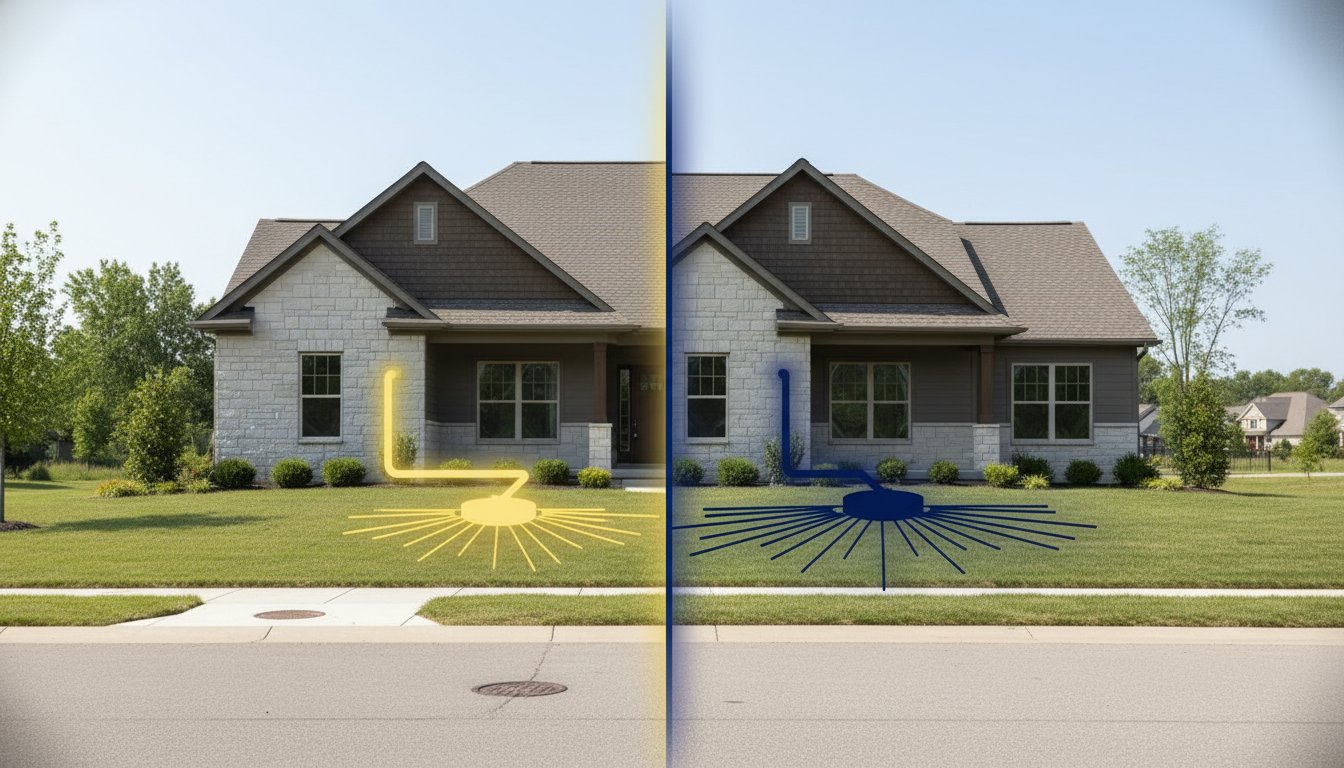
Choosing between a septic inspection vs sewer scope inspection Indianapolis depends entirely on how your home handles waste. Most Central Indiana properties fall into one of two categories. You either have a municipal connection where the city processes your waste, or you have a private system located on your lot. It is rarely both. Understanding this divide is the first step to protecting your wallet from the $15,000 surprise of a collapsed main line. We want you to have all the facts so you can make a confident decision during your home search.
A standard home inspection follows industry standards that typically stop at the home’s foundation. We test the interior plumbing and fixtures, but we cannot see through soil or concrete to check the health of the buried pipes. This is why specialty diagnostics are essential. If your home is in an established Indianapolis neighborhood like Broad Ripple, you likely need a sewer scope. If you are looking at a rural property in Hamilton County, a septic evaluation is your priority. You can verify your system by checking the Marion County Public Health Department records or the Hamilton County Health Department’s online portal before your inspection period ends.
The Invisible Asset: Why Waste Lines Matter
The city does not own the pipe running under your front yard. As the homeowner, you are responsible for the entire line until it reaches the municipal tap or the septic tank. A standard maintenance check is a small investment compared to the five-figure costs of excavation and replacement. The lateral line is the pipe connecting the home to the public sewer or septic tank. If this “invisible asset” fails, your home becomes uninhabitable within hours. We treat these inspections with the same rigor as a structural foundation check because the stakes are just as high. Your home’s safety is our pride, and that includes the parts you cannot see.
When the Lines Blur: Transitional Areas in Central Indiana
In some parts of Indianapolis, the lines aren’t always clear. The Septic Tank Elimination Program (STEP) has transitioned thousands of homes from private tanks to Citizens Energy Group sewer lines. This creates a unique risk for buyers. You might be buying a home that is currently on city sewer but still has an “abandoned” septic tank buried in the backyard. If that tank wasn’t properly decommissioned, it could collapse and create a dangerous sinkhole. This is a common issue in older neighborhoods that were annexed by the city decades ago.
Buyers in Westfield and Carmel should be especially vigilant. Rapid development means a new subdivision might sit right next to an older property using On-Site Wastewater Treatment. Always verify utility connections through the local health department or utility provider. Our family-owned team can help you identify which system is present so you don’t waste money on the wrong test. We provide the technical expertise you need to navigate these local infrastructure quirks with ease.
The Sewer Scope Inspection: Protecting City-Connected Homes
A sewer scope inspection is a non-invasive look into the home’s most expensive hidden asset. We use a high-definition fiber-optic camera to navigate the lateral line. This process is essential for city-connected homes where the owner is responsible for everything up to the municipal tap. When deciding between a septic inspection vs sewer scope inspection Indianapolis, the camera is your best tool for city infrastructure. It provides a level of detail that a standard visual check simply cannot match.
The process starts by locating the cleanout. This is usually a capped pipe in the basement, crawlspace, or yard. If a cleanout isn’t available, we can often access the line through a roof vent or by temporarily removing a toilet. We feed the camera through the pipe until it reaches the city main tap. Along the way, we record high-quality video evidence. This recording allows both the buyer and seller to see the exact condition of the buried pipes. We look for specific obstructions, cracks, or structural failures that a simple “flush test” would miss entirely.
What the Camera Uncovers
Indianapolis is famous for its mature trees and shifting soil. Root intrusion is the #1 enemy of local sewer lines. Tiny roots find small cracks in clay or cast iron pipes and grow until they cause a total blockage. We also look for “bellies” and “offsets.” These occur when heavy Indiana clay soil shifts, causing sections of the pipe to sag or disconnect. These low spots collect debris and eventually lead to backups.
Pipe material matters too. Many older Indianapolis homes used clay tile or cast iron, which are prone to cracking or scaling. Some even have “Orangeburg” pipes, which are essentially tar-paper tubes that collapse over time. While the EPA provides guidelines for a septic system inspection to maintain on-site health, city dwellers must rely on camera technology to verify these specific material risks. Identifying these materials early can save you from a $15,000 replacement after closing.
The Sewer Scope Report
Our report categorizes findings into “pass,” “marginal,” or “fail” ratings. A “marginal” rating might show minor root growth that needs cleaning, while a “fail” indicates a collapse or major blockage. Data shows that close to 50% of sewer inspections in the Indianapolis area reveal a need for maintenance or repair. You can use this video report as a powerful negotiation tool. If we find a significant issue, you have the evidence to ask for a price reduction or a seller credit.
At 5M Inspection Services, we use specialized diagnostic cameras for maximum accuracy. Our family-owned team takes pride in providing the technical clarity you need. If you’re ready to protect your investment, you can schedule your sewer scope alongside your full home inspection. We deliver high-impact results quickly because we know your real estate timeline is tight. Your home’s safety is our pride, and we ensure you have the facts to move forward with confidence.
The Septic Inspection: Evaluating On-Site Wastewater Treatment
If your potential home is located outside the reach of municipal lines, you aren’t looking for a camera scope. You need a comprehensive evaluation of a private system. When comparing a septic inspection vs sewer scope inspection Indianapolis, the methods are vastly different. A septic evaluation is a multi-point diagnostic process that examines the tank, the baffles, and the absorption field. This system is a living biological filter. Its failure leads to environmental hazards and massive financial loss. We treat this as a high-stakes investigation to ensure your future home is safe and functional.
The centerpiece of a real estate septic evaluation is the “Load and Dye” test. We introduce a specific volume of water, often several hundred gallons, into the system while using a non-toxic tracer dye. This simulates a high-use day, such as a family doing multiple loads of laundry. We then monitor the yard for surface breakouts. If colored water appears on the lawn, the absorption field is no longer processing waste correctly. This test provides a clear “functional flow” assessment that a simple visual check cannot provide. It’s the only way to verify that the system can handle the daily demands of a modern household.
We also perform a visual tank inspection. This involves assessing the sludge levels and the structural integrity of the tank walls. We check the baffles, which are the components that prevent solids from entering and clogging the leach field. A leach field assessment follows, where we probe the soil for saturation. If the soil is “soupy” or smells of effluent, the system is likely at the end of its lifespan. We take this responsibility seriously because your home’s safety is our pride. Our family-owned approach means we look at your potential home as if we were moving in ourselves.
Indiana Septic Standards (IOWPA)
Our evaluations follow the standards set by the Indiana Onsite Wastewater Professionals Association (IOWPA). These guidelines ensure that every component is checked with technical precision. Understand the difference between a functional test and a permit compliance check. A health department might only check if your system meets the original permit from 20 years ago. Our functional test tells you if the system actually works today. In places like Hamilton County, local health departments have strict requirements for new installations. A professional pre-purchase evaluation is your best defense against these regulatory hurdles.
Red Flags in a Septic System
You can often spot the first signs of trouble yourself. Slow drains and gurgling pipes inside the home are common warnings. Outside, look for lush, bright green grass over the absorption field, even during a dry Indiana summer. This usually indicates that the soil is oversaturated with nutrient-rich waste. Spongy soil or standing water near the tank are immediate red flags. If you notice these issues, our team is available via text 24/7 to help you coordinate the right diagnostic steps. We provide the unbiased data you need to negotiate repairs before your closing date.
Central Indiana Real Estate: Why Skipping These Tests is a Gamble
Many homebuyers believe that if the toilets flush and the sinks drain, the waste line is in perfect health. This is the “Flush Test” Fallacy. A main line can be 90% obstructed by roots or nearly collapsed, yet still allow a few gallons of water to pass through during a brief showing. When you are weighing a septic inspection vs sewer scope inspection Indianapolis, remember that a functioning toilet is not a diagnostic tool. It is merely a temporary state of being. We want you to see what is happening beneath the surface before the “invisible” asset becomes a visible disaster in your new basement.
Regional risk factors in Central Indiana make these tests even more critical. In Westfield, the heavy clay soil is notorious for shifting and putting immense pressure on buried pipes. This pressure often leads to “offsets” where pipe sections become misaligned. In Carmel, the beautiful, mature tree canopy presents a different threat. Large root systems from silver maples and oaks are drawn to the moisture inside old clay tile or cast iron joints. They don’t just block the flow; they structurally destroy the pipe. Even a home that is only 10 years old isn’t safe. We have found construction debris, crushed lines from heavy machinery, and poor slope in relatively new builds. Age is never a guarantee of integrity.
Cost vs. Benefit Analysis
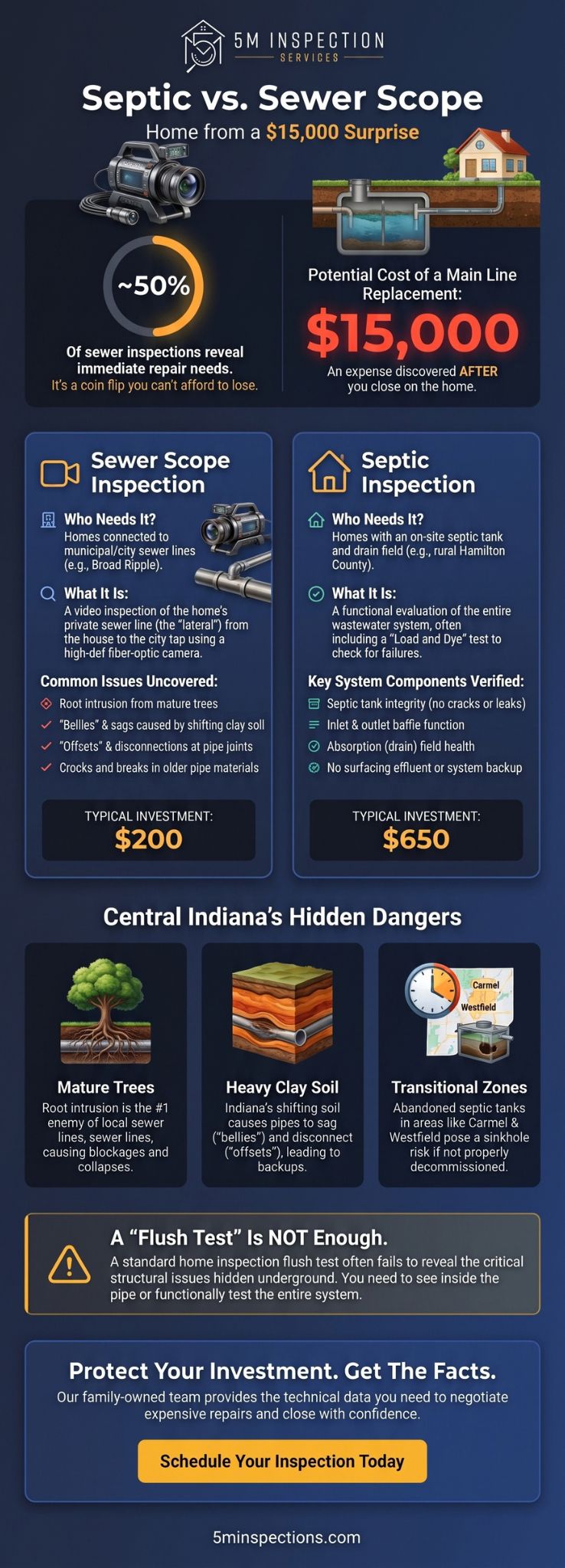
The numbers speak for themselves. A standard sewer scope in Indianapolis typically costs between $125 and $500. A detailed septic inspection for a real estate transaction generally ranges from $300 to $650. Compare these figures to the $15,000 average cost for a main line excavation and replacement. An inspection can literally pay for itself 20 times over by providing the evidence you need to negotiate repairs or a price reduction. Beyond the financial impact, consider the emotional cost. Discovering a sewage backup during your first week of homeownership is a trauma we want to help you avoid. Your home’s safety is our pride, and that starts with a clear view of the infrastructure.
The 5M Advantage: Unbiased Diagnostics
You should always hire a professional inspector rather than a repair company for your evaluation. A plumbing or septic repair business has a built-in conflict of interest; they profit from finding problems that require their repair services. As Top-Rated Home Inspectors in Westfield & Indianapolis, we do not perform repairs. Our reporting is unbiased, objective, and focused solely on your protection. We provide the technical data you need to make a confident decision without any hidden agenda.
Our family-owned team understands that real estate timelines move fast. We are available via text message 24/7 to answer your questions and get your specialty inspections scheduled quickly. Do not leave your biggest investment to chance. Schedule your unbiased waste line inspection today and move forward with the peace of mind you deserve.
Professional Waste Line Diagnostics with 5M Inspection Services
Understanding the waste line divide is only half the battle. Now you need a partner who can execute these technical evaluations with precision. At 5M Inspection Services, we simplify the complex choice of a septic inspection vs sewer scope inspection Indianapolis by offering both as seamless add-ons to our standard buyer’s home inspection. We don’t just check the boxes. We look at your home with the protective eye of a neighbor. Our family-owned status means we take every pipe, baffle, and lateral line personally. Your home’s safety is our pride!
Adding these specialty tests to your booking is straightforward. You can select them during your initial request or text our team at any time to update your order. We know that real estate timelines in Central Indiana move fast. Our 24/7 text availability ensures that you can get a quote or schedule a last-minute diagnostic without waiting for office hours. We respect your time and your investment. Our goal is to provide the data you need to make a confident decision before your inspection contingency expires.
Our Sewer Scope Process
We provide high-resolution video evidence with every sewer scope we perform. You won’t just get a simple “pass” or “fail” result. You receive a detailed narrative report that identifies the exact location and depth of any issues found. This technical clarity is vital for negotiating repairs with sellers. If you are buying in Hamilton County, understanding the specific risks of a Sewer Scope Inspection Westfield IN can save you thousands in future excavation costs. We use modern methodology and high-definition fiber-optic cameras to ensure no root intrusion or pipe belly goes unnoticed.
Trusted Partners for Your Protection
We are certified, unbiased, and thorough. Because we do not offer repair services, our findings are never influenced by a desire to sell you a new sewer line or a septic tank replacement. We serve the entire Central Indiana region, including Indianapolis, Carmel, Westfield, and Fishers. Our team is dedicated to providing the reassurance you need during a stressful property transaction. We believe that every homebuyer deserves a trusted partner who is watchful and detail-oriented. We treat your safety as our own personal responsibility.
Don’t let the fear of hidden repairs overshadow the excitement of your new home. Use our expertise to protect your financial future and avoid Indianapolis’s most expensive hidden repairs. Book your sewer or septic inspection with 5M today! We are ready to help you navigate the infrastructure of your new property with technical proficiency and localized care. Reach out now via text or our website to see why we are the preferred choice for thorough property diagnostics in Indiana.
Secure Your Investment with Expert Waste Line Diagnostics
Don’t let a $15,000 hidden repair ruin your moving day. Whether you are connecting to municipal lines or maintaining a private tank, the choice between a septic inspection vs sewer scope inspection Indianapolis determines your long-term financial security. We provide the technical clarity needed to negotiate with confidence. Led by owners Chris and Morgan Markham, our family-owned team deliver thorough, unbiased reports that standard home inspections simply cannot match. We treat your property with the same care we would give our own neighbors.
Every sewer scope we perform includes a detailed HD video report so you can see the pipe condition for yourself. We understand that real estate timelines are tight, which is why we offer 24/7 text availability for your immediate scheduling needs. We are here to ensure you move into your new home with total peace of mind. Schedule Your Indianapolis Sewer or Septic Inspection Now. You deserve a trusted partner who watches out for your family’s well-being. Your home’s safety is our pride!
Frequently Asked Questions
Do I need a sewer scope if the house is brand new?
Yes, you should always scope a new build. Construction crews often leave heavy debris like mortar, rocks, or wood inside the lines during the building process. Heavy machinery used for site grading can also crush or misalign pipes before the soil settles. We have found significant blockages and structural failures in Indianapolis homes less than 1 year old.
How much does a sewer scope inspection cost in Indianapolis?
A standard sewer scope inspection in Indianapolis typically costs between $125 and $500. Local providers like Hoosier Sewer Scope often advertise a $200 base price for cleanout access. You might pay an additional fee of approximately $50 if the inspector must access the line through a roof vent or by removing a toilet.
Can a general home inspector do a septic inspection?
A general home inspector can only perform a septic evaluation if they hold specialized certifications, such as those from the Indiana Onsite Wastewater Professional Association (IOWPA). A standard home inspection excludes everything beyond the foundation. We maintain the necessary technical expertise to handle both, ensuring your septic inspection vs sewer scope inspection Indianapolis needs are met by one trusted partner.
What happens if the sewer scope finds tree roots?
If we find root intrusion, we document the exact location and severity in our HD video report. Minor roots can often be cleared with a professional hydro-jetting service, but large roots usually indicate structural cracks or failing joints. You should use our unbiased findings to negotiate a repair credit or professional cleaning before you close on the property.
Is a septic dye test the same as a full septic inspection?
No, a dye test is merely one component of a comprehensive evaluation. A full inspection includes checking sludge levels in the tank, examining the baffles, and probing the absorption field for saturation. Relying solely on dye can miss structural tank failures or failing absorption fields that haven’t reached the surface yet. Our family-owned team provides the thoroughness you need to make a confident decision.
How long does a sewer scope inspection take?
A standard sewer scope usually takes between 30 and 60 minutes to complete. If you are opting for a real estate septic inspection, expect the process to take between 2 and 4 hours. We work efficiently to respect your time while ensuring we don’t miss any critical structural details. Your home’s safety is our pride, so we never rush the diagnostic process.
Will a sewer scope inspection damage my pipes?
No, a sewer scope will not damage your plumbing. We use flexible, fiber-optic cameras designed to glide through various pipe materials, including fragile clay or cast iron. This non-invasive method allows us to see the interior condition without any risk to the existing infrastructure. It is the safest way to identify hidden problems before they lead to a backup.
Does homeowners insurance cover sewer line replacement?
Most standard homeowners insurance policies do not cover sewer line replacement due to wear and tear or root intrusion. You typically need a specific “service line” or “sewer backup” rider for this coverage. This is why a pre-purchase inspection is vital; it identifies existing issues that insurance companies will likely exclude as pre-existing conditions. Text us 24/7 if you have questions about your specific property’s waste line needs.