What if your brand-new dream home is actually an untested system of potential structural risks? Most buyers assume that a passing grade from a city inspector means their property is flawless. However, with the 2024 International Residential Code serving only as a legal minimum, many high-speed construction projects leave behind significant issues. Identifying common builder mistakes in new homes is the only way to protect your investment before the contractor leaves the site.
We understand the deep anxiety that comes with the fear of buying a “lemon.” It’s stressful to commit to a national average build cost of $405,000 while wondering if the plumbing or electrical systems were rushed to meet a deadline. You deserve the certainty that your family is safe and your equity is secure. This guide will show you exactly what to look for during construction and why a professional, third-party inspection is a critical safety net for your finances.
You’ll discover a list of red flags for your final walkthrough and learn the specific value of phased inspections. By the end of this article, you’ll have the confidence to hold your builder accountable and ensure your home is truly ready for move-in day.
Key Takeaways
- Learn why “built to code” is only the bare minimum legal requirement and how a private inspection ensures your home meets a higher standard of quality.
- Identify common builder mistakes in new homes like improper roof flashing, poorly sized HVAC systems, and hazardous electrical double-taps.
- Uncover hidden environmental risks, including radon levels in new Indiana builds and sewer lines blocked by construction debris.
- Master the phased inspection strategy to evaluate your home’s structural “bones” and plumbing systems before the drywall goes up.
- Secure your investment by knowing exactly what red flags to document during your final walkthrough before the builder warranty expires.
The New Home Myth: Why ‘Built to Code’ Isn’t Enough
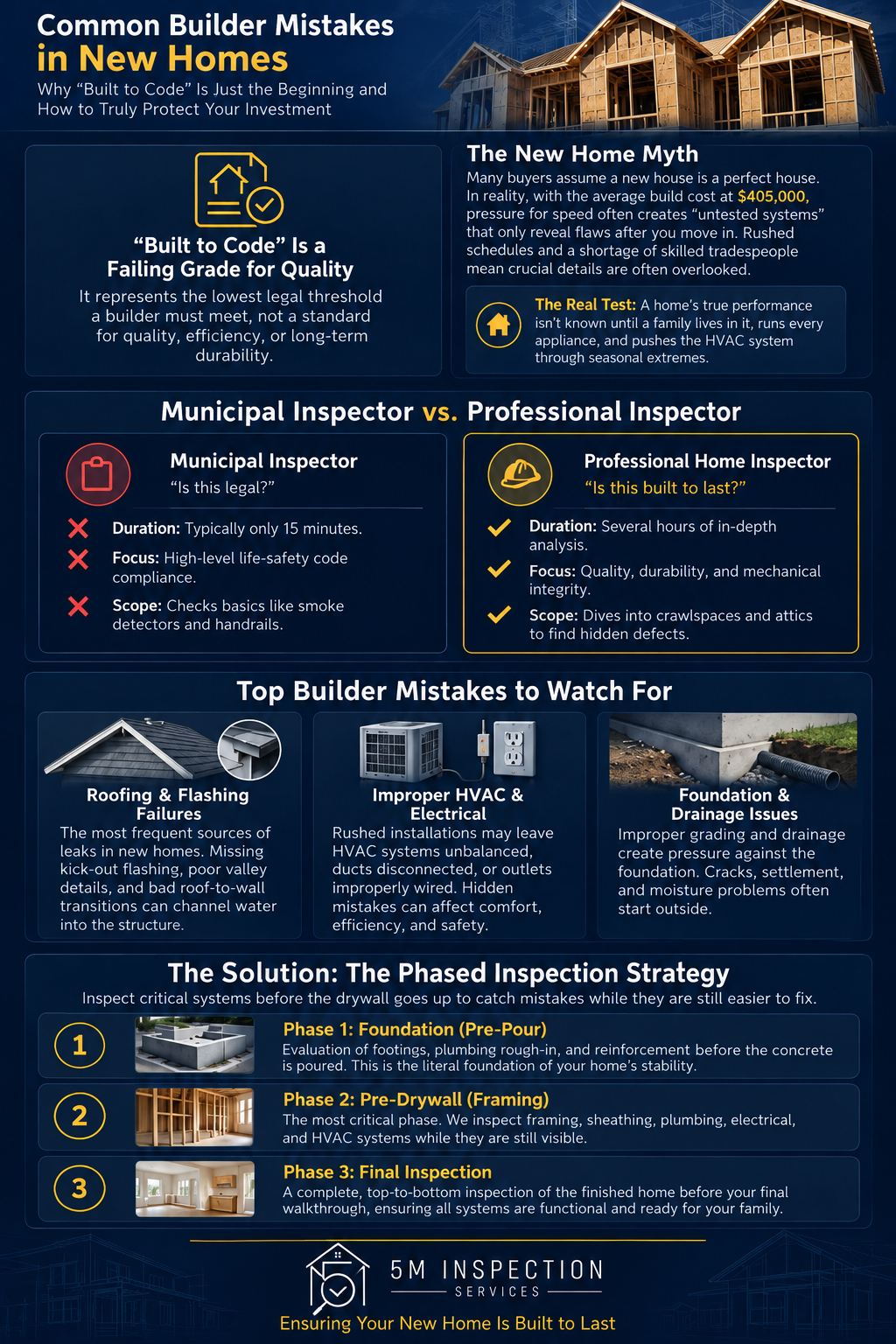
Many buyers walk into a model home and assume that a “brand new” house is synonymous with a “perfect” house. In reality, “built to code” represents the lowest legal threshold a builder must meet to avoid a fine or a stop-work order. It’s the “D-minus” of the construction world. It ensures the structure is safe enough to occupy, but it doesn’t guarantee quality, efficiency, or long-term durability. Identifying common builder mistakes in new homes starts with understanding that code is a floor, not a ceiling.
In 2026, the pressure on construction crews is higher than ever. With the national average cost to build rising to $162 per square foot, builders are squeezed between tight margins and a shortage of master-level tradespeople. To stay on schedule, subcontractors often work at a frantic pace. This environment leads to “untested systems.” A home might look flawless during a walkthrough, but the real stress test doesn’t begin until a family moves in, runs every faucet, and pushes the HVAC system to its limits during an Indiana heatwave.
Municipal Inspectors vs. Professional Home Inspectors
City inspectors are government employees focused on high-level life-safety issues. They check if your stairs have handrails and if your smoke detectors are wired correctly. However, they aren’t looking for the subtle signs of structural integrity and failure that lead to expensive repairs later. A typical municipal inspection might last only fifteen minutes. In contrast, a private New Construction Inspection takes several hours. We dive into the crawlspaces and attics to find where a builder may have cut corners to save time. While a city inspector asks, “Is this legal?”, we ask, “Is this built to last?”
The Impact of the Central Indiana Climate on New Builds
Our local environment plays a massive role in how a house settles. Indianapolis weather cycles are notoriously hard on new construction. Rapid freeze-thaw cycles can interfere with how concrete foundations cure, leading to premature spiderweb cracking. We also see specific issues in growing communities like Carmel and Fishers, where expansive clay soils are common. If a builder doesn’t account for these soil dynamics, the foundation can shift, causing common builder mistakes in new homes like sticking doors or cracked drywall within the first year. Furthermore, high humidity during the summer months can trap moisture inside wall cavities before the AC is active, creating a breeding ground for mold that stays hidden behind your brand-new paint.
- Soil Expansion: Carmel and Fishers clay requires precise drainage to prevent foundation pressure.
- Curing Issues: Temperature swings in Central Indiana can affect the structural bond of mortar and concrete.
- Moisture Traps: Rushed schedules often mean closing up walls before the lumber has properly dried.
Top Structural and Exterior Builder Mistakes
While many homeowners worry about paint colors or floor plans, the real threats are often hidden in the home’s exterior shell. Structural defects aren’t just aesthetic issues. They compromise the safety and longevity of your property. Identifying these common builder mistakes in new homes early can save you tens of thousands in repair costs after your one-year warranty expires. We see these errors frequently in Central Indiana, where rapid construction timelines often clash with complex weather patterns.
Roofing and Flashing Failures
Roof leaks in brand-new builds are surprisingly frequent. The culprit is rarely the shingles themselves. Instead, it’s almost always the flashing. We often find missing “kick-out” flashing where a roof edge meets a vertical wall. Without this simple piece of metal, water is channeled directly into the siding and wall cavity. This leads to hidden rot that you won’t see until it’s a major problem. Poor valley transitions and “shingle over” errors also create paths for moisture to penetrate the roof deck. Interestingly, a comprehensive foundation inspection often begins at the roof. If water isn’t managed correctly at the top, it eventually pools at the bottom, saturating the soil around your foundation and causing hydrostatic pressure.
Thermal envelopes are another area where speed leads to errors. Inadequate attic insulation or poorly sealed gaps around windows allow conditioned air to escape. This doesn’t just raise your utility bills. It leads to condensation issues inside your walls. If windows aren’t flashed with the correct sequence of tape and drip caps, water will eventually rot the framing. These are common builder mistakes in new homes that stay hidden behind the drywall for years.
Exterior Grading and Siding Issues
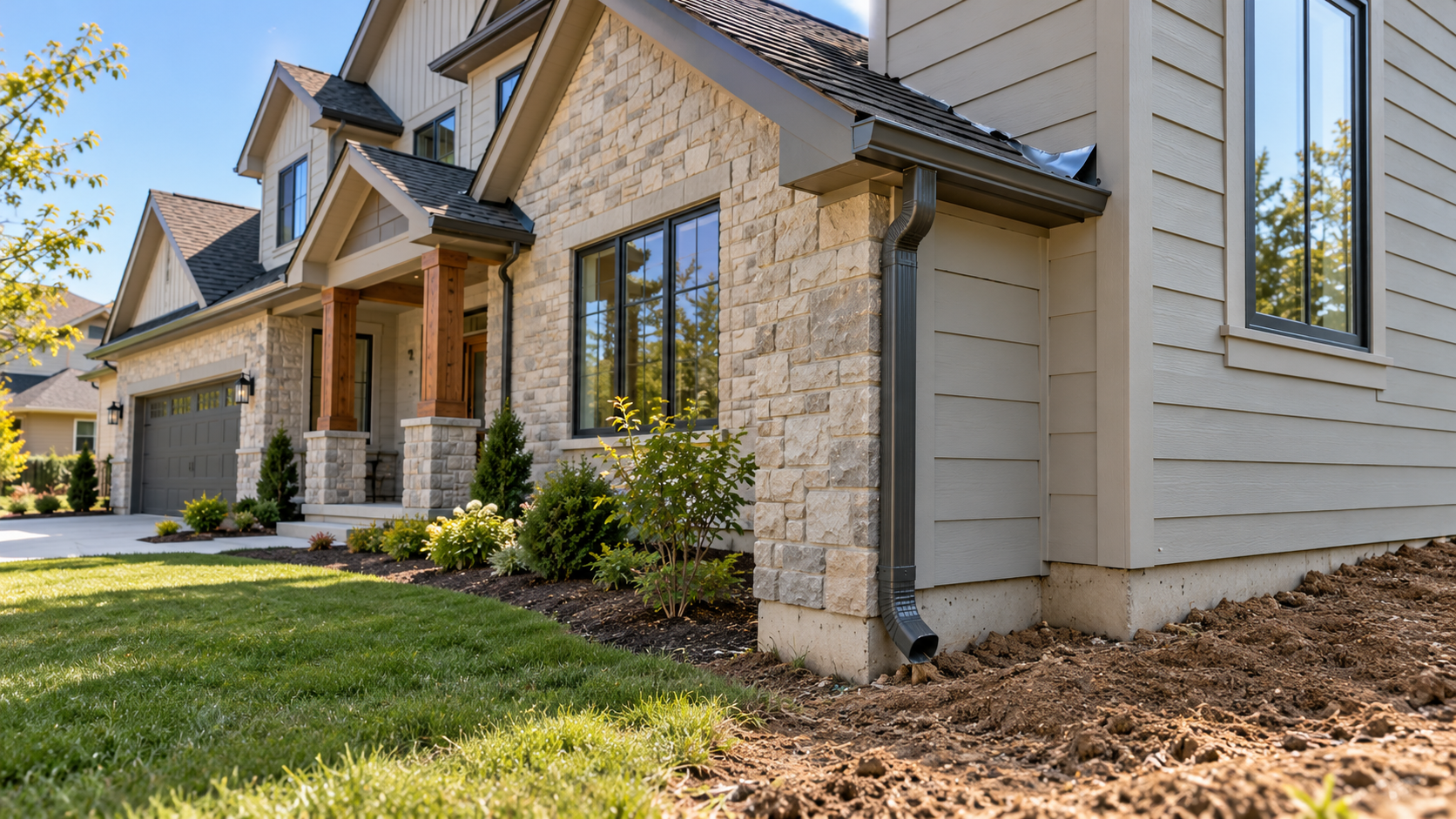
In Central Indiana, poor grading is a primary cause of foundation failure. The ground must slope away from the house at a rate of at least 6 inches within the first 10 feet. When builders fail to achieve this “positive drainage,” water collects against the basement or crawlspace walls. This is a foundation killer. We also look for siding clearance. If siding is installed too close to the ground or a roofline, it wicks up moisture. This leads to premature rot and creates an easy path for termites. Proper gutter discharge is the final piece of the puzzle. Downspouts must carry water far enough away to prevent it from recirculating back toward the foundation. If you’re concerned about these hidden exterior flaws, a professional New Construction Inspection provides the detailed oversight you need before closing.
- The 6-in-10 Rule: Soil must drop 6 inches in height over the first 10 feet of distance from the home.
- Siding Gaps: Fiber cement and wood siding need a 1-2 inch gap from roof surfaces to prevent moisture wicking.
- Gutter Extensions: Discharge should be directed at least 5-10 feet away from the foundation walls.
Invisible Defects: HVAC, Electrical, and Plumbing Errors
Once the drywall is finished and the paint is dry, the most complex systems in your house disappear from view. This is exactly when common builder mistakes in new homes become “invisible” threats. You won’t see a loose wire or a disconnected duct behind a wall, but you’ll certainly feel the impact on your utility bills and your family’s safety. These mechanical errors are often the result of different trades working in tight spaces, where one technician’s work might accidentally compromise another’s earlier installation.
Electrical Safety and Panel Mistakes
The electrical panel is the heart of your home’s safety system, yet it’s a frequent site for oversight. One of the most critical red flags we find is the double tapped breaker. This occurs when two separate wires are connected to a single circuit breaker terminal that isn’t designed for it. It creates a loose connection, leads to overheating, and poses a genuine fire risk. We also frequently identify “open grounds” or reversed polarity in brand-new outlets. These errors happen when subcontractors rush through the final “trim out” phase. While the outlet might still power your lamp, it won’t provide the surge protection or grounding your expensive electronics require. Additionally, we check that GFCI and AFCI breakers are wired correctly; if they trip constantly or fail to trip during a test, your home isn’t protected against ground faults or arc fires.
HVAC System Imbalance
A “new” HVAC system is not a guarantee of a comfortable home. Many builders fail to properly commission or balance the system after installation. We often find ductwork that’s been crushed, kinked, or completely disconnected in the attic. If one bedroom is consistently stuffy, it’s likely a sizing or airflow issue that was never addressed. Construction dust is another silent culprit. If the builder ran the furnace while sanding drywall or installing flooring, that fine white powder clogs the evaporator coils and limits the system’s lifespan before you even move in. Improper venting is the most dangerous error. Blocked or poorly sloped exhaust flues can trap moisture in your attic or, in severe cases, lead to carbon monoxide buildup inside the living space.
Plumbing errors follow a similar pattern of hidden neglect. We listen for “water hammer,” which is a loud knocking sound when faucets are turned off. This indicates unsecured pipes that will eventually vibrate, rub against framing, and develop pinhole leaks. In unconditioned crawlspaces or attics, we often find incomplete pipe insulation. It’s a small detail that leads to a massive disaster during the first sub-zero Indianapolis night. Identifying these common builder mistakes in new homes requires a technical eye and a commitment to your long-term security. We verify that every line is secured and every connection is tight, ensuring your “dream home” doesn’t turn into a series of expensive “invisible” repairs.
- Electrical Integrity: Every breaker must be rated for the number of conductors it holds to prevent arcing.
- Ductwork Inspection: We verify all joints are sealed with mastic or foil tape, not just standard duct tape.
- Plumbing Security: Lines must be clamped every few feet to prevent movement and long-term joint failure.
Environmental Hazards in New Construction
Fresh paint and new carpet often mask environmental risks that begin long before you receive the keys. Many buyers assume that because a home is brand new, it must be “clean” from a health and utility perspective. This is a dangerous misconception. Environmental common builder mistakes in new homes are often the most expensive to correct because they involve the soil beneath your feet or the pipes buried under your slab. These issues don’t just threaten your property value; they can directly impact your family’s long-term health.
Radon: The Silent Risk in Indiana New Builds
Radon is a Class A carcinogen prevalent in Central Indiana soil. While many 2026 builds include a “passive” radon system, these are often nothing more than a plastic pipe running from the sub-slab to the roof without a fan. They rely on natural pressure changes to vent gas, which is frequently insufficient for our local geography. Modern homes are built to be incredibly airtight for energy efficiency. This is great for your utility bill, but it creates a vacuum effect that traps radon gas inside the living space more effectively than in older, draftier houses. Even slab-on-grade homes in communities like Carmel and Fishers show high levels of this odorless gas. Securing radon testing Carmel Indiana families can rely on is the only way to verify if your passive system needs to be converted into an active one with a dedicated mitigation fan.
Sewer Scoping: Checking for Construction Debris
Your main sewer line is often used as a convenient disposal site during the construction process. It’s common for subcontractors to wash drywall mud, grout, or excess mortar down drains. We’ve even found lunch bags, soda cans, and wood scraps lodged in “new” sewer mains. These items snag solid waste and lead to a total backup within your first few months of living in the home. A professional sewer inspection uses a high-resolution camera to travel the full length of the line to the municipal tap. This is the only way to see these buried mistakes. The cost of a camera scope is negligible compared to the thousands of dollars required to dig up a brand-new driveway or mature landscaping to replace a blocked or collapsed pipe.
Mold is another hidden byproduct of a rushed build schedule. If the home was framed during a rainy period and the “wet” lumber was sealed behind drywall before it reached a safe moisture content, mold will grow in the wall cavities. We meticulously check for these moisture traps in crawlspaces and attics where airflow is often restricted. If you want to ensure your new investment is truly safe, schedule a New Construction Inspection to identify these environmental threats before your builder’s liability ends.
- Passive vs. Active: Passive systems lack a fan and often fail to lower radon levels below the EPA action limit of 4.0 pCi/L.
- Debris Blockages: Hardened construction materials in sewer lines are a leading cause of premature backup.
- Wet Framing: Trapped moisture in new lumber is a primary driver of “new home” mold growth.
The Phased Inspection Strategy: Protecting Your Investment
Relying on a single inspection at the end of a build is a mistake. By the time you see the finished trim and shiny appliances, over 80% of the home’s critical systems are already sealed behind drywall. A phased approach is the only way to catch common builder mistakes in new homes before they become permanent, expensive fixtures. We recommend a four-phase strategy that monitors the home’s evolution from the first scoop of dirt to the final days of your builder’s warranty.
- Phase 1: Pre-Slab/Foundation. We check the plumbing lines and vapor barriers before the concrete is poured. Once that slab is down, any error becomes a jackhammer project.
- Phase 2: Pre-Drywall. This is the “x-ray” phase. We inspect the framing, electrical runs, and plumbing stacks while they’re still exposed.
- Phase 3: Final Walkthrough. We verify that every system is functional, safe, and meets the standards we’ve tracked throughout the project.
- Phase 4: 11th-Month Warranty. We return just before your one-year coverage expires to find issues that only appear after the home has “settled.”
Why the Pre-Drywall Inspection is Critical
This is the most vital window for quality control. We look for missing fire blocking, which is essential for stopping the spread of flames through wall cavities. We also identify structural notched studs where a plumber or electrician might’ve cut too deep into a load-bearing member. We verify that the wiring and plumbing match your blueprints exactly. It’s also our last chance to ensure insulation is installed without the gaps or compression that lead to the thermal failures we discussed earlier. Catching these common builder mistakes in new homes now is simple. After the drywall is up, it’s nearly impossible.
The 11th-Month Warranty Inspection
Most builders provide a one-year limited warranty. As that deadline approaches, your home has finally survived a full cycle of Indiana’s extreme seasons. The soil has settled, the wood has expanded and contracted, and the HVAC has been pushed to its limits. This is when drywall cracks, roof leaks, or foundation shifts finally reveal themselves. A professional inspection report provides the objective, technical evidence you need to force a builder to honor their commitment. It moves the conversation from “I think something is wrong” to “Here is a certified professional’s finding.” Don’t let your warranty expire and leave you with the bill. Schedule your 11th-month inspection with 5M today to ensure your home remains the secure investment you were promised.
Secure Your Future and Your Investment
Building a home is one of the most significant financial commitments you’ll ever make. Don’t let the excitement of a fresh start blind you to the reality of the construction process. Relying on a city inspector to catch common builder mistakes in new homes is a gamble your family shouldn’t have to take. From invisible electrical hazards to buried sewer debris, the risks are too high to ignore until the warranty has already expired.
By using a phased inspection strategy, you gain a protective partner who watches over your build from the foundation to the final walkthrough. At 5M, we’re a family-owned and operated team deeply rooted in Central Indiana. We bring certified technical expertise in specialized areas like radon testing and sewer scoping to every job site. You’ll receive detailed, easy-to-read reports delivered quickly, giving you the leverage you need to hold your builder accountable. It’s about more than just a house; it’s about your peace of mind.
Protect your new home investment—Schedule a professional inspection with 5M today.
We’re here to ensure your new chapter begins on a solid, safe foundation. You’ve worked hard for this home, and we’ll work just as hard to protect it.
Frequently Asked Questions
Do I really need a home inspection for a brand-new house?
Yes, an inspection is vital because new homes are essentially untested prototypes. Even with the best intentions, crews can overlook critical details during a fast-paced build. A professional inspection identifies common builder mistakes in new homes that could lead to expensive repairs or safety hazards shortly after you move in.
Will the builder let me bring my own private inspector?
Reputable builders will allow you to hire a third-party professional to evaluate the work. It’s your right as a buyer to ensure the property meets the standards promised in your contract. Most builders actually prefer catching errors before the final walkthrough to reduce their future warranty liability. Just be sure to coordinate the timing with your project manager to avoid site conflicts.
What is the most common mistake builders make in new homes?
Water management errors are the most frequent issues we encounter. This includes missing kick-out flashing on the roof and improper exterior grading that allows water to pool near the foundation. These common builder mistakes in new homes are often the root cause of mold growth and structural shifting within the first few years of ownership.
Is a city building inspection the same as a private home inspection?
No, they serve completely different purposes. A city inspector checks for the bare minimum legal safety standards required by local government. A private home inspector evaluates the home for quality, long-term durability, and overall performance. We spend hours on-site, whereas a municipal official may only be there for fifteen minutes.
When is the best time to schedule a new construction inspection?
The most effective strategy is a phased approach. You should ideally schedule inspections before the foundation is poured, before the drywall is installed, and during your final walkthrough. A fourth inspection during the 11th month of your warranty is also highly recommended to catch settling issues before your coverage ends.
What happens if my inspector finds a major defect in a new build?
You should provide the official inspection report to your builder immediately. In most cases, the builder is responsible for correcting any defects that don’t meet building codes or the quality standards outlined in your purchase agreement. Having a professional, unbiased report makes these conversations much easier and ensures the repairs are documented.
Can radon be a problem in a brand-new house?
Absolutely. Newer homes are often more susceptible to radon buildup because they’re built so tightly for energy efficiency. This airtight construction prevents soil gases from escaping naturally through gaps in the structure. Since radon is a Class A carcinogen, testing during the first year is a necessary step to protect your family’s health.
What is a pre-drywall inspection and why does it matter?
This is an inspection of the home’s “skeleton” while the framing, wiring, and plumbing are still exposed. It matters because it’s the only time we can verify that structural components aren’t damaged and that mechanical systems are installed correctly. Once the drywall is up, these critical systems are hidden and much harder to fix.