
Why would you pay for a private inspector when the municipal official has already signed off on your new build? It’s a common question, but city inspectors often have dozens of sites to visit in a single day; they simply cannot catch every detail. With single-family permits in Central Indiana rising by 4 percent in early 2026, builders are under immense pressure to deliver quickly. Choosing phased construction inspections Indiana means you have a dedicated partner on-site at every critical milestone, ensuring nothing gets missed before the walls go up.
You deserve to feel confident that your new home is built to last, not just built to code. We understand the stress of managing a complex build, especially when you worry about structural issues appearing long after the builder’s warranty expires. This article explains how third-party verification identifies errors while they’re still easy to fix. We’ll walk through the inspection process that provides a detailed repair list for your builder, giving you the certainty that your investment is sound from the foundation to the roof.
Key Takeaways
- Understand why phased construction inspections Indiana are essential for catching structural defects that municipal code inspectors often overlook.
- Learn the three critical milestones of a new build—foundation, framing, and final walk-through—where third-party oversight saves you from future repair costs.
- Discover why Central Indiana’s specific clay soil and radon levels require specialized attention during the construction process.
- Gain practical strategies for writing inspection contingencies into your contract and professionally addressing builder pushback.
- Find out how local, family-owned expertise provides the long-term peace of mind you need for your investment in Carmel, Westfield, or Indianapolis.
What Are Phased Construction Inspections and Why Do They Matter?
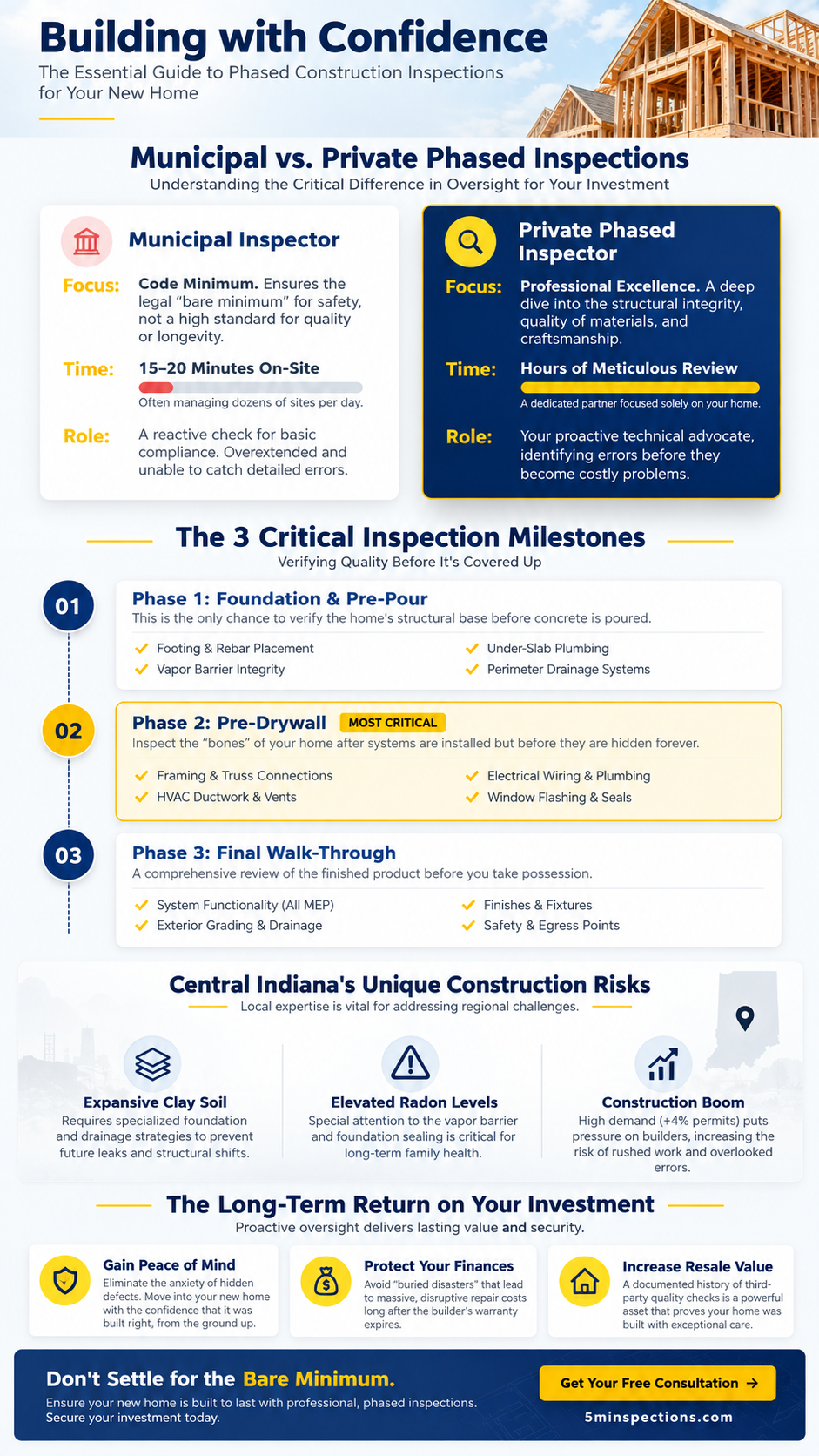
Phased construction inspections Indiana represent a strategic quality-control process for new builds, ensuring that every major structural component is verified before it is concealed. A new home is a complex assembly of thousands of parts. Unlike a standard home inspection performed on an existing house, phased inspections occur at three specific milestones: before the foundation is poured, after the framing and systems are installed, and finally, right before you receive the keys. This process creates a transparent record of your home’s integrity from the ground up.
You might wonder, what is a home inspection in the context of a brand-new house? It isn’t just a check for broken appliances. It’s a deep dive into the skeleton of your home. While Indiana law provides statutory warranties for new construction, including ten years for major structural defects, these warranties are reactive. They only matter after something fails. Phased inspections are proactive; they identify the error before it becomes a disaster. This oversight ensures your investment in a community like Westfield or Carmel is protected by more than just a promise on paper.
Code Minimum vs. Professional Excellence
City building inspectors play a vital role in our communities, but they are often overextended. A municipal inspector might spend only 15 to 20 minutes at a job site to verify basic safety requirements. Our team spends hours meticulously reviewing every detail. Building codes are the legal “bare minimum” required to ensure a structure doesn’t collapse or catch fire. They aren’t a high-bar standard for excellence. We act as your technical advocate, translating complex structural requirements into clear action items for your builder during the high-stress construction process.
The Long-Term ROI of Phased Inspections
The financial benefits of choosing phased construction inspections Indiana extend far beyond the construction phase. By preventing “buried disasters” like improper window flashing or foundation cracks, you avoid the massive disruption of future repairs. In competitive Central Indiana markets, having a documented history of third-party quality checks is a powerful asset. It proves to future buyers that your home was built with exceptional care, directly supporting your resale value. Most importantly, it removes the “hidden” anxiety of moving into a new home. You can sleep soundly knowing your family is protected by a structure that exceeds the minimum standards.
The Three Critical Phases of New Home Inspections
Building a home involves a complex sequence of specialized trades. If one contractor makes a mistake, it’s often covered up by the next trade before you ever see it. Choosing phased construction inspections Indiana breaks this cycle by inserting professional oversight at the exact moments when errors are most likely to be hidden. Missing even one of these evaluations significantly increases your risk of inheriting a structural or mechanical defect that won’t surface until years after your builder’s warranty has expired.
We believe that a house is only as strong as its weakest hidden component. By reviewing the structure at three distinct milestones, we create a complete story of your home’s health. This timeline ensures that your builder remains accountable for quality at every step, not just the final finish.
Phase 1: The Foundation and Under-Slab Review
Before the concrete truck arrives, we inspect the footings and rebar placement. This is the only time we can verify the vapor barrier is intact and that underground plumbing is positioned exactly where the blueprints demand. We look for proper drainage systems to prevent the basement leaks so common in our wet Indiana climate. Our team references the International Residential Code to ensure the “feet” of your house are built to last a lifetime. If the foundation isn’t right, nothing else matters.
Phase 2: Framing, Mechanicals, and the Pre-Drywall Stage
The “pre-drywall” stage is the most critical phase for catching builder errors. Once the drywall is hung, the “bones” of your home are hidden forever. We meticulously inspect stud spacing, load-bearing headers, and truss connections to ensure structural integrity. We also evaluate the mechanical, electrical, and plumbing (MEP) systems. We check for nicked wires, improperly sloped pipes, and crushed HVAC ductwork. This phase provides essential foundation inspection context by showing how the framing transfers weight to the ground. If a plumber has notched a structural joist to fit a drain line, we identify it now while it’s still easy to repair.
Phase 3: Final Closing Inspection
The final walk-through is about functionality, safety, and finish. We test every appliance, light fixture, and HVAC zone in their finished state. Our inspectors climb into the attic to check insulation levels and walk the roof to verify shingle installation. We also examine the exterior grading to ensure water flows away from your home. This results in a comprehensive punch-list for your builder to address before you sign the closing papers. It’s your last opportunity to hold the builder to a high standard. If you want to ensure your new build is truly ready for move-in day, our new construction inspection provides the final layer of protection you need.
Addressing Central Indiana Construction Risks
Building a home in Central Indiana presents environmental challenges that national builders sometimes overlook. Our local landscape isn’t just a flat canvas; it’s a complex mix of heavy clay soils and varying radon levels that demand specialized attention. When you invest in phased construction inspections Indiana, you’re not just checking for straight walls. You’re ensuring your home is engineered to survive the specific pressures of the Hoosier climate. While Indiana’s official code enforcement provides a safety baseline, local environmental risks often require a higher standard of care than the minimum legal requirement.
Every region has its quirks. In our suburbs, the combination of flat terrain and expansive soil creates a unique set of “hidden” risks. We’ve seen how these factors can compromise a build before the family even moves in. Our goal is to identify these regional red flags while they’re still manageable.
Soil Expansion and Foundation Health
If you’re building in Fishers or Noblesville, you’re likely dealing with heavy Indiana clay. This soil acts like a sponge; it expands significantly when wet and shrinks during our dry summer months. This constant movement puts immense hydrostatic pressure on new foundations. Central Indiana’s heavy clay soil necessitates specific foundation drainage standards to mitigate the intense pressure that can lead to early structural failure. We’ve found that “settling” is often used as an excuse for poor compaction or improper backfilling. By inspecting the foundation phase, we verify that your builder has used the correct materials and techniques to keep your basement dry and your walls crack-free for decades.
Radon and Environmental Safety
Modern homes are built to be incredibly airtight for energy efficiency. While this is great for your utility bills, it can create a “chimney effect” that traps radon gas inside your living spaces. Central Indiana is a high-risk area for radon, and new construction is not immune. In fact, tighter sealing can lead to higher concentrations than what you might find in an older, draftier house. We believe that radon testing Carmel Indiana is a non-negotiable step for any new build. Beyond gas, these “tight” homes can also harbor mold if the ventilation systems aren’t balanced perfectly from day one. We check for these environmental hazards before they become a health risk for your family.
Indiana’s seasonal temperature swings also play a role in material health. A house framed in the humid July heat and finished in the freezing January air undergoes significant thermal expansion and contraction. We look for signs of moisture entrapment or stressed joints that occur during these transitions. Managing drainage and grading in the flat terrain of the Indianapolis suburbs is equally vital. Without a precise slope away from the structure, water will inevitably find its way into your crawlspace or basement. We ensure your lot is graded for longevity, not just for aesthetics.
Navigating the Inspection Process with Your Builder
Securing your right to independent oversight starts before the first shovel hits the dirt. Most production builders use standardized contracts that may not explicitly mention third-party evaluations. You should request a specific contingency in your initial agreement that allows for phased construction inspections Indiana at key milestones. This ensures your builder is contractually obligated to provide access and wait for a professional review before proceeding to the next stage, such as hanging drywall or pouring concrete.
Coordinating schedules requires clear communication between you, your site supervisor, and your inspector. Builders move fast. A framing crew might finish on a Tuesday and the drywallers could arrive on Wednesday morning. By staying in constant contact with your project manager, you can ensure our team has the window needed to perform a thorough evaluation without delaying the project. If a builder pushes back, remember that you are the client. You have a right to verify the structural integrity of your largest financial investment.
Communication Strategies for Homeowners
The best way to handle builder objections is to frame the inspection as a “second set of eyes” rather than a confrontation. When a supervisor claims they’ve already checked the work, simply explain that you want a documented record of the home’s quality for your own peace of mind. We provide a detailed report that you can hand directly to your site supervisor. This list isn’t a “gotcha” tool; it’s a professional punch-list that helps the builder deliver a superior product. This proactive approach is just as vital now as a pre-listing inspection Indianapolis will be when you eventually decide to sell your home years down the road.
The Warranty Safety Net
Your protection shouldn’t end on closing day. Indiana law provides statutory warranties that cover workmanship for two years and major structural defects for ten years. We strongly recommend scheduling an “11th-Month Warranty Inspection” before your initial one-year builder coverage expires. This is the final safety net to catch “settling” issues, drywall cracks, or mechanical failures that only appear after a full cycle of Indiana seasons. If we find a problem at month 11, the builder is responsible for the repair costs, not you. It’s the most effective way to hold them accountable before the clock runs out on your coverage. To protect your investment from the start, schedule your new construction inspection today.
Securing Your Investment with 5M Inspection Services
Choosing a partner to oversee your new home build is a decision rooted in trust. At 5M Inspection Services, we don’t view ourselves as just another contractor on the site. We are your protective, detail-oriented advocates. Chris and Morgan Markham founded 5M Inspection Services on the values of honesty, personal accountability, and quality service. When you choose us for phased construction inspections in Indiana, you get personalized attention from a local, family-owned business that puts your family’s safety and investment first.
Our local expertise in Westfield, Carmel, and the greater Indianapolis area is a significant advantage for our clients. We understand the specific construction trends and regional soil challenges discussed earlier in this guide. Because we live and work in these communities, we have a vested interest in the quality of our local housing stock. We combine technical rigor with a familial warmth that alleviates the inherent stress of a complex build. We’re here to provide certainty, not just a report.
A Meticulous Partner for Your New Build
We believe that a great inspection is only useful if you understand the results. Our team doesn’t hide behind high-level technical terminology. We explain every finding and solution in plain English so you can have productive conversations with your builder. Construction timelines in Central Indiana move at a brisk pace; we’ve seen 731 single-family permits filed in the nine-county area in January 2026 alone. To keep up with this speed, we prioritize constant digital accessibility. You’ll never be left wondering about the status of your report or the safety of your structure. As leading home inspectors, we ensure you have the data you need exactly when you need it.
Schedule Your Central Indiana Phased Inspection
The most expensive mistakes are the ones that get covered up. Early detection is the primary goal of phased construction inspections Indiana. If you wait until the final walk-through to hire an inspector, you’ve already missed the opportunity to verify the foundation and the internal systems. We offer customized packages that cover the three critical milestones: the pre-slab foundation, the pre-drywall rough-in, and the final delivery. This comprehensive approach ensures that your home is sound from the footings to the roof shingles. Don’t leave your investment to chance or rely solely on a busy municipal official. Protect your new investment with 5M Inspection Services today.
Build Your Future on a Solid Foundation
Your new home is more than just a floor plan; it’s a lifelong investment for your family. By choosing phased construction inspections Indiana, you ensure that every hidden component, from the rebar in your foundation to the wiring behind your drywall, meets the highest quality standards. We’ve seen how Central Indiana’s heavy clay soil and seasonal shifts can stress a new build. Our team identifies these regional risks early, providing the third-party verification you need to hold builders accountable before the walls go up.
Since 2019, 5M Inspection Services has operated as a family-owned partner for homeowners in Carmel, Westfield, and Indianapolis. We specialize in the specific soil and climate factors that define our region. Our detailed reports include high-resolution photos, giving you a clear, visual record of your home’s structural health before you sign the closing papers. You don’t have to manage the stress of a complex build alone. Book Your Phased Construction Inspection Package today to secure the peace of mind you deserve. We’re ready to help you move into your new home with total confidence.
Frequently Asked Questions
Do I really need a home inspection on a brand-new house?
Yes, a professional inspection is essential because builders often work under tight deadlines that can lead to overlooked errors. While municipal inspectors check for basic code compliance, they don’t have the time to verify the quality of every structural and mechanical detail. Independent oversight ensures your home is built to the standards you paid for, not just the legal minimum.
Will my builder allow a private inspector on the construction site?
Most builders allow private inspectors as long as you coordinate the visit in advance. It’s best to include an inspection contingency in your initial contract to guarantee access at every stage. We work collaboratively with site supervisors to ensure our evaluations don’t disrupt their timeline while still providing the thorough review your investment requires.
What is the most important phase of a phased construction inspection?
The pre-drywall phase is often considered the most critical because it’s the last time the “bones” of the house are visible. During this stage of phased construction inspections Indiana, we can verify the integrity of the framing, plumbing, and electrical systems before they’re sealed. Once the drywall is up, identifying structural defects or improper mechanical installations becomes significantly more difficult and expensive.
How much do phased construction inspections cost in Indiana?
The cost for these services varies depending on the square footage of the home and the complexity of the build. While industry averages for multi-phase packages exist, you should contact a professional inspector directly for a quote tailored to your specific project. Investing in these evaluations early often saves thousands of dollars in future repairs that would have been hidden behind finished walls.
When should I schedule my pre-drywall inspection?
You should schedule this inspection once the framing is complete and the mechanical, electrical, and plumbing rough-ins are finished. It must happen before the builder installs insulation or drywall. Because construction moves fast, stay in close contact with your project manager to identify the narrow window when the home’s skeleton is fully exposed and ready for review.
Does a phased inspection include radon or mold testing?
These are specialized environmental tests that are typically added to a standard inspection package. Because modern homes are built with tight seals, testing for radon is a vital safety step for Central Indiana properties. We also look for conditions that could lead to mold growth, such as improper ventilation or moisture entrapment, during each phase of the construction process.
What happens if the inspector finds a code violation that the city missed?
If we find a violation or a quality issue the city missed, you should present our detailed report to your builder immediately. Most reputable builders are willing to fix identified errors before the next trade arrives. Having professional documentation makes it much easier to advocate for repairs, ensuring your home meets both legal codes and high-quality standards before you close.
Can I just do one inspection at the very end of the build?
You can, but a final inspection alone cannot identify structural or mechanical issues hidden behind the drywall. Choosing phased construction inspections Indiana allows us to see the components that are impossible to evaluate once the house is finished. A single final walk-through is helpful for cosmetic and functional checks, but it doesn’t offer the same level of structural certainty as a multi-phase approach.