
What if that “free” estimate you just received is actually the most expensive mistake you’ll ever make? It’s a common trap for homeowners. You notice a stair-step crack in the brickwork and call a repair company, only to be met with a high-pressure sales pitch instead of a technical assessment. We understand that your home is your most significant investment. The anxiety of potential structural failure can be overwhelming. A professional foundation inspection should be a diagnostic tool, not a prelude to a renovation contract. You deserve an objective look at the bones of your property to determine if that crack is a harmless sign of settling or a symptom of a deeper issue.
In this guide, you’ll learn how to identify structural red flags and understand the latest 2026 Indiana Building Code requirements. We’ll explore why poor drainage causes 60% of residential foundation failures and how new regulations like Indiana House Bill 1005 give you more choice in who evaluates your home. We’ll walk through the entire assessment process so you can secure an unbiased report. This ensures you have the facts needed for repair planning or real estate negotiations, providing the peace of mind that your home remains on solid ground.
Key Takeaways
- Learn to distinguish between harmless cosmetic settling and active structural movement exacerbated by Central Indiana’s unique clay soil.
- Discover the specific components of a professional foundation inspection, including perimeter grading checks and internal moisture evaluations.
- Identify the critical differences between an unbiased professional assessment and a repair contractor’s estimate to protect your financial interests.
- Master structural terminology like hydrostatic pressure and bowing to accurately categorize issues as either routine maintenance or urgent safety failures.
- Use objective data to navigate property transactions with certainty, ensuring your home remains a safe and secure investment for your family.
Identifying the Warning Signs: When Do You Need a Foundation Inspection?
Every home experiences some degree of settling. It’s a natural part of a building finding its place in the earth. However, there’s a distinct line between harmless settling and active structural movement. In Central Indiana, our local geology plays a major role in this distinction. The region is heavily characterized by expansive clay soil. This material acts like a sponge; it swells significantly when saturated and shrinks during our dry summer months. This constant volume change exerts tremendous force on various types of foundations, often leading to cracks that require a professional eye to evaluate.
Weather patterns in Indianapolis further complicate structural health. The seasonal freeze-thaw cycles cause the ground to heave and subside repeatedly. This movement can eventually fatigue even the most robust concrete. You might first notice this through the “Stuck Door” test. If a bedroom door or the front entry suddenly refuses to latch or drags against the frame, your home’s base is likely shifting. Scheduling a foundation inspection is the only way to confirm if these alignment issues are minor seasonal shifts or a sign of a deeper crisis that threatens your property’s value.
Exterior Red Flags You Can Spot Today
Walk around your perimeter. Your home’s exterior serves as the first line of defense, and it often broadcasts distress before the interior does. Look for these specific markers:
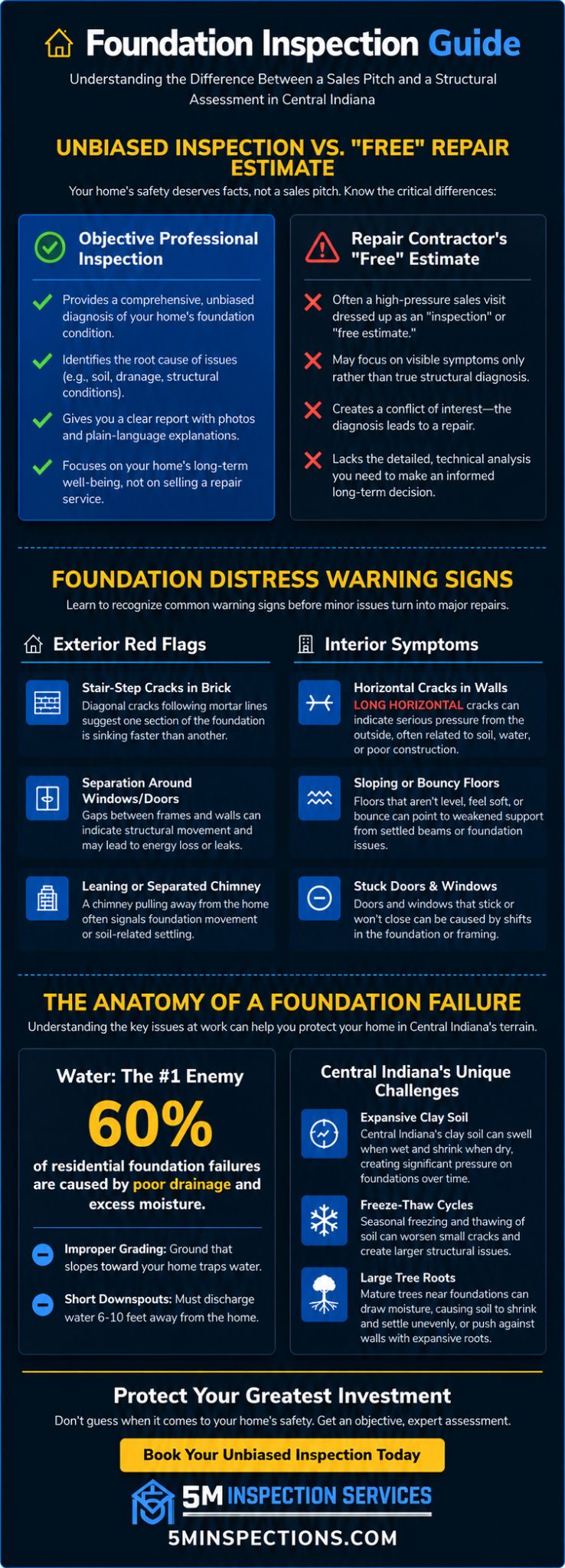
- Stair-step cracks in brick mortar: These typically follow the grout lines in a diagonal pattern. They indicate that one section of the wall is sinking faster than the rest.
- Separation around window frames: Gaps appearing between the siding or brick and your window headers suggest the wall is pulling away or bowing.
- Chimney separation: If you see daylight between your chimney and the house siding, the chimney’s independent footing is likely failing.
Interior Symptoms of Structural Distress
Step into the basement or crawlspace. This is where the most telling evidence hides, often masked by drywall or insulation. A detailed foundation inspection focuses on these high-risk areas:
- Horizontal cracks in basement walls: These are particularly dangerous. They often signal hydrostatic pressure, where water-saturated soil is literally pushing your walls inward.
- Sloping or “bouncy” floors: In older homes across Carmel or Westfield, a floor that feels uneven or springy often points to settled support piers or rotting joists.
- Recurring nail pops: If you patch a ceiling crack or a nail pop and it returns in the exact same spot, the structure is still moving.
Identifying these signs early can save you from the stress of emergency repairs. We believe in providing an objective assessment so you can make informed decisions about your home’s future without the pressure of a sales pitch.
The Anatomy of a Professional Foundation Assessment
A rigorous foundation inspection is far more than a casual walk-around. It’s a technical deep dive into the forces acting upon your home. We begin by analyzing the exterior environment. In Central Indiana, expansive clay soils affect 25% of U.S. land and cause billions in annual damages. We look for large trees whose root systems might be thirsty for the moisture held in that clay. When roots draw water out, the soil shrinks and the footings settle. We also remain watchful for “cosmetic masking.” Freshly painted basement walls or new landscaping against the house can sometimes hide active movement from an untrained eye.
Water Management: The Foundation’s Greatest Enemy
Water is the primary catalyst for structural failure. Research confirms that poor drainage is responsible for 60% of residential foundation failures. During our assessment, we evaluate the grading of your lot. The ground must slope away from the slab to prevent water from pooling at the base. We inspect gutter downspout extensions to ensure they discharge at least six to ten feet away from the perimeter. If water saturates the soil near your walls, hydrostatic pressure builds up. This pressure eventually forces moisture through the concrete, often leaving behind efflorescence, a white, powdery salt deposit that signals a long-term moisture problem.
The Structural Integrity Walkthrough
Inside the basement or crawlspace, the focus shifts to load-bearing components. We measure wall deflection, which is the technical term for bowing. Concrete block walls often bow inward when the external soil pressure exceeds the wall’s strength. We also examine the sill plates, main beams, and joists. These wood members must be free of rot and structural fatigue. Because structural health is often compromised by wood-destroying organisms, many homeowners choose to bundle a termite (WDI) inspection with their structural assessment for total peace of mind.
Finally, we inspect the support piers and lally columns. These vertical supports must be plumb and resting on stable footings. If a pier has shifted or the “DIY” shims used by a previous owner have compressed, you’ll experience the bouncy floors and wall cracks mentioned earlier. Our goal is to provide a clear, data-driven picture of these components so you know exactly where your home stands. We treat your property’s security as a point of professional integrity and personal commitment.
Unbiased Inspection vs. Repair Estimates: Choosing the Right Pro
The “free” inspection trap is one of the most common hurdles homeowners face. When you call a foundation repair company, you’re often inviting a salesperson into your home. Their success is measured by the number of piers or anchors they sell, not the accuracy of their diagnosis. This inherent bias often leads to recommendations for expensive, unnecessary work. An unbiased foundation repair inspection removes this conflict. It focuses on the technical facts of your home’s health, not a monthly sales quota. You deserve an honest assessment from a partner who has no financial stake in the repair work itself.
During a standard buyer’s home inspection, the structural evaluation is a critical component. We look at the visible bones of the house. This includes the foundation walls, support columns, and the roof structure. While a general inspection identifies signs of movement, a specialized structural walkthrough provides the context needed to understand the cause. We treat your property’s security as a point of professional integrity. By identifying issues early, we help you avoid the stress of property transactions by providing certainty and informed decision-making.
Comparing Your Professional Options
Choosing the right expert depends on your specific needs and the stage of your property journey. Each professional serves a different purpose:
- Structural Engineer: These professionals offer the highest level of technical design. They’re best suited for homes with catastrophic failures requiring custom engineered solutions. However, their fees are often the highest in the industry.
- Repair Contractor: They offer free estimates. While helpful for understanding repair costs, they shouldn’t be your only source of information. Their goal is to sell their specific repair system.
- Certified Home Inspector: We provide a moderate-cost, objective diagnostic focus. This is the ideal first-step screening for buyers and sellers who need a reliable overview without the pressure of a sales pitch.
The Conflict of Interest in Foundation Work
You shouldn’t let the person selling the solution provide the diagnosis. It’s a matter of professional integrity. An independent foundation inspector can save you thousands of dollars by identifying when a “major issue” is actually a minor maintenance task. In competitive markets like Fishers and Carmel, having an objective report is a powerful negotiation tool. It allows you to present data-backed evidence during a real estate transaction rather than just a contractor’s quote.
At 5M Inspection Services, we made a conscious choice: we do not perform repairs. This ensures our loyalty remains entirely with you. Our reports are used to plan necessary maintenance or negotiate fair terms in a sale. We provide the technical proficiency and modern methodology you need to move forward with confidence. Our voice is unbiased and objective, maintaining the necessary distance of a certified professional while remaining deeply invested in your well-being.
Understanding Your Foundation Report and Next Steps
Your foundation report is a roadmap. It translates technical observations into a prioritized list of actions designed to protect your equity. Reading it shouldn’t feel like decoding a foreign language. We focus on three primary terms: settlement, deflection, and hydrostatic pressure. Settlement refers to the vertical downward movement of the home. Deflection is the technical term for horizontal bowing, usually seen in basement walls. Hydrostatic pressure is the weight of water-saturated soil pushing against your masonry. Understanding these terms helps you distinguish between a house that is simply “breathing” and one that is in active distress.
A comprehensive house foundation inspection serves as the cornerstone of your long-term maintenance plan. It provides a baseline for your property’s health. If we identify significant movement, we may recommend a follow-up evaluation by a licensed structural engineer to design a specific repair plan. However, for most homeowners, the report serves as a shield. It prevents you from overpaying for repairs that aren’t necessary. When you do need work, you can hand our objective findings to contractors to ensure you receive apples-to-apples repair quotes based on data, not a sales pitch.
Prioritizing Repairs Based on Risk
We categorize our findings to help you manage your budget and stress levels. Not every crack requires a pier. We use a three-class system to define urgency:
- Class 1: Cosmetic cracks. These are hairline fractures in mortar or drywall. They don’t threaten the structure. We recommend monitoring them during seasonal changes.
- Class 2: Minor movement. These signs suggest the foundation is reacting to environmental stress. The priority here is usually improving drainage to stabilize the soil.
- Class 3: Structural failure. This involves significant bowing or crushing of masonry. These issues require immediate stabilization or the installation of support piers to prevent further damage.
The After-Inspection Action Plan
Once you have the report, don’t rush into a contract. Start with the root cause. This almost always involves water management. Fix the gutters and adjust the grading before you invest in expensive structural piers. Next, use the inspector’s findings to obtain multiple quotes from reputable repair firms. This ensures the scope of work remains consistent across all bidders. Finally, schedule a follow-up check after the next significant weather event or season change. This allows you to verify that your drainage improvements are working as intended. If you’re currently in the middle of a property transaction, it’s time to schedule your professional assessment to ensure you’re making a sound investment.
Protecting Your Central Indiana Investment with 5M Inspection Services
Your home is more than a structure; it’s the center of your family’s life. At 5M Inspection Services, we recognize the weight of that responsibility. Our approach is built on the belief that every homeowner deserves total transparency. As a family-owned business, we don’t answer to corporate shareholders. We answer to you, our neighbor. Whether you’re in Westfield, Carmel, or the heart of Indianapolis, our commitment remains the same: providing a rigorous technical evaluation without a hidden sales agenda. We treat your property’s security as a point of professional integrity and personal commitment.
The 5M “No-Bias” Guarantee is the cornerstone of our practice. We sell the truth, not the repair. Because we don’t offer home repair services, our findings are never skewed to justify a construction project. This objectivity is vital in the fast-paced Central Indiana real estate market. When you’re in the middle of a time-sensitive deal, you need answers quickly. We pride ourselves on being modern, highly responsive, and empathetic to the urgent nature of property transactions. A professional foundation inspection from an independent expert is the only way to ensure you’re making a sound financial decision.
The 5M Difference in Structural Evaluation
Our process goes far beyond a standard walkthrough. We utilize modern tools and methodology specifically adapted for the unique challenges of Central Indiana homes. We don’t just point out a crack; we explain the “why” behind every finding. Our communication is direct and efficient. We guide you through a logical progression from general assessments to specific structural testing. This level of thoroughness ensures that no detail is overlooked, from the grading of your yard to the integrity of your load-bearing beams. We position ourselves as your collaborative partner in property safety.
Ready for Peace of Mind?
Don’t let a small crack in the basement wall become a major financial crisis. The stress of the unknown is often worse than the reality of the situation. Getting the facts before you sign a repair contract puts the power back in your hands. Our detailed reports empower you to negotiate with confidence or plan your maintenance with precision. We are watchful, detail-oriented, and ready to help you protect what matters most. Take the first step toward certainty today. Schedule your unbiased foundation inspection with 5M today!
Building a Strong Future for Your Home
Your home’s stability is the bedrock of your family’s safety and financial security. We’ve explored how to distinguish between harmless settling and active structural failures, emphasizing that proactive water management is your first line of defense. A technical assessment is a diagnostic tool, not a sales pitch. By choosing an independent professional, you gain the clarity needed to navigate real estate negotiations or repair planning without the pressure of a commission-based quote. You deserve an objective partner who prioritizes your property’s health over a repair contract.
Since 2019, 5M Inspection Services has operated as a family-owned business serving homeowners across Indianapolis, Westfield, Carmel, and Fishers. Owners Chris and Morgan Markham lead the team with a commitment to thorough, reliable inspections and personal attention to every evaluation. This ensures our technical proficiency meets the highest standards of professional integrity. We don’t just find cracks; we provide the certainty you need to protect your largest investment. Don’t let structural anxiety linger while the soil continues to shift. Secure your home’s future with an unbiased 5M Foundation Inspection today. You can move forward with the confidence that your home remains on solid ground.
Frequently Asked Questions
How much does a professional foundation inspection cost in Central Indiana?
Industry data indicates that the average cost for a foundation inspection in Indiana is $443. This price varies based on the square footage of the home and the complexity of the structure. While a structural engineer may charge between $600 and $900 for a technical design report, an objective assessment from a certified inspector offers a more cost-effective screening for most residential property transactions.
Can I sell my house if the foundation inspection shows issues?
Yes, you can sell a house with structural issues, but Indiana law requires you to disclose these findings to potential buyers. Many homeowners choose to address these concerns before listing to protect their equity. Research from 2026 shows that 60% of sellers prefer to resolve foundation problems beforehand to avoid significant price reductions or collapsed deals during the negotiation phase.
How long does a typical foundation inspection take to complete?
A thorough foundation inspection generally takes between 45 and 90 minutes. The exact duration depends on the accessibility of the crawlspace or basement and the overall size of the perimeter. We move efficiently through a structured checklist, evaluating the exterior grading, interior wall alignment, and load-bearing components to provide a comprehensive view of your home’s health.
What is the difference between a foundation inspection and a general home inspection?
A general home inspection provides a broad overview of all major systems, whereas a specialized foundation check focuses strictly on structural integrity. While a general inspector identifies visible cracks, a dedicated structural assessment analyzes the “why” behind the movement. We look at specific environmental factors like Central Indiana’s expansive clay soil and drainage patterns to determine if the home is stable.
Do all cracks in a basement wall mean the foundation is failing?
No, many cracks are simply cosmetic results of concrete shrinkage or minor settling. Vertical hairline cracks are common and often don’t threaten the home’s safety. However, horizontal cracks or stair-step patterns in masonry are red flags for hydrostatic pressure. These specific indicators suggest active movement and require a professional evaluation to ensure the walls aren’t beginning to bow or fail.
Should I get a foundation inspection for a new construction home in Fishers?
Scheduling a new construction inspection is a vital step even for brand-new homes in Fishers. Modern builds can still suffer from improper soil compaction or grading errors that lead to rapid settling. Ensuring your builder adhered to the 2026 Indiana Building Code provides you with a documented baseline of structural health before your builder’s warranty period expires.
Will my homeowners insurance cover the cost of a foundation inspection?
Standard homeowners insurance policies typically do not cover the cost of an inspection or repairs related to earth movement and settling. Coverage is usually reserved for sudden, accidental events like a major pipe burst that undermines the slab. It’s best to verify your specific policy details, but most structural maintenance is considered an out-of-pocket responsibility for the homeowner.
How often should I have my home foundation checked by a professional?
Professional inspectors recommend a structural check every three to five years as part of a healthy maintenance routine. You should also request an assessment after periods of extreme weather, such as the heavy rainfall or prolonged droughts common in the Indianapolis area. Regular monitoring allows you to catch drainage issues early, often preventing the need for expensive structural stabilization later.