
Did you know that savvy homebuyers negotiate an average of $14,000 in savings just by acting on their inspector’s findings? In the high-speed Indianapolis real estate market, it’s easy to feel pressured into overlooking a “minor” crack or a strange smell in the basement. You want a safe home for your family, not a five-figure repair bill hidden behind a fresh coat of paint. We understand that technical jargon and complex structural reports feel overwhelming when you’re making a life-changing decision. It’s our job to be your meticulous, protective partner during this process.
This guide identifies the critical home inspection deal breakers for buyers that threaten your safety and your financial future. You’ll gain a clear red light/green light framework to help you distinguish between routine maintenance and permanent liabilities like foundation failure or severe mold. We’re providing the professional reassurance you need to navigate Hamilton County negotiations. By the end, you’ll know exactly when to ask for a credit and when it’s time to walk away so you can buy your next Central Indiana home with total confidence.
Key Takeaways
- Distinguish between minor cosmetic flaws and high-risk structural failures that impact your family’s safety and your long-term investment.
- Identify the “Big Four” systemic issues, including foundation cracks and roofing disasters, that require expert evaluation before you close.
- Recognize the most critical home inspection deal breakers for buyers in Central Indiana, from elevated radon levels to active mold colonies.
- Learn why specialized testing like sewer scopes is vital for uncovering hidden, expensive pipe failures that standard inspections don’t reach.
- Develop a strategic negotiation plan to prioritize safety-first repairs or secure financial credits from sellers in competitive markets.
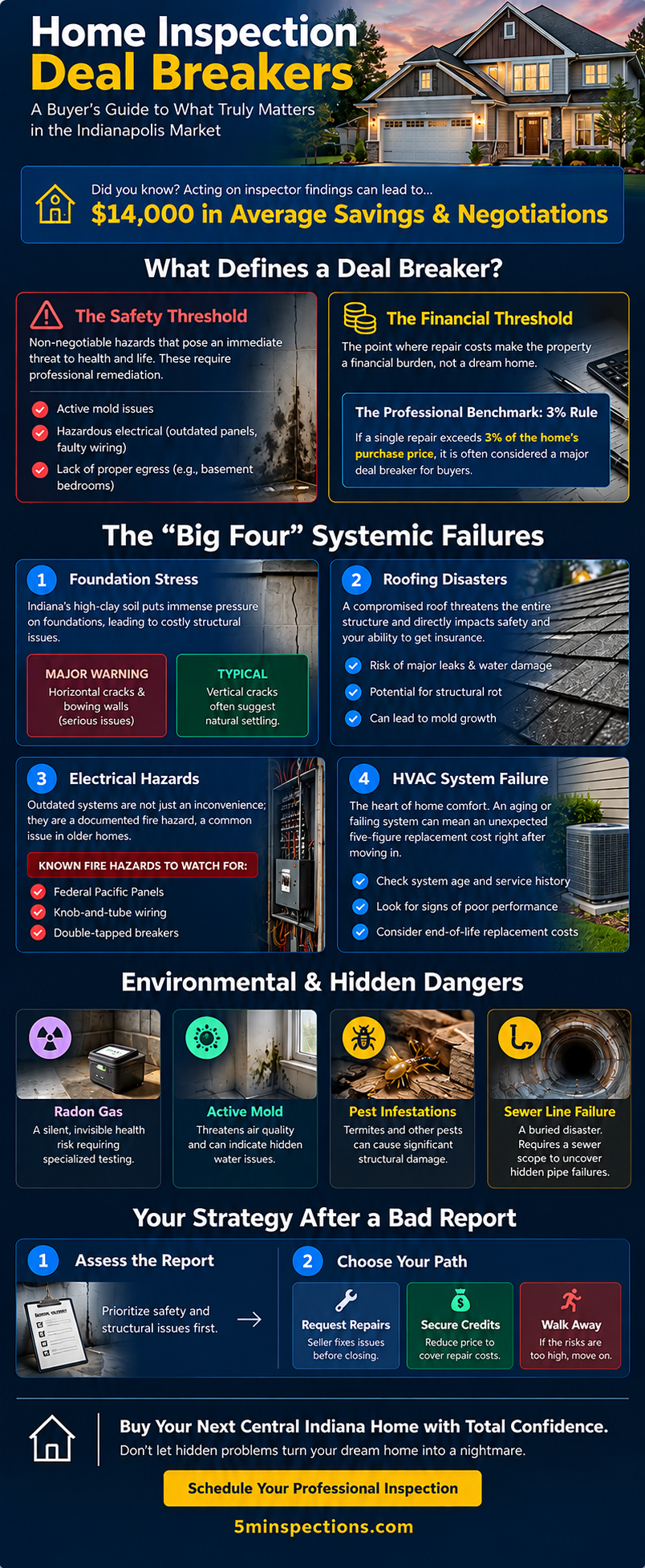
What Defines a Home Inspection Deal Breaker in 2026?
A home inspection deal breaker isn’t a universal list found in a textbook. It’s a personal intersection of risk tolerance, financial liquidity, and physical safety. To understand the stakes, we first need to define what is a home inspection? at its core. It is a professional, visual assessment of a property’s condition, designed to protect you from unseen liabilities before you sign the final papers. In 2026, we still see many buyers confuse simple cosmetic flaws with genuine structural failures. A stained carpet or a dated kitchen is a weekend project. A bowing foundation wall or a compromised roof structure is a catastrophe.
The inspection contingency in your purchase agreement provides the legal framework to address these issues. It acts as your primary safety net. If our report reveals significant home inspection deal breakers for buyers, this clause allows you to renegotiate the price, demand repairs, or walk away with your earnest money intact. Your loan type also dictates the definition of a deal breaker. FHA and VA loans have strict “Minimum Property Requirements.” These lenders may refuse to fund the deal entirely if they find peeling lead paint or missing handrails. Conventional loans are often more flexible, leaving the “pain threshold” entirely up to you.
The Safety Threshold: Non-Negotiable Hazards
Safety is binary. A home is either a secure environment for your family or it’s a liability. We prioritize issues that pose an immediate threat to life or health. Many older homes in Indianapolis have “grandfathered” electrical components that met standards decades ago but are known fire hazards today. We don’t care if a system was legal in 1950; we care if it’s dangerous now. Common safety red flags include active gas leaks, outdated electrical panels prone to overheating, or a lack of proper egress in basement bedrooms. These are non-negotiable hazards that require immediate professional intervention.
The Financial Threshold: Calculating the ‘Pain Limit’
Every buyer has a financial limit where a house stops being a dream and starts being a burden. You must define your personal budget for post-closing repairs before the inspection begins. A common professional benchmark is the 3% rule. If a single repair, such as a full sewer line replacement, exceeds 3% of the home’s purchase price, it’s often classified among the major home inspection deal breakers for buyers. If these costs exceed your liquid cash or stall your closing, the deal may no longer be viable. We provide the data so you can decide if the investment matches the reality of the structure.
The ‘Big Four’ Structural and Systemic Failures
The “Big Four” represent the most significant financial risks you’ll face during a property transaction. These systems, foundation, roof, electrical, and HVAC, are the bones and vitals of the house. When they fail, repair costs often spiral into five figures. These are the primary home inspection deal breakers for buyers because they directly impact the home’s safety and your ability to secure insurance. If the core of the house is failing, the rest of the property’s features matter very little.
Electrical systems deserve a close look. We often find Federal Pacific panels or knob-and-tube wiring in older Indianapolis neighborhoods. These aren’t just technicalities; they’re documented fire hazards. We also watch for double tapped breakers, which can lead to overheating and circuit failure. If a home’s “vitals” are compromised, it’s time to pause. We treat your safety as our professional integrity, ensuring you know exactly what’s lurking behind the drywall.
Foundation Stress in Central Indiana
Indiana’s geography presents unique challenges. Our high-clay soil acts like a sponge. It expands when wet and shrinks during dry spells. This constant movement puts immense pressure on basement walls. You might see horizontal cracks or bowing walls. These indicate serious structural distress. While vertical cracks often suggest natural settling, horizontal ones are major home inspection deal breakers for buyers. We assess your foundation health to determine if you need a structural engineer’s intervention before proceeding. If you’re concerned about a specific property, a professional buyer’s home inspection can provide the clarity you need.
Major System Life Cycles
Predicting when a system will fail is part of our protective role. A furnace older than 20 years is on borrowed time. We look for cracked heat exchangers. These can leak carbon monoxide into your living space. Roofing also has a clear expiration. A roof with two layers of shingles is a liability. It traps heat and adds excessive weight to the structure. This often complicates home inspection negotiation, as many insurance companies refuse to cover double-layered roofs. Finally, watch for outdated plumbing. Materials like polybutylene or galvanized steel are prone to internal corrosion. These “hidden” disasters are why we meticulously inspect every inch of the home’s mechanical systems.
Environmental Deal Breakers: Radon, Mold, and Pests
While structural failures are visible to the trained eye, environmental hazards often lurk in the air or within the walls. These invisible threats are frequent home inspection deal breakers for buyers because they affect your family’s health as much as your wallet. In Central Indiana, we face specific geological and climatic challenges that make certain tests essential rather than optional. Ignoring these risks can lead to significant long-term liabilities that standard inspections might miss without specialized testing.
Environmental concerns are often ranked among the Biggest Home Inspection Deal Breakers because they require specialized remediation. For instance, wood-destroying insects (WDI) like termites can hollow out structural beams before you even notice a problem. In historic Indianapolis neighborhoods, we also monitor for lead-based paint and asbestos. These materials aren’t always deal breakers if they’re undisturbed, but they become major financial burdens if you plan to renovate or if they’re deteriorating. Our role is to provide the data you need to make a protective decision.
Radon Testing: A Central Indiana Essential
Central Indiana is a known high-risk area for radon gas, a colorless, odorless byproduct of decaying uranium in the soil. This is why Radon Testing Carmel Indiana is a non-negotiable step for any diligent buyer. Radon is the leading cause of lung cancer for non-smokers. The EPA has set an action level of 4.0 pCi/L; if a home tests at or above this limit, mitigation is required. While a mitigation system is a common negotiation point, high levels discovered late in the process can stall a closing if the seller refuses to cooperate.
Mold and Moisture Intrusion
Mold is often a symptom of a larger, hidden problem. While “black mold” is a common buzzword that causes panic, any active mold growth indicates a moisture intrusion issue that must be resolved. We frequently find mold in attics due to poor ventilation or in basements with high humidity. Simply cleaning the surface won’t solve the problem if the source isn’t addressed. Professional mold sampling provides the objective data needed for negotiation. According to 2026 industry data, professional mold remediation averages around $2,400, though severe cases involving an entire house can reach $30,000. Knowing these figures helps you determine if the home fits your financial “pain limit.”
The Buried Disaster: Sewer Line Failures
Most buyers don’t realize that a standard home inspection typically stops at the house exit. While we meticulously examine the interior plumbing, the main line running from the foundation to the city connection remains a mystery without specialized equipment. This hidden pipe is one of the most significant home inspection deal breakers for buyers because failures are impossible to detect from the surface. You won’t know a problem exists until sewage backs up into your new basement. By then, the financial damage is already done.
The geography of Central Indiana plays a role here too. In older neighborhoods, we often find root intrusion from mature trees or collapsed sections of outdated clay piping. Even in growing areas like Westfield and Carmel, the cost of excavation and street repairs can be staggering if the line fails under a paved driveway or public sidewalk. Don’t assume a newer property is safe. We’ve seen construction debris or heavy machinery crush lines in brand-new developments. This is why even new construction homes need a sewer inspection to ensure the path to the city main is clear and structuraly sound.
What a Sewer Scope Reveals
We use high-definition camera technology to visualize the “unseen” interior of your main waste line. A sewer scope identifies specific threats like “bellies,” which are low spots where water and waste pool, eventually causing a blockage. We also look for Orangeburg pipes, a legacy material made of wood pulp and tar that is notorious for structural failure. Identifying these issues early allows you to distinguish between a simple $500 professional cleaning and a full-scale line replacement that could cost thousands.
Sewer Issues as a Deal Breaker
Liability is the primary concern for buyers. In most Indiana jurisdictions, the homeowner is responsible for the pipe from the house all the way to the city main, even the portion under the street. If a seller refuses to address a collapsed line or significant root blockage, you’re inheriting a ticking time bomb. While a minor clog is a routine negotiation point, a $15,000 replacement is a definitive deal breaker for many. We provide the visual evidence you need to hold sellers accountable. To protect your investment from these buried disasters, you can schedule a sewer scope inspection as part of your comprehensive property assessment.
Negotiation Strategy: Moving Forward After a Bad Report
Receiving a detailed inspection report can feel like a punch to the gut. You finally found the perfect house, only to learn it has structural or safety defects. Don’t let the technical jargon or the pressure of the market force you into a bad investment. This is where your strategy matters most. You must prioritize your “Ask” list by focusing on safety and structural integrity first. Cosmetic issues like peeling wallpaper or old carpet are distractions. The genuine home inspection deal breakers for buyers are the ones that compromise the home’s livability or your financial security.
Deciding between requesting a repair or a closing cost credit is a pivotal choice. We generally recommend asking for a credit. This allows you to hire your own certified professionals and oversee the quality of the work yourself. When a seller agrees to a repair, they often look for the cheapest solution possible; sometimes they rely on a “handyman” rather than a licensed specialist. If the issues are too severe or the seller refuses to budge, you must be prepared to walk away. A house is a sound investment only if the cost of ownership doesn’t outweigh the value of the property.
At 5M Inspection Services, we provide clear, high-impact summaries that help you communicate these findings to your Realtor. We act as your technical advocate, ensuring the data is undeniable during the negotiation phase. Our goal is to provide the certainty you need to make a move that protects your family and your bank account.
Contingencies and Legal Protections
Indiana real estate contracts have specific timelines you must follow. Missing an inspection response deadline can result in a waiver of your rights. You should also understand the “Right to Cure” clause. This gives the seller an opportunity to fix the defects before you can legally terminate the contract. Protecting your earnest money requires strict adherence to these dates and professional documentation of all home inspection deal breakers for buyers. We ensure your report is delivered quickly so you have ample time to consult with legal or real estate experts.
The Inspector-Realtor-Buyer Partnership
Your Realtor uses our report as a professional leverage tool. It’s hard for a seller to argue with high-definition photos of a collapsed sewer line or a radon reading above 4.0 pCi/L. Once negotiations are finished, never skip the final walkthrough. This is your last chance to ensure that agreed-upon repairs were completed to a professional standard. If a repair looks like a “band-aid” fix, don’t be afraid to speak up before the final signatures are dry. We stand by our findings to ensure you close with total confidence.
Secure Your Investment with Professional Certainty
Buying a home in Central Indiana is a significant milestone, but it shouldn’t be a gamble. You now have the framework to distinguish between simple maintenance and genuine home inspection deal breakers for buyers. By prioritizing structural integrity, environmental safety, and buried sewer health, you protect your family and your financial future. Knowledge is your best leverage when sitting at the negotiation table.
We believe every property deserves careful attention. As a family-owned business operated by Chris and Morgan Markham, we take pride in providing detailed, objective inspections to help you make informed decisions. We offer specialized sewer scope and radon testing to uncover the risks that others miss. You won’t have to wait for answers. We deliver our detailed reports within 24 hours so you can act fast in this competitive market. Your security is a point of our professional integrity.
Don’t let uncertainty stall your dreams. Schedule your comprehensive Buyer’s Inspection with 5M today and move forward with total confidence. We’re here to watch over your next big step and ensure your new house is truly a safe home.
Frequently Asked Questions
Is a cracked foundation always a deal breaker?
No, but the direction and size of the crack determine the level of risk. Vertical cracks are often the result of natural settling, while horizontal cracks indicate significant structural pressure from Indiana’s expansive clay soil. If a wall is bowing or the floors are sagging, the repair could cost tens of thousands of dollars. We recommend a structural engineer’s assessment for any horizontal cracking to determine if it’s a fixable flaw or a permanent liability.
Can I walk away from a home purchase after the inspection?
Yes, you can walk away if you have an inspection contingency in your signed purchase agreement. This legal clause allows you to terminate the contract and protect your earnest money if the report reveals defects you aren’t willing to accept. You must adhere to the specific response timelines outlined in your contract. if the home inspection deal breakers for buyers are too severe or negotiation fails, you have the right to exit the deal.
How much radon is too much when buying a home?
Any radon level at or above 4.0 picocuries per liter (pCi/L) is considered high by the EPA and requires a mitigation system. Because radon is the leading cause of lung cancer for non-smokers, levels in this range pose a genuine health threat to your family. Professional mitigation systems are highly effective at reducing these levels. We advise buyers to ensure a system is installed and re-tested before closing if the initial results exceed this threshold.
What are the most common home inspection deal breakers in Indiana?
The most frequent deal breakers in Indiana include horizontal foundation cracks, elevated radon levels, and hidden sewer line collapses. Because many local homes are older, outdated electrical panels like Federal Pacific and active mold in unventilated attics are also recurring issues. These problems represent the highest financial and safety risks for buyers in our region. Identifying these early prevents you from inheriting a “money pit” after the keys are handed over.
Should I buy a house with a 20-year-old roof?
You can, but you should budget for a full replacement in the very near future. Most asphalt shingle roofs have a life cycle of 20 to 25 years, meaning a 20-year-old roof is likely at its “death date.” Beyond the risk of active leaks, many insurance companies refuse to issue new policies on roofs of this age. This can stall your mortgage approval and prevent the closing from moving forward unless the roof is replaced.
What if the seller refuses to fix a major inspection issue?
You have three primary options: accept the home as-is, negotiate a closing cost credit, or terminate the contract. If the report identifies major home inspection deal breakers for buyers, accepting the home as-is is rarely a sound investment. Requesting a financial credit is often better than a repair because it allows you to hire your own trusted contractors. If the seller won’t budge on safety or structural issues, walking away is usually the safest move.
Is mold in the attic a reason to walk away from a deal?
Not necessarily, but you must identify and fix the underlying moisture source. Mold in an attic is usually a symptom of poor ventilation or a hidden roof leak. If the remediation cost is high and the seller refuses to address the moisture problem, the mold will simply return. We use mold sampling to provide the objective data you need to decide if the cleanup and necessary repairs fit within your financial pain limit.
How do I know if an electrical issue is dangerous or just old?
Dangerous issues involve fire-prone components like Federal Pacific panels, double-tapped breakers, or scorched outlets. While some systems are simply outdated, they become critical hazards if they’ve been improperly modified or covered with insulation. We look for specific signs of overheating and circuit failure. If a system poses an immediate fire risk to your family, it’s a non-negotiable safety hazard that requires professional intervention before you move in.