
Did you know that nearly 40% of homes tested in Indiana reveal radon levels at or above the EPA’s recommended action level of 4.0 pCi/L? That means one in three families in our state could be breathing in the second leading cause of lung cancer without even knowing it. When you are in the middle of a property transaction, it’s natural to wonder, is radon testing necessary in Indiana, or is it just another line item on a long list of expenses? You want your home to be a safe haven, and the thought of an invisible health hazard is understandably unsettling.
We believe your peace of mind is worth the technical precision of a professional test. This article will show you why our state’s unique glacial geography makes radon testing a non-negotiable safety step for every homeowner and buyer in 2026. We will also dive into the specifics of Indiana Senate Bill 61, which mandates new radon disclosures as of July 1, 2026. By the end, you’ll have a clear roadmap for navigating EPA action levels and the confidence to handle high results with professional integrity.
Key Takeaways
- Understand how Indiana’s glacial history created a high-risk environment and why is radon testing necessary in Indiana for every property transaction.
- Learn the biological impact of alpha particles and why radon remains the leading cause of lung cancer among non-smokers.
- Navigate the 2026 legal requirements for radon disclosure to ensure your real estate deal is transparent and compliant with state law.
- Discover the technical differences between testing methods and why maintaining “closed house conditions” is vital for an accurate reading.
- Identify how localized expertise in Central Indiana provides the objective data you need to make informed, confident decisions for your family.
Understanding Radon Risks: Why Indiana is a Geographic Hot Zone
Radon is a silent, radioactive gas that originates from the natural breakdown of uranium in our soil and rocks. Because it is colorless and odorless, you cannot see or smell it, yet it consistently migrates from the ground into the air we breathe. In many parts of the country, radon is a minor concern. However, our state’s geological history tells a different story. If you are wondering, is radon testing necessary in Indiana, the answer lies beneath your feet. We believe in providing you with the technical facts so you can make the best decision for your household safety.
The Environmental Protection Agency (EPA) classifies approximately two-thirds of Indiana’s 92 counties as Zone 1. This designation indicates the highest predicted potential for indoor radon levels exceeding 4.0 pCi/L. Current data shows that as many as one in three homes across the state have elevated levels. These statistics are not meant to cause alarm but to provide the objective certainty you need to protect your family from the long-term health effects of radon. Understanding the “why” behind these numbers is the first step in taking control of your home’s environment.
The Science of Indiana Soil: Glacial Deposits and Uranium
Indiana’s landscape was fundamentally shaped by the Wisconsin Glacial Episode. As these massive ice sheets moved across the region, they ground up uranium-rich shale and granite from the north, depositing a thick layer of “glacial till” across Central Indiana. This soil composition is dense with heavy clay and shale, which are particularly effective at trapping and then releasing radon gas. It’s a localized issue that doesn’t follow property lines. You might find that a home in Carmel has safe levels, while a neighboring lot in Westfield tests significantly higher. The specific pocket of glacial debris under your foundation dictates your risk level. This makes individualized testing the only way to be truly sure of your status.
Debunking the Basement Myth: Radon in All Home Types
Many homeowners believe that if they don’t have a basement, they don’t have a radon problem. This is a dangerous misconception. Radon enters buildings through the “stack effect.” As warm air rises and exits through the upper levels of a house, it creates a vacuum in the lower levels. This pressure difference literally sucks soil gases through cracks in concrete slabs, gaps around service pipes, and open crawl spaces. Is radon testing necessary in Indiana for new, airtight constructions? Absolutely. In fact, modern energy-efficient homes are often so well-sealed that they trap radon gas more effectively than older, draftier houses. Whether your home sits on a slab or over a crawl space, the risk remains a reality that requires professional attention.
The Health Implications: Why Necessary Means Life-Saving
When we discuss property safety, we often focus on visible issues like a leaky roof or a cracked foundation. However, the most significant threat to your family’s health is one you cannot detect with your senses. So, is radon testing necessary in Indiana? From a biological perspective, the answer is a resounding yes. Radon is the leading cause of lung cancer in non-smokers, claiming thousands of lives every year. We believe that protecting your family starts with understanding the invisible. By identifying high levels early, you can take immediate action to ensure your home remains a safe environment for your loved ones.
As radon gas decays, it releases tiny bursts of energy known as alpha particles. When these particles are inhaled, they strike the sensitive lining of the lungs, causing microscopic damage to your DNA. Over time, this damage can lead to cellular mutations and the development of cancer. Because this process happens at a cellular level, there are no immediate symptoms like coughing or headaches to warn you of the danger. This cumulative risk is why testing early in your homeownership is a vital step for long-term health and safety.
Radon and Lung Cancer: The EPA Action Levels
The EPA has established 4.0 pCi/L (picocuries per liter) as the threshold where mitigation becomes essential. It’s vital to understand that no level of radon is truly safe; the EPA recommends considering mitigation even if your levels fall between 2.0 and 4.0 pCi/L. To put this in perspective, living in a home with a radon level of 4.0 pCi/L carries a risk profile similar to the following facts:
- It is roughly equivalent to smoking half a pack of cigarettes every day.
- The radiation exposure is comparable to receiving 200 chest X-rays every year.
- According to the EPA on radon health risks, it is responsible for an estimated 21,000 lung cancer deaths annually in the United States.
The Dangers of the Invisible: Why You Can’t Rely on Senses
You cannot see, smell, or taste radon gas. It’s a silent intruder that enters your living space through the foundation. Radon is a noble gas that penetrates most building materials, including concrete and drywall, with ease. This is why you cannot rely on your neighbor’s low test results as a guarantee for your own home. Soil composition and home construction vary so significantly that two identical houses on the same street can have vastly different readings. If you are still asking is radon testing necessary in Indiana, remember that your neighbor’s safety doesn’t dictate your own. Scheduling a professional Radon Testing service is the only way to obtain the objective data required for a healthy home.
Radon Testing in Indiana Real Estate: Is it Legally Required?
While there is no federal mandate requiring a radon test for every home sale, Indiana state law has become significantly more stringent regarding transparency. For anyone asking is radon testing necessary in Indiana to close a deal, the answer depends on your role in the transaction and your desire for a smooth closing. As of July 1, 2026, Indiana Senate Bill 61 has fundamentally changed the real estate landscape. This law mandates that sellers provide buyers with a specific radon warning statement and disclose any known information about radon concentrations in the dwelling before a real estate transaction is finalized. We believe this shift is a win for consumer safety, ensuring that every buyer is fully informed about the air they will breathe.
Even beyond state law, your lender might have the final say. Many financial institutions, particularly those handling FHA or VA loans, strongly suggest or even require environmental testing to protect the long-term value of the property. A high radon reading isn’t just a health concern; it’s a structural and financial variable that must be managed. Using a professional test as a tool for price negotiation ensures that you aren’t left with an unexpected bill for a mitigation system after you’ve already moved in.
Indiana Disclosure Laws for Sellers
Sellers in our state must complete the Indiana Seller’s Residential Real Estate Sales Disclosure form. This document requires you to be honest about any “known” environmental hazards. If you’ve performed a test in the past that showed elevated levels, you’re legally obligated to share those results. Liability often stems from what is known but not disclosed. To avoid last-minute surprises that could kill a deal, we recommend a Pre-Listing Inspection Indianapolis sellers can use to get ahead of the curve. Identifying a radon issue early allows you to handle it on your terms rather than under the pressure of a buyer’s deadline.
Why Buyers Should Always Include a Radon Contingency
For buyers, the “Radon Addendum” is your most effective protection. This standard Indiana purchase agreement document allows you to make the sale contingent upon the home testing below the EPA action level. If the results are high, you have the contractual right to request that the seller pay for a mitigation system. Testing during your initial inspection period is the most cost-effective time to act. It’s much simpler to negotiate a solution when the seller is still motivated to close. Don’t skip this step; it’s a small investment that provides massive leverage and long-term peace of mind for your family’s future.
Professional Testing vs. DIY: What to Expect
When you decide to address the air quality in your home, you’ll likely face a choice between a store-bought kit and a professional service. You might wonder, is radon testing necessary in Indiana with a certified expert, or can a $15 canister do the job? While DIY kits are available at many local health departments, they often fall short during the high-stakes environment of a real estate transaction. We believe that professional precision provides the certainty you need when your family’s health and your property’s value are on the line. A professional test utilizes advanced technology that a simple charcoal canister cannot match.
The primary difference lies in the equipment and the protocol. Most DIY kits are passive collectors that only provide a single average reading after being sent to a lab. In contrast, a professional assessment uses active, calibrated machinery that monitors environmental changes in real time. This technical depth is essential because radon levels fluctuate based on weather, barometric pressure, and home ventilation. Without hourly data, a single high or low reading can be misleading, potentially leading to unnecessary stress or a false sense of security.
Continuous Radon Monitors (CRM) vs. Charcoal Canisters
At 5M Inspection Services, we use high-precision digital Continuous Radon Monitors (CRM) for all our assessments. These devices provide hour-by-hour data points, allowing us to spot unusual spikes that a charcoal canister would miss. DIY canisters are also highly sensitive to lab delays. If a mail-in kit sits in a hot delivery truck or a sorting facility for too long, the results can become skewed and unreliable. Our digital equipment eliminates these variables, providing a tamper-resistant record that is vital for legal compliance and buyer confidence.
The 48-Hour Protocol: Preparing Your Home for the Test
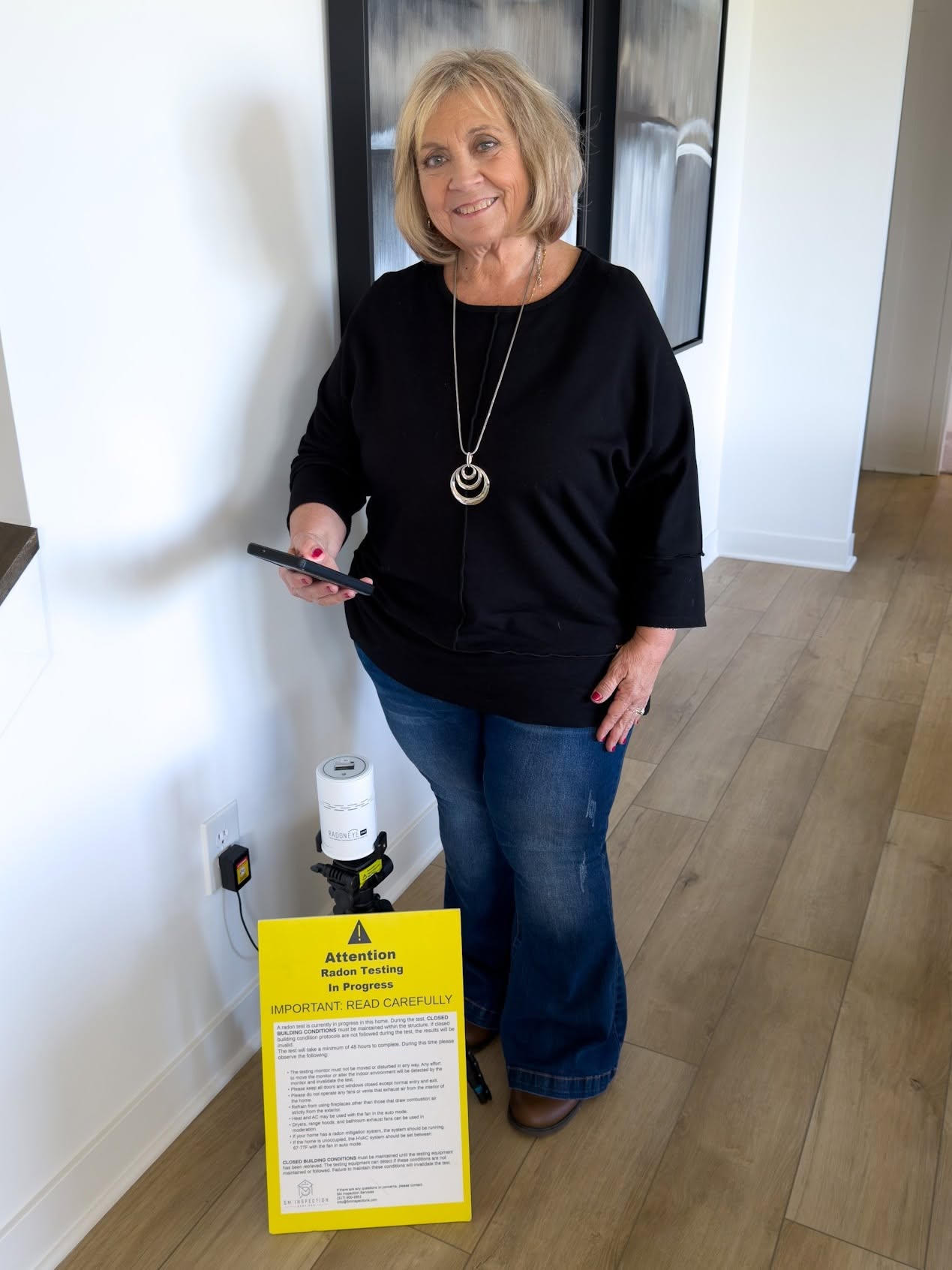
To ensure the most accurate results, we follow a strict 48-hour protocol known as “closed house conditions.” This methodology is designed to simulate the highest potential radon concentration in the home. You must adhere to the following rules during the testing period:
- Keep all windows and exterior doors closed, except for normal entry and exit.
- Do not operate whole-house fans or high-volume attic fans.
- The testing device is placed on the lowest livable level, such as a finished basement or a main floor over a crawl space.
- Avoid using fireplaces or wood stoves unless they are the primary heat source.
One of the biggest advantages of a professional service is the speed of information. While DIY kits require you to wait days or weeks for lab results, our professional equipment allows us to generate an instant, easy-to-read report the moment we pick up the device. This efficiency is critical in the fast-paced Central Indiana real estate market. If you are ready for a definitive answer regarding your home’s air quality, you can schedule your professional Radon Testing today to get the objective data you deserve.
Protecting Your Central Indiana Home with 5M Inspection Services
At 5M Inspection Services, we view ourselves as more than just a service provider. We are your protective, community-oriented neighbor. As a family-owned business, we understand the inherent stress of property transactions. Our goal is to alleviate that pressure by promising certainty through meticulous, technical expertise. When clients ask us, is radon testing necessary in Indiana, we provide the objective data they need to make a confident choice. We take the responsibility of property safety seriously, framing your family’s security as a point of professional integrity and personal commitment.
We take an integrated approach to home safety. By combining our standard Buyer’s Home Inspection with specialized environmental testing, we provide a holistic view of a property’s health. We don’t believe in surface-level summaries. Instead, we offer high-impact, easily accessible segments of information that respect your time and prioritize your health. Whether you are buying a new construction home or a historic property, our unbiased assessments ensure you have a clear understanding of the environmental risks before you sign on the dotted line.
Expert Radon Testing in Carmel, Indianapolis, and Westfield
Our team possesses deep knowledge of local neighborhoods and the specific soil conditions found throughout Central Indiana. This local expertise is vital for accurate results. We understand exactly where to place our Continuous Radon Monitors to capture the most reliable data, accounting for the unique foundation types found in Fishers or the glacial deposits beneath Westfield. If you are moving to the area, check out our specialized guide on Radon Testing Carmel Indiana to see how we protect homes in your specific community. We ground our brand in this community-centric context because we are personally accountable to the neighbors we serve.
From Results to Resolution: Understanding Your Report
Receiving a report with high pCi/L numbers can be overwhelming, but we are here to guide you through the data. We help you interpret the results with professional authority and familial warmth, ensuring you understand exactly what the numbers mean for your family’s safety. If your test reveals levels above the EPA action level, we provide clear guidance on how to find qualified radon remediation professionals. Our role is to provide the objective testing that identifies the problem, allowing you to seek specialized technical solutions with confidence. We remain modern, highly responsive, and empathetic to the urgent nature of the real estate industry.
Schedule your professional radon test with 5M Inspection Services today and let our family protect yours with the reliable, thorough data you deserve.
Secure Your Home’s Future with Professional Clarity
You now understand that Indiana’s unique geology and the legislative updates of 2026 have fundamentally changed the stakes for local property owners. When you evaluate whether is radon testing necessary in Indiana, you aren’t just checking a box for a real estate transaction. You are making a vital commitment to your family’s long-term health and safety. We’ve explored how professional digital monitoring provides the technical precision that DIY kits lack, ensuring your results are both accurate and legally compliant.
At 5M Inspection Services, we’ve been family-owned and operated since 2019. Our certified environmental testing specialists bring localized expertise to every home in Indianapolis, Carmel, and Westfield. We don’t just provide a report; we offer the certainty you need to move forward with confidence. Your home should be a place of security, not a source of invisible concern. We are here to be your watching, detail-oriented partner in property safety.
Taking this proactive step ensures your home remains the healthy environment your loved ones deserve for years to come.
Frequently Asked Questions
Is radon testing really necessary if the house doesn’t have a basement?
Yes, testing is absolutely essential regardless of your home’s foundation type. Radon gas enters through cracks in concrete slabs and gaps around plumbing in crawl spaces. Because air pressure differences pull soil gases upward, homes without basements are frequently found with elevated levels. We believe every homeowner deserves the certainty of a professional test to ensure their living environment is truly safe for their family.
How much does a professional radon test cost in Indiana?
Industry data suggests that professional radon testing in Indiana typically ranges from $100 to $400. While you might see varying rates depending on your specific county or the complexity of the property, this investment provides high-precision data that DIY kits cannot match. We recommend focusing on the reliability of the equipment and the expertise of the technician rather than just the lowest price point to ensure your family’s protection.
What is a ‘safe’ level of radon for an Indiana home?
Technically, there is no known safe level of radon exposure. The EPA has established 4.0 pCi/L as the action level where mitigation becomes a necessity for health safety. However, they also suggest considering mitigation for levels between 2.0 and 4.0 pCi/L. Our goal is to help you reduce your exposure to the lowest level possible, providing you with the technical data needed to make an informed decision for your household.
Can I just buy a radon test kit at a hardware store?
You can purchase DIY kits, but they often lack the precision required for a real estate transaction. These passive devices are susceptible to lab delays and environmental interference. When asking is radon testing necessary in Indiana with a professional, consider the benefit of Continuous Radon Monitors. Our high-precision equipment provides hour-by-hour data and tamper-resistance, giving you a level of certainty that a store-bought canister simply cannot provide.
What happens if the radon test comes back high during a home sale?
High results typically lead to a mitigation request from the buyer. In most Indiana real estate transactions, a reading at or above 4.0 pCi/L allows the buyer to utilize the Radon Addendum to negotiate for a professional mitigation system. This is a common and manageable part of the closing process. We provide the objective data that serves as a neutral foundation for these negotiations, helping both parties move toward a safe resolution.
How long does a radon test take to complete?
A standard professional radon test requires a minimum of 48 hours of continuous monitoring. During this time, the home must maintain “closed house conditions” to ensure a representative sample of the soil gas concentration. Once our technicians retrieve the Continuous Radon Monitor, we can generate a comprehensive report immediately. This efficient timeline respects the fast-paced nature of property transactions while maintaining the rigorous standards required for accurate environmental testing.
Does a new construction home need a radon test?
Yes, new construction homes are often at higher risk because they are built to be extremely airtight. While energy efficiency is a benefit, it can inadvertently trap radon gas inside the living space. Many builders in Central Indiana now include passive radon piping, but these systems aren’t always sufficient. Is radon testing necessary in Indiana for a brand-new house? We believe it’s a non-negotiable step to verify that these systems are functioning correctly before you move in.
If my neighbor’s house has low radon, is mine safe too?
You cannot rely on a neighbor’s test result to determine your own risk. Radon levels are dictated by the specific soil composition directly beneath your foundation and the unique structural integrity of your home. Two identical houses sitting side-by-side can have vastly different radon concentrations. We provide individualized testing because your family’s safety shouldn’t be based on a guess or a neighbor’s data point. Only a direct test provides the certainty you need.