
The most expensive part of your home isn’t the roof or the HVAC; it’s the 4-inch pipe buried several feet under your lawn that you’ve likely never seen. Most homeowners realize there’s an issue only after raw sewage begins backing up into their basement or shower. It’s a stressful, messy, and incredibly expensive situation that can cost Indiana residents upwards of $18,000 to resolve. We understand the anxiety of hearing a strange gurgle in the pipes and wondering if you’re facing a simple clog or a total system collapse. Recognizing the early signs of sewer line problems is the only way to protect your property and your bank account from a catastrophic failure.
You deserve an honest assessment without the pressure of a high-stakes sales pitch from a repair company. This guide will walk you through seven critical red flags that indicate your underground infrastructure is failing. We’ll explain exactly what to look for, from soggy patches in the yard to persistent odors, and show you how unbiased diagnostic testing provides the clarity you need. By the end of this article, you’ll know when a slow drain is just a nuisance and when it’s time to call in a professional for a definitive look inside your pipes.
Key Takeaways
- Learn to spot the early signs of sewer line problems, including persistent sewage odors and strange gurgling noises from your plumbing fixtures.
- Discover why Central Indiana’s mature trees and aging homes create a “perfect storm” for hidden pipe damage and root intrusion.
- Understand how a high-definition sewer scope inspection identifies structural issues like cracks and offsets without digging up your lawn.
- Recognize the value of obtaining an unbiased diagnostic report from a certified inspector who doesn’t have a financial interest in selling you repairs.
- Gain the certainty you need to protect your property’s value and avoid the stress of an unexpected, multi-thousand dollar excavation project.
The ‘Invisible’ Threat: Why Sewer Line Health Matters
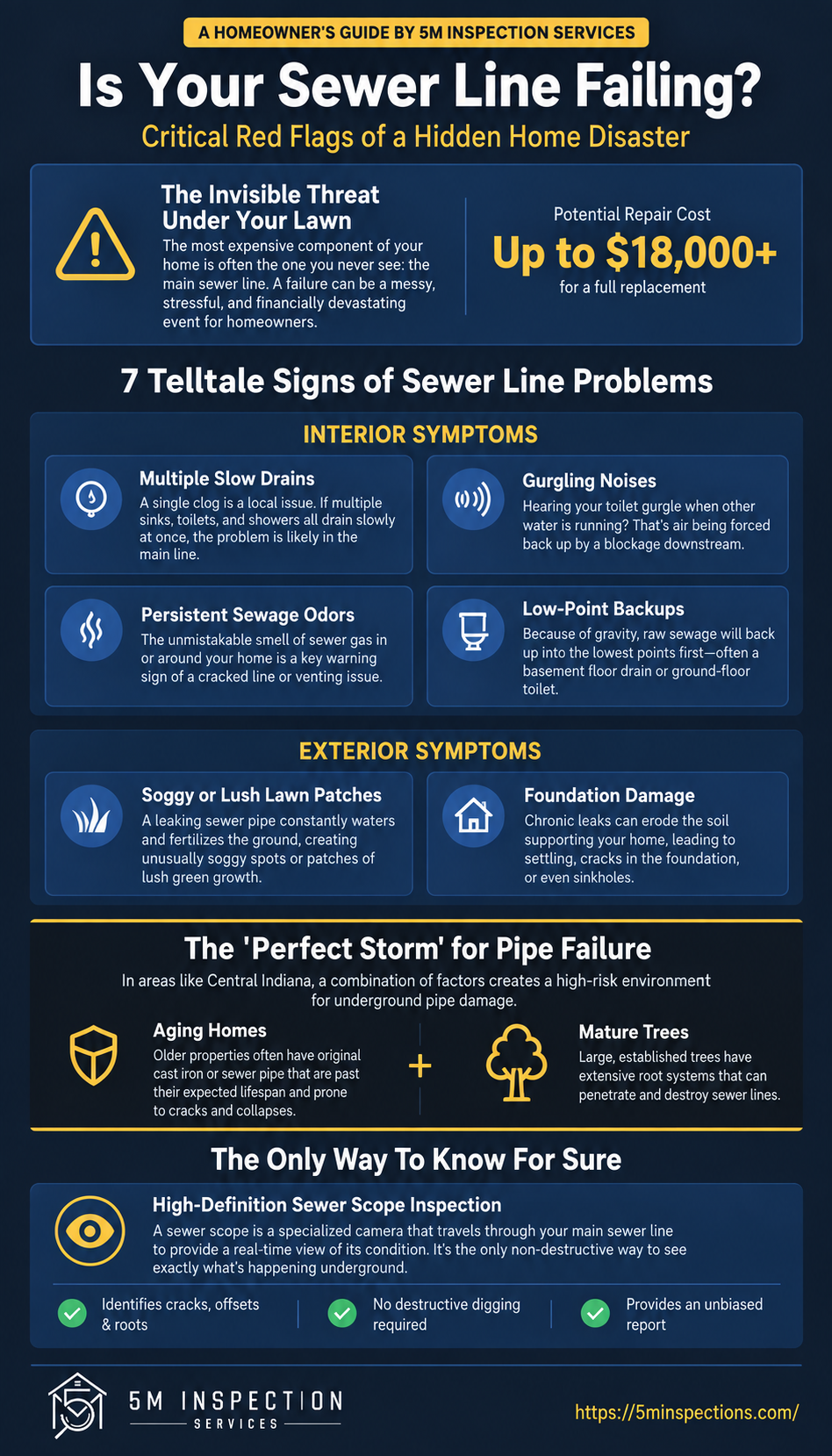
Your home’s plumbing is a complex network, but the main sewer line is the single most important artery in the entire system. It carries every drop of waste away from your property. Because these pipes are buried deep underground, they usually stay “out of sight, out of mind” until a total failure occurs. This hidden nature is exactly what makes them dangerous. You can’t see a hairline crack or a growing root mass until the water stops flowing or the basement floods. It’s a silent risk that requires a proactive eye.
Many homeowners in our community are surprised to learn that a standard home inspection doesn’t include the underground main line. Most inspectors check the fixtures and the visible interior pipes, but they stop once the plumbing exits the foundation. This leaves a massive gap in your knowledge. Sewer repairs are frequently the most expensive “surprise” in real estate, sometimes costing more than a new roof or a complete HVAC overhaul. Understanding the signs of sewer line problems is the first step in protecting your investment and your peace of mind.
Main Line vs. Secondary Clogs
It’s vital to distinguish between a simple localized clog and a systemic main line failure. A slow-draining kitchen sink is usually a local issue caused by grease or food debris. You can often fix these with a plunger or a hand snake. However, if multiple drains across the house are backing up simultaneously, the problem is likely in the main line. This is a systemic issue that requires more than a quick DIY fix.
Localized fixes like chemical cleaners won’t solve a structural problem buried in your yard. These products are designed for organic clogs near the drain, not for pipes that have shifted or collapsed. A sewer lateral is the specific pipe connecting your home’s internal plumbing to the municipal Sanitary sewer system. When this lateral fails, the entire house loses its ability to shed waste, making the home temporarily uninhabitable.
The Cost of Waiting
Small problems underground never stay small. A tiny crack in a pipe joint releases moisture and nutrients that act like a beacon for tree roots. Once a single root tip finds its way inside, it will grow into a dense mass that catches debris and eventually shatters the pipe. Procrastination is the enemy of your bank account in these scenarios.
Waiting too long increases the risk of environmental contamination and foundation damage. Raw sewage leaking near your home can erode the soil, leading to costly structural shifts. Think of early detection as a form of “homeowner insurance.” Identifying signs of sewer line problems today prevents a minor hairline fracture from turning into a ten-thousand-dollar excavation project tomorrow. You deserve the certainty that your home’s foundation is sitting on solid, dry ground.
7 Red Flags: Common Signs of Sewer Line Problems
Your home has a way of communicating when something is wrong deep underground. These signals aren’t always obvious. Sometimes they look like a thriving garden or sound like a simple plumbing quirk. Identifying the signs of sewer line problems early is the best way to protect public health and the environment from the consequences of a major sewage spill. We want to help you catch these issues before they require a backhoe and a massive checkbook.
Interior Symptoms: What You Hear and Smell
When you hear your toilet gurgling while the laundry runs, it’s not a ghost. It’s air trapped by a downstream blockage. As water struggles to pass through a restricted pipe, air is forced back up through the traps. This creates that distinct “bubbling” sound in your sinks or toilets. You should also watch your lowest drains carefully. Because gravity rules the system, backups almost always start at the lowest point in the home, such as a basement floor drain or a downstairs shower.
Smell is another powerful diagnostic tool. Don’t confuse a “rotten egg” odor from a failing water heater with the heavy, damp scent of sewer gas. If you smell sewage in your basement or near your floor drains, the trap may have dried out, or worse, the main line is venting back into your home. This gas is more than just a nuisance; it’s a structural warning that shouldn’t be ignored.
Exterior Symptoms: Yard and Foundation Warnings
The signs of sewer line problems often manifest outside before they cause an interior flood. Your yard can act as a map for what is happening four feet below the surface. Look for these specific changes:
- Lush, Green Patches: If one area of your lawn is suddenly more vibrant than the rest, the pipe below is likely leaking. Sewage is a powerful fertilizer that feeds the grass from beneath.
- Indentations and Sinkholes: A leaking line saturates and washes away the surrounding soil. This causes the ground to settle or even create small sinkholes over the path of the pipe.
- Soggy Spots: Puddles that appear when it hasn’t rained are a major warning. These spots often stay soft or “spongy” even during a dry spell.
- Pest Influx: Rodents and sewer flies are attracted to the organic matter in a leaking line. If you see a sudden increase in insects near your foundation, it’s time for a closer look.
Before you commit to an expensive excavation, it’s wise to get an objective view of the situation. A thorough sewer scope inspection can confirm if these symptoms are a minor clog or a structural failure requiring professional attention.
Why Sewer Lines Fail in Central Indiana
Every region faces unique challenges when it comes to property maintenance. In Central Indiana, our geography and local history play a massive role in the health of our underground infrastructure. From the historic neighborhoods of Indianapolis to the established subdivisions in Carmel, the ground beneath our feet is constantly working against aging pipes. Understanding the signs of sewer line problems requires looking at the specific environmental factors that define our corner of the state. We see these issues daily, and they usually stem from a combination of material fatigue and aggressive local ecology.
The “Age Factor” is the most common culprit. If your home was built before 1980, there is a high probability that your waste system relies on vitrified clay or cast iron. These materials were the industry standard for decades, but they weren’t designed to last forever. Over time, the heavy clay soil common in Indiana puts immense pressure on these pipes. Our soil expands when saturated and contracts during dry spells, a cycle that stresses old pipe joints until they eventually shift or snap. This movement creates “bellies” or sags where waste pools and hardens, leading to recurring blockages that a simple snake cannot fix.
Common Pipe Materials in Indianapolis and Carmel
Vitrified clay pipes are incredibly brittle. While the material itself doesn’t rot, the numerous joints every few feet are prime entry points for roots. Cast iron pipes face a different struggle. They are prone to “channeling,” where the bottom of the pipe slowly corrodes away until waste is flowing directly into the soil beneath the metal. Perhaps the most dangerous material we encounter is Orangeburg. Found in some mid-century Indiana homes, this “tar paper” pipe is essentially layers of wood pulp and coal tar. It lacks structural integrity and frequently collapses into an oval shape, making it impossible to clear or even scope effectively once it begins to fail.
The Role of Mature Landscaping
We all love the canopy of Silver Maples and Oaks that shade our Indiana streets, but their root systems are relentless. It’s a common myth that roots “break” pipes. In reality, they enter through existing microscopic cracks or slightly loose joints to seek out moisture and nutrients. Once inside, the warm, nutrient-rich environment of the sewer line acts as a super-fertilizer.
Tree roots can travel over 50 feet to find a microscopic leak in a sewer line joint. This is why the “greenest grass” in your yard is often directly above a failing joint. The roots are essentially being fed from within. If you notice these specific growth patterns or other signs of sewer line problems, it is a clear signal that your landscaping has successfully breached your plumbing. Catching this early with a professional inspection can be the difference between a localized cleaning and a total system replacement.
The Only Way to Know for Sure: Sewer Scope Inspection
While physical symptoms in your yard or basement are strong indicators, they aren’t definitive. You can’t fix what you can’t see. A sewer scope inspection removes the guesswork by providing a literal inside look at your home’s waste system. This process involves a high-definition, waterproof camera attached to a long, flexible rod. We feed this camera through your home’s cleanout and navigate the entire length of the pipe. The live video feed reveals exactly what is happening underground, from hairline fractures to total collapses. It’s the difference between guessing and knowing.
Many people confuse “snaking” a line with a proper diagnostic. Snaking is a blind process. It uses a metal cable to punch a hole through a blockage to get water moving again. It might solve the immediate symptom, but it doesn’t tell you why the blockage occurred. It could be a simple “soft” clog, or it could be a structural failure that will return next month. Scoping provides the visual evidence required to make an informed decision. For real estate transactions, a video recording is your most powerful tool. It’s hard evidence that can be used to negotiate repairs or credits during the closing process.
When to Order a Sewer Scope
If your home was built more than 20 years ago, a scope is no longer optional; it’s essential maintenance. We also strongly recommend this service if you have mature trees within 50 feet of your main line. Roots are persistent and will travel great distances for water. During a Buyer’s Home Inspection, this is the only way to avoid a post-closing disaster. Don’t inherit someone else’s buried problem because you missed the subtle signs of sewer line problems during your initial walkthrough.
Interpreting the Results
Our reports focus on two major structural issues: bellies and offsets. A “belly” is a sag in the pipe where water and waste pool. Over time, this debris hardens and causes recurring clogs that no amount of chemicals will fix. An “offset” occurs when two sections of pipe no longer line up perfectly. This creates a lip that catches waste and provides an easy entry point for roots. By identifying these specific flaws, you can use our unbiased report to request specific seller credits or professional repairs before you sign the final paperwork. If you’ve noticed any signs of sewer line problems, don’t wait for a backup. Schedule your sewer scope inspection today to get a clear, unbiased look at your home’s most critical infrastructure.
Expert, Unbiased Diagnostics with 5M Inspection Services
When you’re facing the potential for a buried disaster, the last thing you need is a high-pressure sales pitch. Many homeowners make the mistake of calling a repair company to diagnose their pipes. This creates an inherent conflict of interest. A plumber makes money by finding problems that require expensive excavation. At 5M Inspection Services, we take an independent approach to property inspections. We focus on identifying potential issues and providing an accurate, unbiased assessment without offering repair services. That means our recommendations are based on what we find, not on selling you additional work.
As a family-owned business, Chris and Morgan Markham built 5M Inspection Services on the values of honesty, professional integrity, and personal service for homeowners throughout Central Indiana. We understand the specific challenges facing homes in Westfield, Indianapolis, Carmel, and Fishers. Our meticulous approach ensures that every inch of your main line is scrutinized. If you’ve observed signs of sewer line problems, you deserve a report that is as unbiased as it is thorough. We deliver our findings through fast, digital reporting that gives you the evidence needed to make an informed decision without the stress of a sales quota hanging over the conversation.
The Advantage of an Unbiased Sewer Scope
You should never have your diagnostic work performed by the person who stands to profit from the repair. Our high-resolution camera equipment provides clear, undeniable evidence of your pipe’s interior. We aren’t looking for ways to inflate a bill; we’re looking for the truth. This objective third-party evaluation offers genuine peace of mind. You’ll receive a detailed video recording and a professional summary that identifies exactly where issues exist, or confirms that your system is functioning as intended. It’s about certainty, not a sales pitch.
Protecting Your Investment in Central Indiana
Sewer health is closely tied to other critical systems in your home. A leaking line can quickly compromise your foundation health, leading to structural shifts and moisture intrusion. We look at the big picture of your property’s safety. For a deeper dive into the technical aspects of maintenance and what to expect during the process, explore our Sewer Inspection Guide. Don’t let the hidden signs of sewer line problems turn into a financial catastrophe. Protect your future home and your family’s security with a professional, unbiased sewer scope today.
Secure Your Property with Professional Certainty
Your home is likely your largest investment, and protecting it means looking beyond the walls and under the ground. Recognizing the early signs of sewer line problems is the only way to prevent a minor pipe issue from escalating into a multi-thousand dollar buried disaster. Whether you’ve noticed lush patches in the lawn or suspicious gurgling in the pipes, the next step is obtaining a definitive answer through high-resolution video diagnostics. You deserve to know the exact state of your infrastructure without the pressure of a repair estimate.
Since 2019, 5M Inspection Services has helped homeowners across Central Indiana make informed decisions about their properties. As a family-owned business run by Chris and Morgan Markham, we put your safety and peace of mind first. Because we don’t offer repair services, you can count on us for honest, unbiased assessments focused on your property’s condition, not on selling additional work. Avoid costly surprises, such as unexpected excavation work, by understanding your property’s condition before problems get worse. With clear findings and expert insight, you’ll have the information you need to make informed decisions and protect your investment.
Schedule Your Unbiased Sewer Scope Inspection with 5M Today and ensure your home’s infrastructure is built to last. We are ready to help you move forward with confidence and clarity.
Frequently Asked Questions
Is a sewer scope inspection worth it for a new construction home?
Yes, it’s a critical safeguard for new builds. Heavy machinery used during construction can easily crush buried pipes, and it’s common for tradespeople to accidentally wash construction debris like concrete or drywall mud down the drains. Identifying these defects while your builder is still under warranty ensures the repair isn’t your financial responsibility.
How much does a typical sewer line repair cost in Indianapolis?
Repair costs in Indiana typically range from $2,700 to over $18,000 depending on the depth of the pipe and the repair method used. In Indianapolis, trenchless sewer line replacement averages around $2,775, though complex projects involving deep excavation or long distances can reach much higher figures. These costs highlight why early detection is so vital for homeowners.
Can tree roots be removed without replacing the entire sewer line?
You can temporarily clear roots using methods like hydro-jetting or mechanical snaking, but this is not a permanent solution. Because roots enter through existing structural cracks or loose joints, they will inevitably grow back. To stop the cycle, the pipe usually requires structural repair or a trenchless lining to seal the entry points permanently.
What happens if I ignore the signs of a sewer line problem?
Ignoring the signs of sewer line problems often leads to a catastrophic sewage backup into your living space. Beyond the immediate mess, leaking sewage can erode the soil beneath your home, leading to foundation instability. With over 50,000 sewer overflows occurring annually in the U.S., proactive maintenance is the only way to prevent becoming a statistic.
Does homeowners insurance cover a collapsed sewer line?
Standard homeowner’s insurance policies in Indiana generally do not cover the cost of sewer line replacement. Most carriers view this as a maintenance issue rather than a sudden peril. However, many residents now opt for a specific “service-line endorsement” for an additional premium, which can provide coverage for these specific underground failures.
How long does a sewer scope inspection take to complete?
A professional sewer scope usually takes between 30 and 60 minutes to complete. This timeframe allows the inspector to locate the cleanout, navigate the camera through the entire lateral line to the municipal main, and record high-definition footage. You’ll typically receive a digital report and video link shortly after the process is finished.
Can I perform a sewer inspection myself with a rented camera?
While you can rent equipment, it’s rarely effective for diagnostic purposes. Rental cameras often lack the high-definition resolution and self-leveling features needed to identify hairline cracks or subtle “bellies.” Furthermore, an untrained eye might miss the signs of sewer line problems that an experienced, unbiased inspector would catch instantly.
What is the most common cause of sewer failure in Carmel, Indiana?
The primary cause of failure in Carmel is the combination of aging clay pipes and heavy clay soil. Indiana’s soil expands and contracts significantly with moisture changes, which puts immense physical stress on brittle pipe joints. Once a joint shifts, the mature root systems of local Oaks and Maples quickly invade the line to seek out moisture.