In Central Indiana, an underground sewer line is often a ticking clock where the absence of current backups doesn’t equal a clean bill of health. You’re likely asking yourself, “do I need a sewer scope inspection for an older home if the drains seem to be working fine right now?” It’s a fair question. Between standard inspection fees and closing costs, the last thing you want is another “add-on” service that feels like an unnecessary upcharge. You want to protect your family’s future budget from a $10,000 surprise the week after you move in.
We believe that certainty is the only way to truly enjoy your new home. We’ve seen how Indiana’s clay-heavy soil and harsh freeze-thaw cycles can crush older cast iron or clay pipes without warning. This guide will show you why a sewer camera is your most vital line of defense against hidden structural failures. You’ll discover the specific criteria for ordering a scope, the common pipe materials that fail in our local neighborhoods, and how to move toward your closing date with absolute confidence in your investment.
Key Takeaways
- Learn why standard home inspections only check for immediate drainage and why they can’t detect the structural integrity of your underground pipes.
- When asking “do I need a sewer scope inspection for an older home,” consider the unique pressure Indiana’s heavy clay soil and freeze-thaw cycles place on aging infrastructure.
- Identify the specific failure points of common local materials like clay tile and cast iron, from joint separation to channel corrosion.
- Understand the significant return on investment when comparing a one-time inspection fee to the high costs of emergency excavation and mold remediation.
- Discover the step-by-step process of a high-definition camera run, including how we access your system to provide absolute certainty before you close.
What is a Sewer Scope Inspection and Why is it Critical for Older Homes?
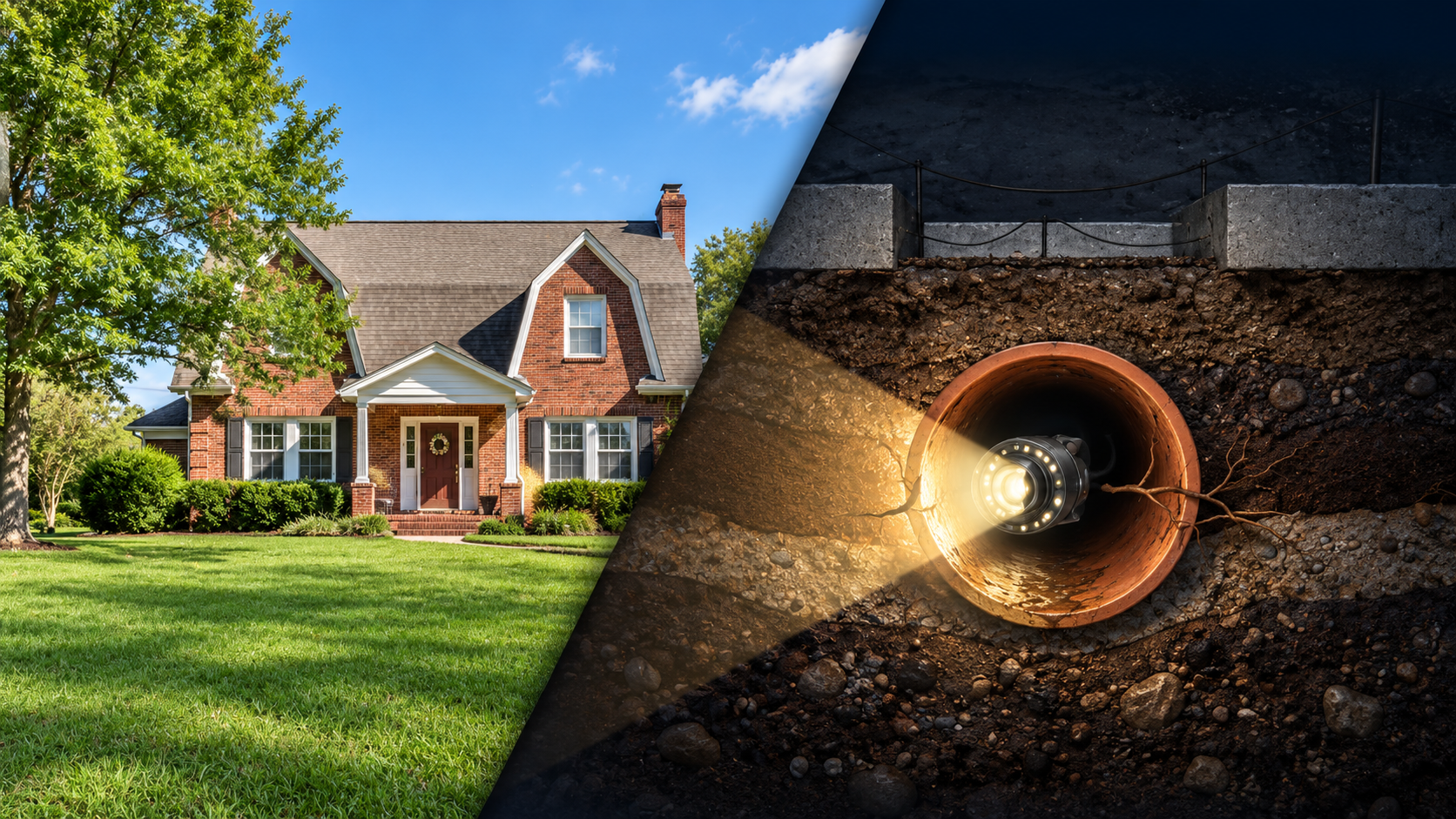
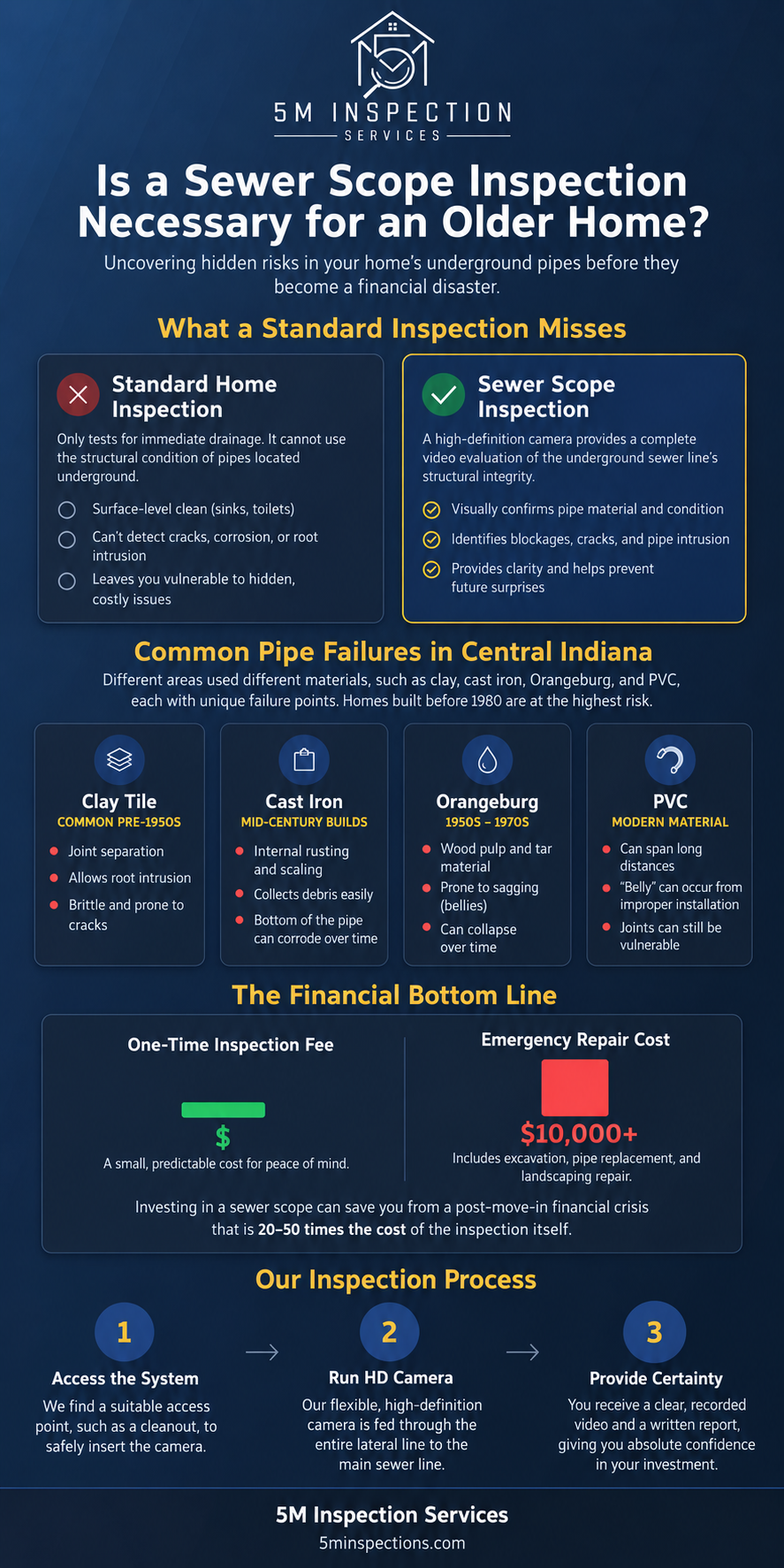
A sewer scope inspection is a high-definition video evaluation of the lateral sewer line. This specialized service involves feeding a flexible, waterproof camera through your home’s waste pipes to examine the path leading from the house to the municipal main or septic tank. While a standard home inspection is thorough, it has a physical limit. Your inspector will flush toilets and run sinks to ensure the water disappears, but they cannot see the structural integrity of the pipes buried deep beneath your lawn. This is where most multi-thousand dollar disasters hide.
Many buyers in our community ask, “do I need a sewer scope inspection for an older home if everything seems to be draining?” The answer is almost always yes, particularly for properties built before 1980. This era marks a significant threshold in construction history. It was the turning point when builders began moving away from rigid, brittle materials like clay and cast iron toward modern PVC. At 5M Inspection Services, we use professional borescope technology to see through this “unseen” infrastructure, providing you with a clear, recorded view of the pipe walls and joints before you sign the closing papers.
The Gap Between “Working” and “Failing”
A sewer line can drain perfectly today while being on the verge of a total structural collapse. Water is incredibly patient; it can still flow through a pipe that is 75% obstructed by aggressive tree roots or one that has a massive crack along the bottom channel. You should understand the difference between a simple clog, which is a minor maintenance issue, and a collapsed pipe wall, which is a major construction project. It is vital to remember that the lateral line is the homeowner’s responsibility, not the city’s, meaning any failure under your yard is your bill to pay.
When “Old” Becomes a Liability
Indiana’s architectural history is beautiful, but its underground history is complex. Pre-1950s homes in areas like Indianapolis or Carmel almost always feature clay tile pipes. These were built in sections, and as our heavy soil shifts, those joints can separate and allow roots to enter. Homes built in the 1970s and 1980s are often the most deceptive. They might look updated on the surface, but they frequently utilize transitional materials that are now reaching the end of their functional lifespan. If you want to dive deeper into the technical specs of these materials, you can read our complete guide to sewer inspections. We’ve seen too many Central Indiana buyers skip this step only to face an excavation bill that dwarfs the cost of the inspection itself.
Common Pipe Materials and Failures in Central Indiana
When you ask, “do I need a sewer scope inspection for an older home,” the answer is often found in the specific material buried in your yard. Central Indiana’s housing stock is a timeline of plumbing evolution. Each era brought new materials, and each material has its own unique failure profile. Understanding what’s under your lawn is the first step in avoiding a massive post-closing repair bill. Research on the reasons for sewer line failure shows that material age and environmental stress are the primary drivers of system collapse.
- Clay Tile: Standard for pre-1950s homes, these pipes are incredibly durable but were installed in short sections. Over time, the joints separate, allowing soil and roots to enter the system.
- Cast Iron: Common in mid-century builds, these pipes suffer from “scaling,” where the interior rusts and creates a rough surface that catches debris. Eventually, the bottom channel can corrode away entirely.
- Orangeburg (Bituminous Fiber): Found in many 1950s through 1970s Indiana suburbs, this “no-man’s land” piping is essentially layers of wood pulp sealed with tar. It’s prone to flattening under the weight of our heavy soil.
- PVC: While modern and rust-proof, even plastic lines can fail. Poor bedding during installation or significant soil shifts can cause these rigid pipes to snap or “belly.”
If you’re unsure what material your prospective home uses, a Sewer Scope Inspection can provide an immediate, visual answer.
Root Intrusion: The Silent Destroyer
Established neighborhoods in areas like Indianapolis, Carmel, and Fishers are famous for their mature Silver Maples and Oaks. These trees have aggressive root systems that seek out the moisture and nutrients found in sewer joints. While hair-like roots are common and often cleanable, they can quickly grow into structural root masses that crack pipe walls. Once roots have breached the pipe, chemical “root killers” act as a temporary bandage. They don’t fix the structural wound that allowed the entry in the first place.
Bellies and Offsets
A “belly” occurs when a section of pipe sags, creating a low point where standing water and waste collect. This is frequently caused by Central Indiana’s clay-heavy soil settling or eroding over decades. An “offset” happens when two sections of pipe no longer align, creating a sharp edge that catches toilet paper and solids. Soil heaving in winter often causes these shifts. When these misalignments occur, it’s only a matter of time before a total backup happens. You don’t want to discover an offset during your first week of homeownership.
The ROI of a Sewer Scope: Inspection vs. Repair Costs
Investing in a specialized camera evaluation is fundamentally about risk mitigation. When people ask “do I need a sewer scope inspection for an older home,” they’re often weighing a small upfront cost against a potential financial catastrophe. In Indianapolis, the average traditional sewer line replacement can cost around $8,400. If you encounter a “belly” or a significant sag in the pipe, those specific repairs typically range between $3,500 and $8,500. Comparing these thousands of dollars in potential liability to the cost of a one-time inspection makes the decision a matter of simple math.
The financial impact of a sewer failure extends far beyond the plumbing itself. A main line backup doesn’t just stop your drains; it often sends raw sewage into your lowest living spaces. You’re then looking at emergency flooring replacement, professional sanitization, and potentially expensive mold remediation. These hidden costs can easily double the price of the physical pipe repair. Additionally, many “Sewer Backup” insurance riders have specific clauses that require proof of maintenance. They may deny coverage if the failure was caused by long-term root intrusion or age-related deterioration that existed before your policy started. A clean inspection report provides the documentation you need to ensure your coverage is actually valid.
Negotiation Leverage for Buyers
A sewer scope report is one of the most powerful tools you can bring to the closing table. High-definition video evidence of a cracked pipe or a separated joint is objective and undeniable. It moves the conversation from a vague worry to a documented structural failure that needs immediate attention. You can use this data to request that the seller performs the repairs before closing or provides a financial credit so you can handle it yourself. Most sellers are genuinely unaware of these deep-earth issues. If you’re on the other side of the fence, check out our pre-listing inspection guide to see why smart sellers scope their lines before hitting the market.
The “No Signs” Fallacy
The most common objection we hear is that the drains are working fine today. This is a dangerous assumption for an older property. Pipes don’t always fail suddenly; they deteriorate over decades. A partial collapse or a heavy root mass can allow water to pass for years while catching just enough debris to eventually cause a total, messy blockage. By the time you see signs like gurgling toilets or slow drains, the damage is already done. There is a profound psychological peace of mind that comes from seeing the interior of your main line. You can move into your new home knowing that your foundation and your budget are both secure.
Central Indiana Environmental Factors: Soil and Trees
Central Indiana presents a unique set of geological challenges that directly impact the longevity of underground utilities. When you ask, “do I need a sewer scope inspection for an older home,” you aren’t just checking the age of the pipe. You’re checking how that pipe has survived decades of Indiana’s aggressive environmental stressors. Our region is defined by heavy, expansive clay soil that behaves differently than the sandy or loamy soils found in other parts of the country. This soil expands significantly when wet and contracts during our dry summer months, creating a constant cycle of movement around your buried infrastructure.
Expansive clay acts like a slow-motion hydraulic press on clay pipes. Over time, this relentless pressure can snap rigid pipe sections or force joints to separate. Our local climate adds another layer of stress with intense freeze-thaw cycles. Indianapolis winters are harder on underground infrastructure than southern climates because the frost line reaches deeper into the earth. As the ground freezes and thaws, it heaves. This movement can easily misalign older pipes that lack the flexibility of modern materials. You also need to consider the municipal responsibility split. In Indianapolis, the Department of Public Works (DPW) maintains the main sewer lines, but the lateral line from your house to that main is entirely your responsibility.
Soil Shifting in New and Old Neighborhoods
Settling isn’t a problem exclusive to century-old homes in Meridian-Kessler. Even in newer developments in Fishers or Noblesville, soil shifting can occur shortly after construction. Heavy rain seasons can saturate the ground, causing recently disturbed soil to settle unevenly. If a line wasn’t bedded perfectly in gravel, this shifting can create “bellies” or offsets in a matter of months. We’ve performed inspections on homes less than five years old that already showed signs of significant pipe stress due to local soil conditions. If you want to ensure your home is structurally sound from the ground up, schedule your sewer scope inspection today.
Landscaping Red Flags
Your yard often provides visual clues about what is happening six feet underground. In established neighborhoods like Carmel and Westfield, mature Silver Maples and Oaks are common. These species have incredibly thirsty, aggressive root systems that can sense the moisture leaking from a tiny pipe crack. A lush, green patch of grass in a dry Indiana summer is a warning sign rather than a point of pride. It often indicates that your sewer line is leaking nutrient-rich water into the soil, essentially “fertilizing” that specific area. These landscaping issues are frequently linked to broader property concerns, which is why we often recommend pairing a scope with foundation inspections. When soil is wet enough to attract roots, it’s often wet enough to threaten your foundation’s stability.
What to Expect During Your 5M Sewer Scope Inspection
When you’ve decided the answer to “do I need a sewer scope inspection for an older home” is a firm yes, the next step is understanding the mechanics of the visit. Our process is designed to be efficient, transparent, and non-invasive. We begin by locating the primary access point, known as the cleanout. In Central Indiana homes, this is typically found in the basement near the floor drain, inside a crawlspace, or as a vertical PVC pipe in the yard. If a cleanout isn’t readily available, we can often access the system through a roof vent or by temporarily removing a toilet, ensuring we get the view we need without damaging the property.
Once access is established, the camera run begins. We feed a high-definition, waterproof camera through the lateral line, following the exact path your waste takes to reach the municipal tap or septic tank. This isn’t just a blind probe; our equipment provides a real-time video feed that allows us to see every joint, crack, and root intrusion along the way. Our team don’t just record the footage; we explain the findings as they appear on the screen. You’ll see exactly what we see, which allows you to ask questions and understand the health of your infrastructure in the moment.
After the physical inspection is complete, you won’t be left waiting for answers. We provide a comprehensive final report, including a link to the full video recording and a written summary of our findings, within 24 hours. This speed is critical in a fast-moving real estate market where inspection response deadlines are often tight. You’ll have the objective data you need to make an informed decision or negotiate repairs before the clock runs out.
The 5M Professional Standard
We take pride in our role as unbiased, third-party evaluators. Because 5M Inspection Services does not perform sewer repairs, we have no financial incentive to “find” problems that don’t exist. Our family-owned approach is built on professional integrity and local accountability. We provide a rigorous technical assessment that protects your interests, not a sales pitch for excavation services. This commitment to honesty is why we are consistently recognized among the top-rated home inspectors in Westfield and Indianapolis. We’re here to be your protective partner in the home-buying process.
Next Steps if an Issue is Found
If our camera uncovers a problem, don’t panic. Not every finding requires a backhoe and a five-figure check. We help you distinguish between “minor” issues, like hair-like roots that can be cleared with routine hydro-jetting, and “major” structural failures like collapsed Orangeburg or severe offsets. We’ll provide clear recommendations on whether the line simply needs a professional cleaning or if you need to consult a licensed plumber for structural repair. Ready to protect your investment? Schedule your sewer scope with 5M Inspection Services today and get the certainty you deserve.
Secure Your Investment Below the Surface
Your future home is more than just the walls and roof you see during a walkthrough. It’s a complex system of infrastructure that must withstand Central Indiana’s aggressive clay soil and punishing winters. We’ve explored how aging materials like clay tile and cast iron are prone to silent failures that a standard home inspection simply cannot detect. By the time you notice a backup, you’re often already facing a repair bill that could have been a negotiation point before closing.
If you’re wondering whether you need a sewer scope inspection for an older home, it’s worth considering the potential cost of hidden sewer line problems. At 5M Inspection Services, family-owned and operated by Chris and Morgan Markham, we help you make informed decisions with clear, reliable findings. Backed by over 200 five-star reviews across Central Indiana, we provide high-definition video reports within 24 hours, giving you a closer look at your sewer line’s condition. Don’t let an unexpected pipe problem turn your dream home into a costly headache.
Protect your home from buried disasters—Book your Sewer Scope with 5M Inspection Services. We look forward to helping you make a truly informed decision about your next property.
Frequently Asked Questions
Does a standard home inspection include a sewer scope?
A standard home inspection does not include a sewer scope. Your inspector will run water and flush toilets to ensure the interior drains function, but they cannot see the structural condition of the buried lateral line. To identify cracks, root intrusion, or collapsed sections under your lawn, you must order a specialized camera evaluation as a separate service.
How much does a sewer scope inspection cost in Indianapolis?
A standard sewer scope inspection in the Indianapolis area typically costs between $159 and $500. This price varies based on how the inspector accesses the system, such as through a ground-level cleanout, a roof vent, or by temporarily removing a toilet. While this is an additional fee, it’s a small investment compared to the thousands of dollars required for emergency pipe excavation.
How long does a sewer scope inspection take?
Most sewer scope inspections are completed within 30 to 60 minutes. The total time depends on the length of the lateral line and the ease of access to the cleanout. During this window, the inspector feeds the camera to the city main or septic tank while recording high-definition footage. You’ll receive a detailed report and the full video link within 24 hours.
What happens if the inspector finds tree roots in the line?
If tree roots are discovered, the next step depends entirely on the severity of the intrusion. Hair-like roots can often be cleared with professional hydro-jetting or mechanical cleaning. However, thick root masses often indicate that the pipe joints have already separated or the walls have cracked. In these cases, we recommend a consultation with a licensed plumber to evaluate if a structural repair is necessary.
Can I do a DIY sewer inspection with a rented camera?
We don’t recommend attempting a DIY sewer inspection with a rented camera. Professional-grade borescopes provide high-definition clarity and self-leveling heads that rental units often lack. More importantly, an experienced inspector knows how to identify the subtle differences between harmless debris and a catastrophic structural failure. You’re paying for an unbiased expert’s interpretation of the footage, not just the equipment.
Is a sewer scope necessary for a home that is only 20 years old?
Yes, a sewer scope is still highly recommended for homes built within the last 20 years. While newer PVC pipes don’t rust like cast iron, they are still susceptible to “bellies” or offsets caused by Central Indiana’s heavy, shifting clay soil. Even if you don’t think you need a sewer scope inspection for an older home, discovering a crushed plastic line before closing can save you from an unexpected repair bill.
What is the most common cause of sewer line failure in Central Indiana?
Tree root intrusion is the most common cause of sewer line failure in Central Indiana. Aggressive root systems from local Silver Maples and Oaks seek out moisture in pipe joints, eventually causing blockages and structural cracks. This issue is often exacerbated by our region’s clay-heavy soil, which expands and contracts with the seasons, putting immense pressure on buried pipes and forcing joints to separate.
Will a sewer scope find issues with the septic system?
A sewer scope will identify issues in the lateral line leading to the septic tank, but it is not a substitute for a full septic inspection. The camera can find clogs, cracks, or collapses in the pipe, but it cannot evaluate the health of the septic tank itself or the condition of the leach field. For properties with on-site sewage systems, we recommend both a scope and a specialized septic evaluation.