An estimated 1 in 3 homes in Indiana has elevated radon levels, making a “high” reading much more common than most homeowners realize. If you just received a report with a number at or above 4.0, you’re likely asking: what do high radon test results mean for my family’s safety and my real estate transaction? It’s natural to feel a surge of anxiety about lung cancer risks or the possibility of a home purchase falling apart. However, a high reading is a solvable maintenance issue, not a reason to walk away from a property.
We know that technical jargon like “picocuries” and “action levels” can feel overwhelming when you’re trying to protect your kids and your investment. You deserve clear answers and a straightforward path forward. This guide will help you decode your specific radon readings and explain the health implications based on current EPA standards. We’ll show you how to resolve high levels effectively so you can move forward with your real estate deal with confidence. You’ll learn exactly how mitigation works in Indiana and how to negotiate these results without losing the home you love.
Key Takeaways
- Learn exactly what do high radon test results mean by decoding the EPA’s 4.0 pCi/L action level and its implications for your family’s safety.
- Discover why Central Indiana counties like Hamilton, Marion, and Boone are designated high-risk zones due to the region’s specific glacial soil.
- Understand why high radon is a solvable maintenance issue rather than a reason to walk away from a real estate deal.
- Explore how Active Soil Depressurization (ASD) works to create a permanent, low-pressure safety zone under your home’s slab.
- Recognize the accuracy advantages of using professional continuous monitors over standard hardware store DIY kits for your property assessment.
Understanding Your Radon Test Results: The pCi/L Breakdown
Radon measurements are expressed in picocuries per liter, abbreviated as pCi/L. To understand What is Radon?, you have to look at the way radioactive elements break down in the soil beneath your home. A picocurie represents the rate of radioactive decay. Specifically, it is one-trillionth of a Curie. When you ask what do high radon test results mean, you’re looking at the concentration of these radioactive alpha particles in every liter of air your family breathes. In Indiana, where the soil is rich in uranium, these numbers provide a vital health diagnostic for your property.
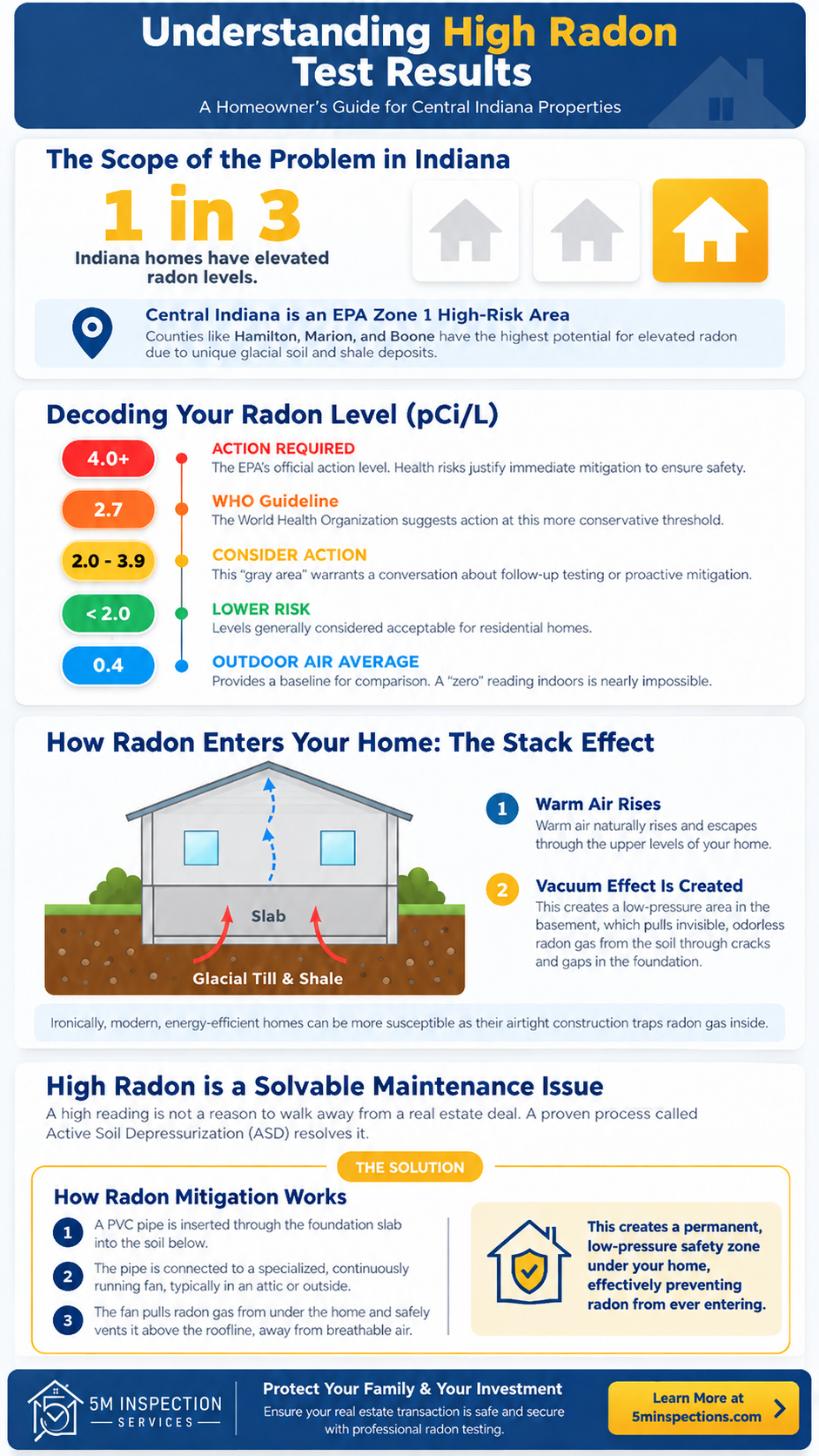
The U.S. Environmental Protection Agency (EPA) established 4.0 pCi/L as the official Action Level for residential properties. This number isn’t a random choice; it’s a practical benchmark where the health risks justify the immediate need for a mitigation system. It’s worth noting that the World Health Organization (WHO) suggests a more conservative threshold of 2.7 pCi/L to further minimize long-term lung cancer risks. While any exposure carries some risk, the EPA mandates that 4.0 pCi/L is the specific point where homeowners must implement professional mitigation to ensure residential safety.
What is a “Safe” Level of Radon?
Scientifically, there is no such thing as a completely safe level of radiation. However, in the context of home ownership, levels below 2.0 pCi/L are generally considered acceptable and manageable. For a clear perspective, consider that outdoor air typically averages around 0.4 pCi/L. Because of the unique geological makeup of Indiana, achieving a “zero” reading in a basement or crawlspace is nearly impossible. Our goal is to reduce your indoor levels as close to the outdoor background level as possible. We prioritize your family’s security by aiming for the lowest achievable number through modern, reliable testing and mitigation strategies.
Short-Term vs. Long-Term Test Variations
Most real estate transactions utilize a 48-hour short-term test to keep the deal moving quickly. You should view this result as a snapshot of current conditions rather than a permanent average. Radon levels are fluid and can fluctuate based on several environmental factors. When you’re trying to determine what do high radon test results mean during a home purchase, remember that these variables can spike a reading:
- Heavy rain or saturated soil that forces gas into the home.
- Rapid drops in barometric pressure.
- Strict “closed-house” conditions where windows and doors remain shut for days.
If your initial test results land in the “gray area” between 2.0 and 4.0 pCi/L, we often recommend follow-up testing. A long-term test, which stays in the home for 90 days or more, provides a more accurate average of your actual exposure across different seasons and weather patterns.
Why Radon is Prevalent in Central Indiana Homes
Indiana’s landscape is beautiful, but the soil carries a hidden geological legacy that impacts every homeowner. If you are looking at a report from a local lab and wondering what do high radon test results mean, you first need to look at the ground beneath your foundation. Hamilton, Marion, and Boone counties are all designated as EPA Zone 1. This classification means these areas have the highest potential for elevated radon levels in the entire country. The primary culprits are glacial till and shale deposits left behind thousands of years ago. These materials contain trace amounts of uranium that naturally decay into radon gas, which then migrates upward toward your living space.
Understanding what do high radon test results mean also requires recognizing that your home’s construction style plays a huge role in how much gas is trapped inside. Your house essentially acts like a giant vacuum. Through a process called the “Stack Effect,” warm air rises and escapes through upper floors and the attic. This creates a low-pressure zone at the lowest level of your home, which literally sucks radon gas out of the soil through cracks in the slab, gaps around service pipes, and sump pits. Ironically, modern, energy-efficient homes are often the most susceptible. While “tight” construction is great for your utility bills, it prevents the house from “breathing,” which can cause radon concentrations to build up to dangerous levels much faster than in older, draftier homes.
If you’re moving into one of these high-risk counties, scheduling a professional Radon Testing service is the only way to confirm if these geological factors are affecting your indoor air quality.
The Geology of Carmel, Fishers, and Westfield
Suburbs on the Northside of Indianapolis, including Carmel, Fishers, and Westfield, often see some of the highest radon readings in the state. This is due to specific pockets of uranium-rich soil that aren’t distributed evenly. You cannot rely on a neighbor’s test results to gauge your own risk. Soil composition can change drastically within just a few feet; one house may have a reading of 1.2 pCi/L while the house next door hits 12.0 pCi/L. While many new construction homes in these areas include passive radon pipes, these systems lack a fan and often aren’t enough to keep levels below the action threshold on their own.
Health Risks: Why High Results Demand Action
The health implications of radon are serious but manageable. According to the EPA, radon is the second leading cause of lung cancer in the United States, surpassed only by smoking. There is also a significant synergistic effect to consider: if you or a family member smokes, the risk of developing lung cancer from radon exposure increases nearly tenfold. We want to reassure you that the danger is cumulative. A high test result doesn’t mean your family is in immediate peril today; rather, it indicates a long-term risk that develops over years of exposure. Identifying the problem now allows you to take corrective action before that cumulative risk becomes a reality.
High Radon and Real Estate: Should You Walk Away?
When that report comes back with an elevated number, the first instinct for many buyers is to walk away. Don’t let a number on a page scare you out of a home you love. In the world of real estate, a high reading is a data point, not a “failed” inspection. Unlike structural foundation cracks that require expensive piering or extensive mold growth that involves tearing out walls, radon is remarkably easy to fix. It is one of the most predictable environmental hazards to remediate. Sellers in the Indianapolis area are often already aware of this risk. Many proactive homeowners even prepare for these results by reading our guide on Beyond the App: The Ultimate Pre-Listing Inspect Check. Under Indiana real estate contracts, you have a specific “Inspection Response” window to address these findings. This timeline is your opportunity to request a resolution. If you understand what do high radon test results mean in a legal context, you know they are simply a request for a repair, much like asking for a leaky faucet to be fixed.
Negotiating Mitigation Credits in Indianapolis
You have two main paths when negotiating a high radon result. You can ask the seller to install a system before you move in, or you can request a financial credit at closing. We usually suggest the credit. When you choose the contractor yourself after you own the home, you ensure the work meets your standards. It also ensures the warranty is in your name from day one. To make this request stick, you need a professional radon testing Carmel Indiana report. A certified report from a local expert provides the objective evidence needed to justify a price reduction or credit. It turns an emotional argument into a factual business decision. Most sellers are willing to negotiate because once a high level is disclosed, they must reveal it to any future buyer anyway. This gives you significant leverage to ensure the home is safe before your family moves in.
When High Radon Might Be a Deal-Breaker
While 99% of homes are easily mitigated, there are rare exceptions where the complexity might give you pause. If a home has a complex foundation with multiple additions or a large, open dirt crawlspace, the effort required for mitigation can be higher than average. These “difficult” foundations require more extensive piping, multiple suction points, and stronger fans to be effective. You should also consider the aesthetics of system placement in homes with finished basements where running pipe might be more intrusive. However, even in these complex cases, the issue is almost always solvable. When asking what do high radon test results mean for your specific deal, the only real reason to walk away is if the seller refuses to negotiate or if the structural layout makes the mitigation system’s placement impossible without major renovation. In almost every other scenario, you can stay in the deal and protect your family’s health simultaneously.
The Radon Mitigation Process: Turning High to Low
Once you understand what do high radon test results mean for your family’s health, it is time to pivot toward a solution. In Central Indiana, the gold standard for fixing this issue is Active Soil Depressurization (ASD). This isn’t just a simple vent pipe; it’s a mechanical system designed to change the pressure dynamics of your property. A specialized fan runs 24/7 to create a permanent low-pressure zone beneath your concrete slab or crawlspace liner. By making the pressure under the house lower than the pressure inside the house, the system pulls the gas into the PVC stack before it ever enters your living room.
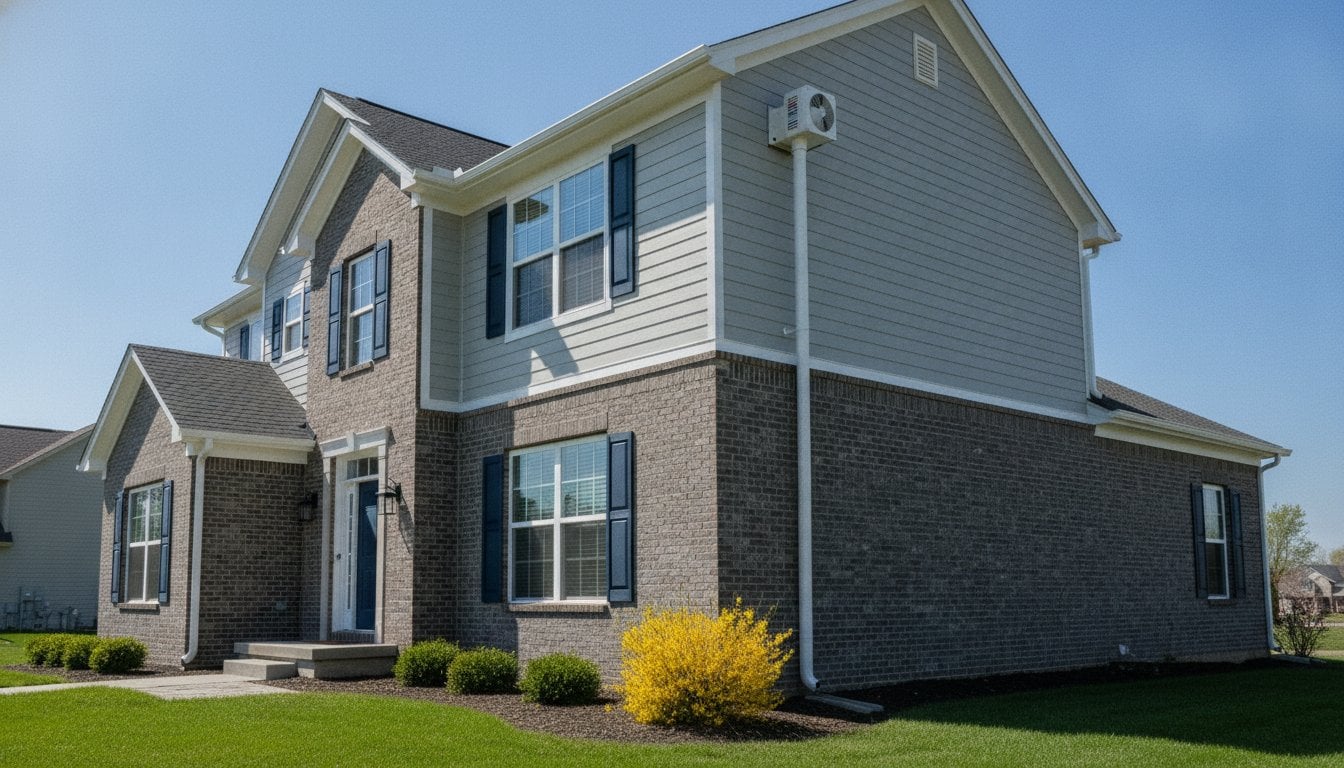
You’ll recognize these systems by the white PVC vent stack running up the side of the house or through the attic to the roofline. Inside the basement or near the suction point, you’ll see a small U-tube manometer. This pressure gauge is your daily visual confirmation that the system is active. If the liquid levels in the tube are uneven, the fan is successfully pulling a vacuum. If they’re level, the system needs professional service. In 2026, homeowners in the Indianapolis area typically see professional mitigation costs range between $800 and $1,200, depending on the home’s size and foundation complexity.
How an ASD System Works
The installation is usually a one-day process. First, the technician drills a suction pit through the slab, removing a small amount of soil to create a “void” where gas can collect. Next, they route a three or four-inch PVC vent pipe from that pit to the exterior or up through the attic. Finally, they install the specialized radon fan. This fan doesn’t move air out of your house; it moves gas from under your house directly to the outside air, where it safely dissipates into the atmosphere.
Post-Mitigation Testing: The Crucial Final Step
Your job isn’t finished once the fan is spinning. You must re-test the home within 24 to 72 hours of installation to prove the system is effective. Indiana standards require an independent test to verify that the levels have dropped below the 4.0 pCi/L threshold. You shouldn’t rely on the word of the person who installed the system to tell you it’s safe. 5M Inspection Services provides independent verification to ensure your system was installed correctly and is actually protecting your family. If you need to verify your home’s safety after a repair, schedule your Radon Testing with a team that has no conflict of interest.
Professional Radon Testing with 5M Inspection Services
When you’re standing in your potential new home, the last thing you want is a generic answer to a serious health question. While big-box retailers sell DIY charcoal canisters, these kits often provide a single, unreliable average that doesn’t tell the whole story. If you want to truly understand what do high radon test results mean for your specific property, you need the precision of a professional continuous electronic monitor. At 5M Inspection Services, we are a family-owned, local Central Indiana business. We treat your family’s safety with the same rigor we would our own. Our team uses tamper-resistant protocols specifically designed for the high-stakes environment of a real estate transaction. This ensures that the data you receive is objective, accurate, and reflects the true conditions of the home. For more insights on how we support local buyers, check out our guide to Top-Rated Home Inspectors in Westfield & Indianapolis.
Our Meticulous Testing Methodology
We don’t just set a device and walk away. Our calibrated electronic monitors track radon concentrations every hour for a minimum of 48 hours. This allows us to see how levels fluctuate with the time of day and barometric pressure changes. We also analyze humidity and temperature alongside radon levels. This extra layer of data helps us identify if “closed-house” conditions were maintained or if external factors skewed the results. We know that real estate deals move fast, so we commit to delivering your comprehensive report within 24 hours of the test completion. You get the facts you need exactly when you need them.
Protecting Your Family’s Future
Hiring a certified professional provides the peace of mind that a hardware store kit simply can’t match. We don’t just hand you a number and leave you to guess what do high radon test results mean for your next steps. Our experts help you interpret the data, explaining the severity of the reading in the context of Indiana’s unique geology. If mitigation is required, we provide trusted local referrals to licensed contractors who can install the ASD systems we discussed earlier. We stand with you as a protective partner throughout the entire inspection process. Schedule your professional radon test with 5M Inspection Services today.
Secure Your Home’s Air Quality Today
Understanding what do high radon test results mean is the first step toward a safer living environment for your family. We’ve explored how Central Indiana’s unique soil makes elevated levels common; however, professional mitigation can reliably lower those numbers. Whether you’re in the middle of a real estate deal or just want peace of mind in your current home, remember that high radon is a manageable maintenance issue. It is a reason for proactive action, not a reason for panic. You now have the knowledge to navigate negotiations and mitigation with total confidence.
5M Inspection Services has been serving Central Indiana since 2019. As a family-owned, locally operated business, we provide professional environmental testing and reliable data to help you make informed decisions about your property. We understand that property transactions can be stressful, so we focus on delivering accurate results, clear reporting, and guidance you can trust. Your family’s health and safety are our priority. Protect your home and family—book your professional radon test now. You have a clear plan to handle radon effectively. Your family’s safety is within reach.
Frequently Asked Questions
Is 4.2 pCi/L a “bad” radon result?
A reading of 4.2 pCi/L is above the EPA action level of 4.0 pCi/L, so you should take steps to mitigate. While it’s not a catastrophic number, it indicates a long-term health risk that requires attention. If you’re asking what do high radon test results mean at this level, think of it as a signal for a routine home repair. It’s a common finding in Indiana that is easily and affordably fixed.
Can I fix high radon levels myself?
You shouldn’t attempt to fix high radon levels yourself. Professional mitigation requires specialized knowledge of sub-slab pressure and airflow dynamics. In Indiana, anyone performing mitigation must be certified by the state department of health. DIY attempts often fail to lower levels effectively and can even make the problem worse by interfering with your home’s foundation or HVAC system. Trust a licensed professional to ensure your family’s safety and your property’s integrity.
How long does it take to lower radon levels in a house?
A professional mitigation system usually lowers radon levels significantly within 24 to 48 hours of installation. The specialized fan begins pulling gas from beneath the slab immediately, preventing it from entering your living space. We recommend waiting at least 24 hours before starting a follow-up test to ensure the system has reached a steady state. This quick turnaround is why radon issues rarely delay a Central Indiana real estate closing for more than a few days.
Will a high radon result lower my home’s resale value?
A high radon result shouldn’t lower your home’s resale value if a certified mitigation system is in place. In fact, having a modern, functional system can be a selling point for savvy buyers. It demonstrates that you have proactively addressed environmental safety and maintained the property. Most buyers in Central Indiana understand that radon is a regional reality. They are usually satisfied as long as the professional test results show the system is working.
Does every house in Indianapolis have radon?
Nearly every house in Indianapolis has some detectable level of radon because it occurs naturally in our regional soil. The average indoor level is about 1.3 pCi/L, while outdoor air sits around 0.4 pCi/L. The real concern is whether your home’s concentration exceeds the 4.0 pCi/L action threshold. Because 1 in 3 Indiana homes has elevated levels, professional testing is the only way to know if your specific property requires a mitigation system.
What happens if the seller refuses to pay for radon mitigation?
If a seller refuses to pay for mitigation, you have several options depending on your contract. You can ask for a closing credit, negotiate a lower sale price, or choose to pay for the system yourself. Understanding what do high radon test results mean for your budget is vital; since the average cost in Indiana is often under $1,200, many buyers choose to proceed and handle the fix themselves to keep the deal moving.
How often should I re-test my home for radon after mitigation?
You should re-test your home at least every two years even if you have a mitigation system installed. Foundations can settle and create new cracks, or fans can wear out over time. A biennial test ensures the system remains effective as your home ages. You should also re-test if you perform significant renovations, such as finishing a basement, which can change the air pressure dynamics and potentially impact your indoor air quality.
Do granite countertops cause high radon test results?
While granite is a natural stone that can emit trace amounts of radon, it is almost never the cause of a high test result. The vast majority of radon in Indiana homes comes directly from the uranium-rich soil beneath the foundation. The EPA has found that the contribution of granite countertops to indoor radon levels is typically negligible compared to the gas entering through the slab. Your soil, not your kitchen, is the primary source.