Did you know that termites cause an estimated $5 billion in property damage across the United States every year? In Indianapolis, we are ranked as the 28th most termite-infested city in the country, which means local homes are at a significant risk. It is a heavy burden to carry. You have worked hard to build a life in your home, and the fear of hidden structural damage is completely valid. You likely feel a mix of anxiety about what is happening behind your drywall and a healthy distrust of high-pressure pest control sales tactics that seem to prioritize profits over your peace of mind.
You deserve clarity and objective facts. This guide will teach you how to spot the subtle signs of termites in house framing and foundations before they compromise your property’s integrity. We will help you distinguish between harmless flying ants and dangerous termite swarmers, and we will show you what a truly professional, unbiased inspection looks like. By the end of this article, you will have the technical knowledge to protect your investment and the confidence to tell a thorough assessment apart from a mere sales pitch.
In this homeowner’s guide, you will learn:
- How to identify the critical signs of termites in house foundations and framing before damage spreads.
- The specific appearance of mud tubes and discarded wings common to Central Indiana homes.
- How to perform a “tap test” to find hollow-sounding wood in your home’s support beams.
- The importance of an objective WDI inspection compared to a high-pressure pest control sales pitch.
- Proactive moisture control techniques to protect your property and ensure long-term structural safety.
The Silent Invaders: Understanding Termite Behavior in Indiana
Termites are often called “silent destroyers” because they consume cellulose, the structural component of wood, from the inside out. Unlike many pests that leave obvious trails, these insects can work for years before a homeowner notices anything is wrong. Understanding Termite Behavior is the first step in protecting your property. In Central Indiana, specifically in cities like Indianapolis, Westfield, and Carmel, the primary threat is the Eastern Subterranean termite. These pests live in massive underground colonies that can contain anywhere from 60,000 to over a million workers. If you spot a single worker or swarmer, it is a mathematical certainty that thousands more are nearby, tunneling through the soil toward your home. A Wood Destroying Insect (WDI) is any insect capable of causing structural damage to a building; they target residential foundations because they require a constant path between moisture-rich soil and their food source.
Why Indianapolis Homes Are Vulnerable
Our local climate provides a perfect environment for these pests. Central Indiana experiences high humidity and significant soil moisture levels, which Subterranean termites need to survive. Many homes in our area feature crawl spaces or slab-on-grade foundations that offer direct wood-to-soil contact. Additionally, the common use of mulch beds right against the siding creates a bridge for them to enter undetected. We see a significant “seasonal surge” in activity during the humid spring months, typically from March through May, when colonies send out swarmers to establish new nests. Knowing the early signs of termites in house structures during this window is vital for early intervention. This is when the risk of infestation is at its peak for local property owners.
Subterranean vs. Drywood Termites
It’s a common misconception that all termites are the same. While coastal regions often deal with Drywood varieties that live entirely within timber, Indiana homeowners must focus on Subterranean termites. These insects are the primary threat in our state and require constant contact with the soil to maintain their moisture levels. Because they travel through the ground, the signs of termites in house foundations often involve mud tubes or moisture-damaged wood near the soil line. This distinction is critical because it tells us exactly where to look. The lowest points of your home are the front lines of defense. Identifying these specific patterns helps us differentiate between a minor nuisance and a serious structural threat to your family’s safety and investment.
Visible Warning Signs: Mud Tubes, Swarmers, and Wings
Finding evidence of an infestation can be unsettling. However, early detection is your best defense against structural damage. The most common signs of termites in house structures are often visible if you know exactly where to look. Subterranean termites are discreet, but they leave behind specific biological and structural clues as they move from the soil into your home’s framing. Identifying these markers early can save you thousands in future repairs.
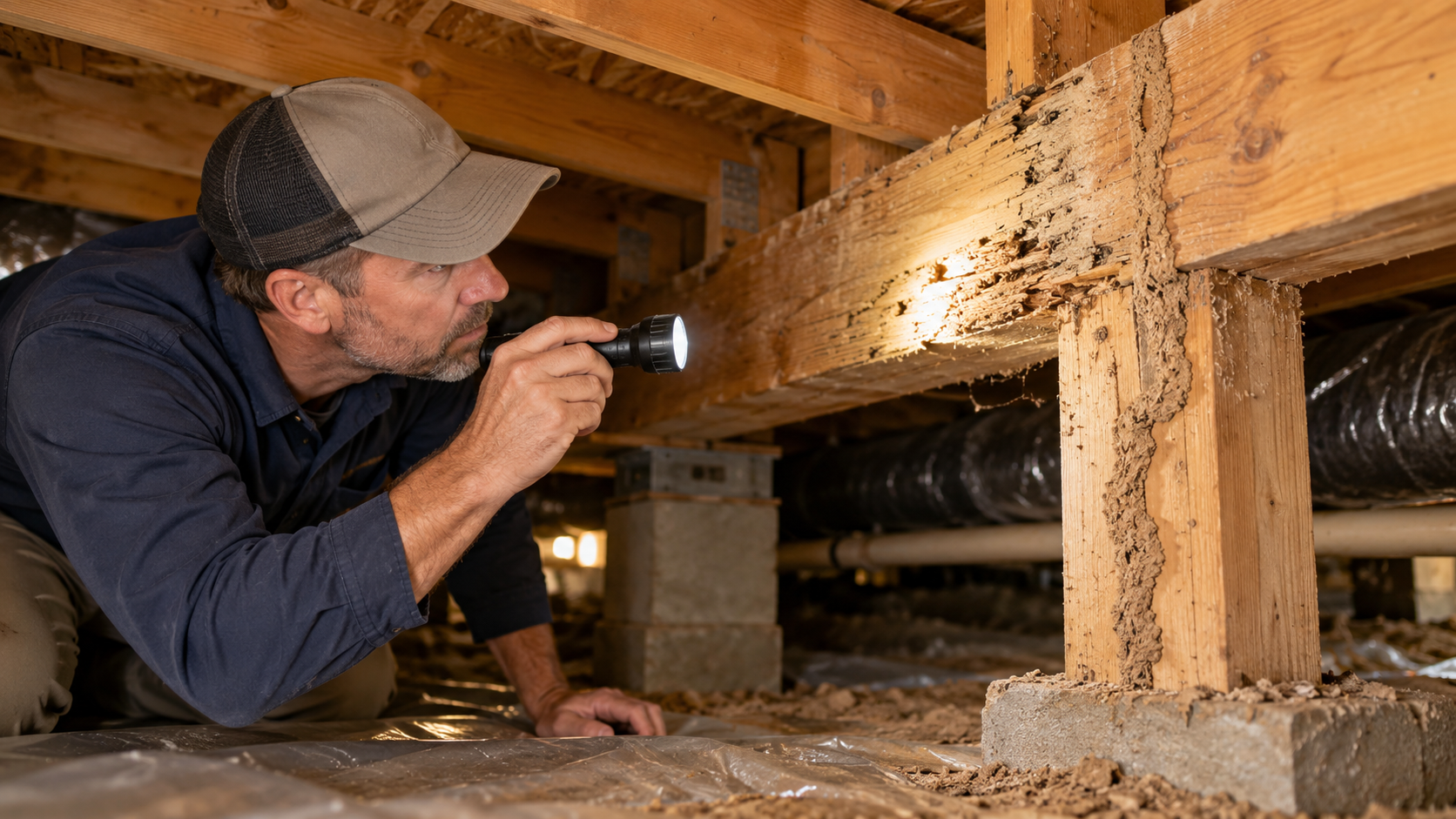
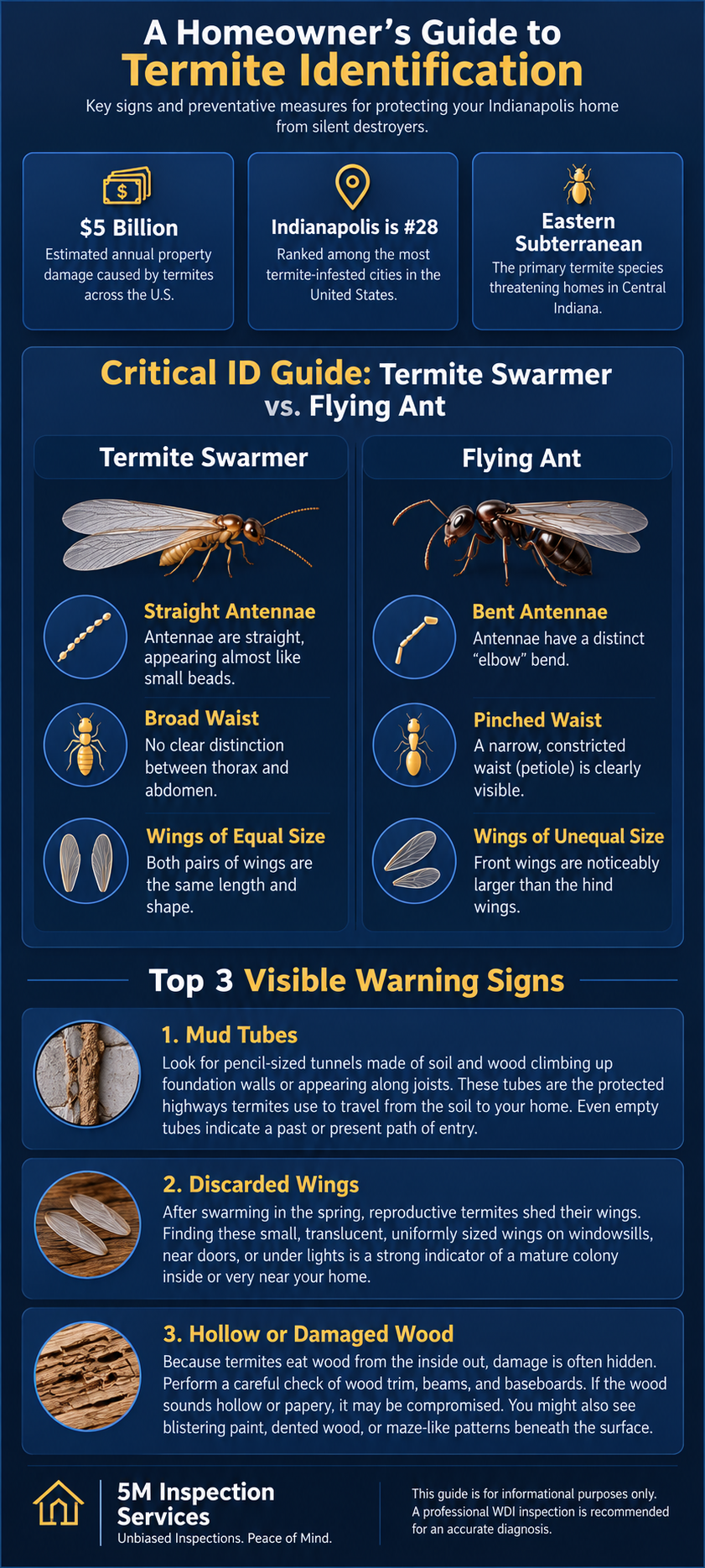
Mud tubes are perhaps the most definitive indicator of their presence. These pencil-sized tunnels act as protected highways, shielding termites from dry air and predators. You will typically find them climbing up foundation walls or spanning across floor joists. If you break a small piece off and see tiny, cream-colored insects moving inside, the tube is active. Even if it appears empty, it is a sign that a colony has already established a path into your residence. If you are unsure about what you’ve found, a professional Termite (WDI) Inspection can provide the certainty you need without the pressure of a sales pitch.
How to Identify Mud Shelter Tubes
When inspecting your basement or crawl space, focus your attention on the rim joist and the sill plate. These are the wood components that sit directly on top of your foundation wall. Look for vertical tubes that have a gritty, earthy texture; they look like dried mud or encrusted dirt. Termites use these to bridge the gap between the ground and your home’s wood. Check these areas twice a year, especially after heavy rains when the soil is saturated and termite activity peaks.
Another critical red flag is the presence of discarded wings. During the spring swarming season, reproductive termites leave the colony to find mates and start new nests. Once they land, they shed their wings in piles. You will often find these translucent, uniform-length wings on windowsills or near entry doors. Finding these inside your home almost always indicates an active infestation within the structure itself. It’s a clear signal that the colony is mature and expanding.
The “Ant vs. Termite” Identification Test
Many homeowners confuse flying ants with termite swarmers. You can tell them apart by looking at three specific physical traits. First, check the waist; ants have a pinched, narrow waist, while termites have a thick, straight body. Second, look at the wings. Ants have two pairs of unequal length, but termites have four wings that are all exactly the same size. Finally, examine the antennae. Ant antennae are elbowed or bent, whereas termite antennae are straight and look like tiny strings of beads.
If you are mid-way through a DIY renovation and uncover white, cream-colored insects inside a piece of wood, don’t reach for the bug spray. Spraying them with over-the-counter chemicals often causes the colony to retreat and relocate to a different part of the house, making professional treatment much harder. Instead, leave the area undisturbed and document the location. Identifying these signs of termites in house framing early allows for a targeted, effective response that protects your home’s long-term stability.
Structural Red Flags: When the Damage Is Hidden
Visible clues like mud tubes are helpful, but the most dangerous activity often happens where you cannot see it. Termites are masters of concealment. They eat wood from the inside out, leaving the exterior veneer or paint completely intact while the core becomes structurally hollow. Identifying these internal signs of termites in house framing requires a more tactile approach. You have to look for physical changes in how your home functions and feels. When a door suddenly sticks or a floorboard feels soft, it is not always a sign of age; it could be the result of a colony compromising your home’s integrity.
One often overlooked red flag is the sudden tightening of doors and windows. Subterranean termites bring moisture with them into the wood as they tunnel. This localized humidity causes the wood to swell, making window frames and door jambs difficult to open or close. While many homeowners in Central Indiana attribute this to seasonal humidity, termite-related swelling is often concentrated in specific areas rather than being uniform throughout the house. If you notice a specific door is consistently sticking while others move freely, it is time for a closer look.
You should also be on the lookout for frass, which is often mistaken for common sawdust. Drywood termites, though less common in the Midwest, leave behind these tiny, wood-colored pellets near “kick-out holes.” Subterranean termites use their droppings to build mud tubes, but you might still find gritty, dirt-like debris falling from small holes in your ceiling or wall. This is not a routine cleaning issue. It is a biological signature of an active colony. Identifying these specific signs of termites in house structures early can prevent the need for massive structural overhauls later.
The Sound of Damage: Tapping and Head-Banging
A simple “tap test” is a highly effective way to identify hidden damage. Take the handle of a heavy screwdriver and thump it against your baseboards, support beams, and floor joists. Healthy wood will produce a solid, sharp thud. Wood that has been hollowed out by termites will emit a dull, hollow ring. In some cases, you might even hear the termites themselves. When the colony is disturbed, soldier termites will bang their heads against the tunnel walls to signal danger. This creates a faint, rhythmic clicking sound. A comprehensive foundation inspection can help identify these hollow points before they lead to sagging floors or cracked drywall.
Drywall and Paint Anomalies
Termites do not just eat wood; they also tunnel through the paper backing of drywall. This often results in tiny “pinholes” about the size of a thumbtack tip. You might also see blistering or bubbling paint that looks remarkably like water damage. If you see a maze-like pattern appearing under thin layers of paint or wallpaper, those are likely termite galleries just below the surface. It is important to distinguish these from the vertical settling cracks common in Indianapolis homes. Settling cracks usually follow a straight line from the corners of windows or doors, while termite damage appears as irregular, topographical maps on the flat surface of the wall.
Unbiased WDI Inspections vs. Pest Control Sales Tactics
Many homeowners make the mistake of calling a pest control company at the first sign of trouble. While these companies often offer “free” inspections, it is vital to recognize the inherent conflict of interest. A business that makes its profit from selling expensive chemical treatments or baiting systems is financially incentivized to find a problem. This often leads to high-pressure sales tactics and exaggerated claims about the severity of the damage. In contrast, a professional home inspector provides an unbiased assessment because they don’t perform the remediation work. At 5M Inspection Services, we prioritize professional integrity over commission. We provide the facts so you can make an informed decision without feeling pressured into a contract you might not need.
Choosing an “inspection only” service gives you a clear, objective baseline. If we find evidence of an infestation, you can take our report to multiple treatment providers to get competitive bids. If we don’t find anything, you have the peace of mind that comes from a certified professional’s seal of approval. This objectivity is why we are trusted by families across Central Indiana. We don’t have a quota to fill; our only goal is to protect your investment and your safety. To get an honest look at your home, schedule your Termite (WDI) Inspection today and secure your peace of mind.
What Happens During a Professional WDI Inspection?
A Wood Destroying Insect (WDI) evaluation is a rigorous, systematic process. We don’t just look at the obvious areas; we perform a comprehensive check of the attic, crawl space, exterior perimeter, and the garage. This thoroughness ensures that even the most subtle signs of termites in house framing are documented. For real estate transactions, we utilize the NPMA-33 form, which is the industry standard required by most lenders. Unlike a pest control technician who might hand you a quote for thousands of dollars, a professional inspector provides a detailed technical report that serves as a neutral record of the property’s condition.
The “Inspect Check” Advantage for Sellers
If you’re preparing to put your home on the market, a pre-listing termite inspection is a strategic move. Discovering an infestation during the buyer’s inspection period can be a major “deal-killer” or lead to aggressive price renegotiations. By identifying any issues early, you maintain control over the timeline and the choice of treatment provider. Check out our Pre-Listing Inspection Guide to see how this fits into your overall selling strategy. We act as a protective partner for Indianapolis sellers, ensuring there are no surprises at the closing table. Our local expertise helps you navigate the specific signs of termites in house structures common to the Midwest, giving you a distinct advantage in a competitive market.
Protecting Your Investment: Next Steps for Central Indiana
If you have identified potential signs of termites in house structures, your first instinct might be to reach for a bottle of bug spray. Resist that urge. Spraying termites with over-the-counter chemicals often backfires. It causes the colony to scatter and relocate to deeper, less accessible parts of your home, making professional remediation significantly more difficult. Instead, document your findings and contact an objective professional. Termites are a serious threat, but they are entirely manageable if caught early by a meticulous expert. We take the responsibility of property safety seriously, framing your security as a point of professional integrity.
Moisture control is your primary line of defense. Eastern Subterranean termites require humidity to survive, so eliminating dampness near your foundation is critical. This is especially true in our humid Indiana climate. For those currently navigating a property transaction, a standard Buyer’s Home Inspection should always include a WDI add-on. This specialized evaluation ensures that hidden structural threats are identified before you sign the closing papers. It provides you with the certainty needed for a secure investment and informed decision-making.
Our approach is built on being a protective, community-oriented neighbor. We understand the inherent stress of property transactions and the fear of hidden damage. By choosing an independent inspection, you bypass the high-pressure sales tactics common in the pest control industry. You receive an unbiased, technical assessment of your home’s health. This transparency allows you to address any issues on your own terms, armed with a comprehensive report from a certified professional who is invested in your well-being.
Preventative Maintenance for Homeowners
You can significantly reduce your home’s risk by making a few simple adjustments to your property’s exterior. We recommend keeping mulch beds at least 6 to 12 inches away from your foundation. This prevents creating a direct bridge for pests to enter your siding. Ensure your gutters and downspouts are clear and diverting water at least five feet away from the structure. If you keep firewood, store it off the ground and well away from the house. These small, proactive steps disrupt the habitat termites need to thrive and protect your home’s structural integrity.
Schedule Your Unbiased Evaluation
5M Inspection Services is a family-owned business rooted in traditional values and personal integrity. We don’t position ourselves merely as a service provider but as a collaborative entity that is watchful and detail-oriented. We proudly serve homeowners and buyers in Westfield, Indianapolis, Carmel, and Fishers with rigorous technical proficiency. Our focus is on delivering high-impact information that respects your time and your budget. Don’t leave your home’s safety to chance or biased sales pitches. Schedule your professional WDI inspection with 5M today and gain the peace of mind you deserve.
Secure Your Home’s Future with Professional Certainty
Protecting your property starts with awareness. By learning to identify the subtle signs of termites in house foundations and framing, you’ve already taken the first step toward safeguarding your investment. Early detection of mud tubes or hollow-sounding wood can prevent thousands of dollars in structural damage. However, knowledge is only half the battle. You deserve an evaluation that prioritizes your safety over a sales commission.
At 5M Inspection Services, we provide the objective clarity you need. We are family-owned and operated by owners Chris and Morgan Markham, a certified WDI (Wood Destroying Insect) specialist dedicated to the Central Indiana community. Because we don’t sell treatment services, our reporting remains completely unbiased and focused on your best interests. We offer technical proficiency with the care of a protective neighbor, ensuring you have the facts required to make informed decisions about your property’s health.
Don’t let hidden threats compromise your peace of mind. Get a Professional, Unbiased Termite Inspection from 5M today. We are here to help you navigate the complexities of home ownership with confidence and integrity.
Frequently Asked Questions
Do termites ever just go away on their own?
Termites do not leave a food source on their own. They are highly organized colonies that will continue to consume cellulose until the structure is compromised or the colony is professionally eliminated. If you stop seeing swarmers in the spring, it doesn’t mean the infestation is gone; it often means the colony has simply moved deeper into the wood to continue its work undisturbed.
Can I treat termites myself with store-bought spray?
DIY treatments like store-bought sprays are generally ineffective against the entire colony. These products only kill the termites you see on the surface, which often triggers a stress response in the nest, causing them to relocate to another part of your house. Professional-grade termiticides and baiting systems are required to reach the queen and eliminate the entire population at its source.
How long does it take for termites to cause structural damage?
Significant structural damage usually takes several years to become visible, but the destruction is constant. A mature colony can consume wood 24 hours a day, often going undetected until the core of a beam is hollowed out. Because they eat from the inside out, the first signs of termites in house framing often appear only after the structural integrity has already been weakened.
Is a termite inspection required for a VA or FHA loan in Indiana?
Yes, a Wood Destroying Insect (WDI) inspection is typically required for VA and FHA loans in Indiana. Because our state is in TIP Zone #2, which indicates a moderate to heavy infestation probability, lenders require a certified NPMA-33 report to ensure the property is structurally sound. We provide these official evaluations to help local buyers meet their mortgage requirements with professional certainty.
What is the difference between a flying ant and a termite swarmer?
You can distinguish these pests by looking at their body shape, wings, and antennae. Termites have thick, straight waists and four wings of equal length, while ants have pinched waists and unequal wings. Additionally, termite antennae are straight and beaded, unlike the bent antennae found on ants. Identifying these physical traits is a key part of spotting the signs of termites in house.
How much does a professional termite inspection cost in Indianapolis?
The cost of a professional termite inspection in Indianapolis typically depends on the size of the home and the complexity of the foundation. While prices vary across the local market, an inspection is a minor investment compared to the thousands of dollars in repairs required after an undetected infestation. We focus on providing meticulous, objective reporting that prioritizes your safety and your budget.
What does termite “frass” look like, and how is it different from sawdust?
Termite frass refers to the tiny, granular pellets produced by Drywood termites, which are less common in Central Indiana. This is often confused with sawdust, but frass has a distinct, uniform shape. You are more likely to see mud tubes or moisture-damaged wood caused by Subterranean termites, which don’t leave traditional frass behind as they travel through the soil.
Can termites eat through concrete or brick foundations?
Termites cannot eat through concrete or brick foundations, but they are experts at finding the smallest entry points. They can pass through foundation cracks as thin as a credit card. Once they find a gap, they build mud tubes to stay hydrated while they bridge the distance between the soil and your home’s wood framing, often bypassing masonry entirely.