Two-thirds of Indiana’s 92 counties are classified as high-risk zones for radon, yet many homeowners only ask how long does a radon test take when a real estate deadline is staring them in the face. You want to protect your family from the second leading cause of lung cancer. You also need to know if that closing date is at risk. It’s a stressful balancing act between household safety and transaction speed.
We understand that you need certain answers, not vague estimates. A professional short-term test requires a minimum 48-hour exposure period to be valid. Unlike DIY kits that can linger in the mail for a week, professional continuous monitors provide the data we need to generate a report almost immediately after the test concludes. This ensures your transaction stays on track while providing the professional results you require.
This article explains the exact timeline of a professional radon inspection from start to finish. You’ll learn about the mandatory closed-house conditions, why professional technology is essential for tight deadlines, and how to ensure your results are both accurate and tamper-proof for your home purchase.
Key Takeaways
- Understand exactly how long does a radon test take with a breakdown of the mandatory 48-hour sensor exposure and the typical 3-to-5-day total process.
- Learn how to coordinate professional testing within Indiana’s 10-day inspection window to ensure you meet your real estate closing deadlines.
- Discover why advanced Continuous Radon Monitors offer faster, more reliable results than DIY kits by eliminating lab mailing delays.
- Identify environmental factors and tampering risks that can invalidate your results and force a 48-hour testing restart.
- Compare short-term and long-term testing methods to determine the best approach for immediate transactions versus ongoing family safety.
The Standard Timeframe: How Long Does a Radon Test Take?
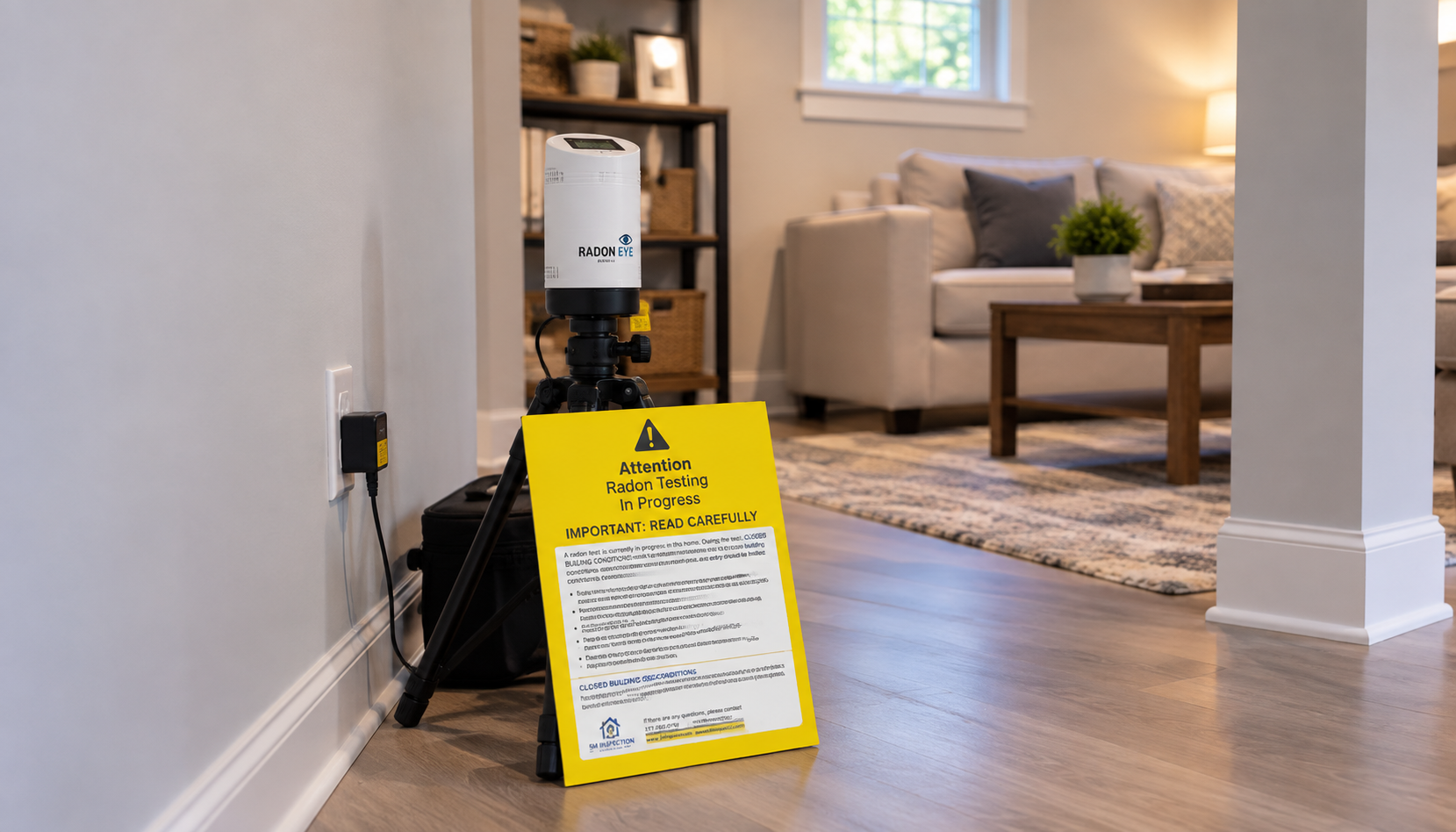
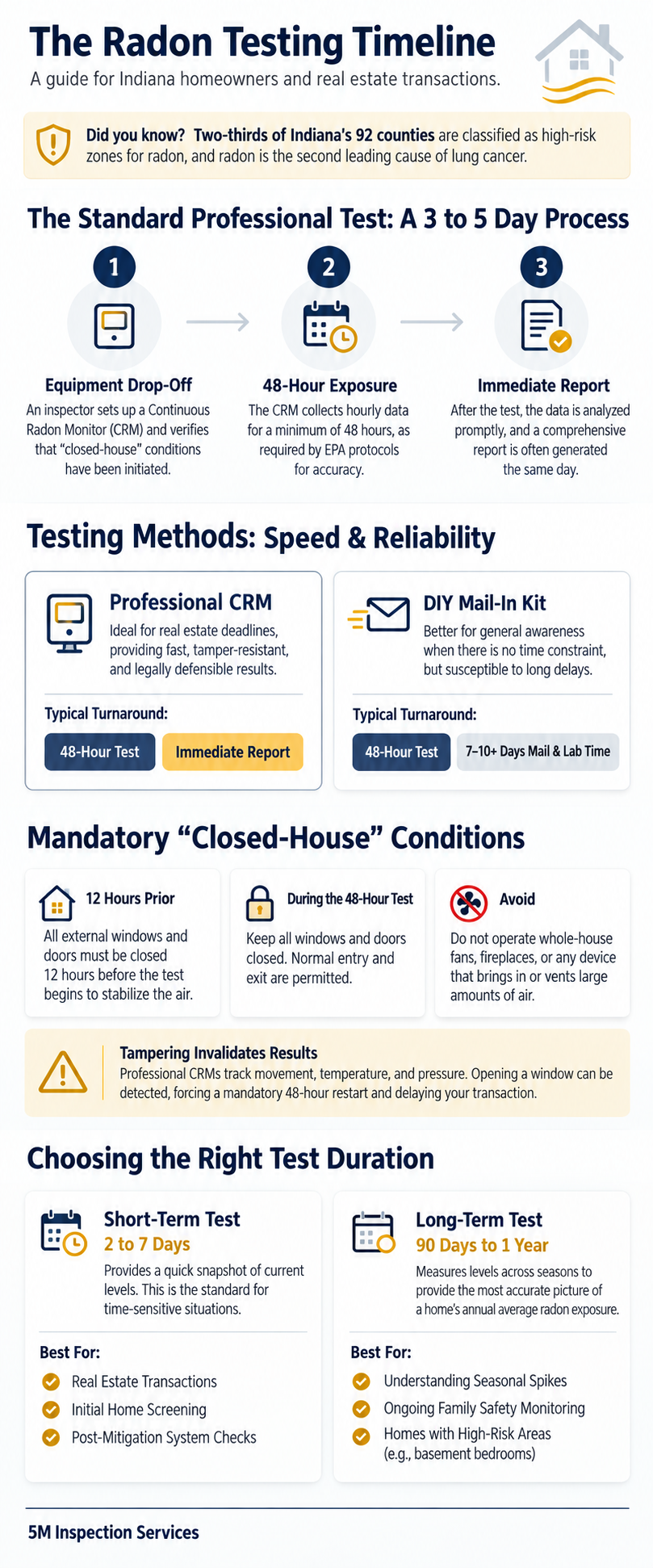
The short answer to how long does a radon test take is 48 hours, but that only accounts for the time the sensor is active in your home. For a professional real estate transaction in Indiana, you should budget between three and five days for the entire process. This timeline covers the initial equipment drop-off, the mandatory testing period, and the delivery of the final report. We prioritize this window to ensure your closing stays on schedule without sacrificing the accuracy of the data.
EPA protocols mandate this 48-hour window to account for diurnal radon fluctuations. Radon levels aren’t static. They rise and fall based on soil temperature, barometric pressure, and even the time of day. A shorter test might catch a temporary “low” and miss a dangerous “high,” giving you a false sense of security. If levels exceed the EPA action level of 4.0 pCi/L, you’ll need to explore Radon mitigation strategies to keep your family safe and your property compliant.
Exposure Time vs. Turnaround Time
Understanding the timeline requires separating the actual testing from the administrative tasks. The process involves three distinct phases: the setup and calibration, the 48-hour exposure, and the data analysis. The 48-hour rule is the minimum duration for a valid short-term test in a residential setting. The question of how long does a radon test take often comes down to the technology used by the inspector.
Professional results are significantly faster than DIY options. When you use a mail-in kit, you often wait an additional 7 to 10 days for lab transit and processing. We use Continuous Radon Monitors (CRMs) that record hourly data. Once the 48 hours are up, we can download the results and provide a report almost immediately. This speed is critical when you’re working against a tight inspection response period.
The 48-Hour “Closed House” Requirement
For a test to be accurate, the home must maintain “closed house” conditions. This means keeping all windows and external doors shut for at least 12 hours before the test begins and for the entire duration of the 48-hour exposure. Normal entry and exit are fine, but you can’t leave the back door open for the dog or keep the windows cracked for a cross-breeze.
This protocol is essential for homes in Westfield and Carmel, where modern, airtight construction can trap radon gases more effectively than older structures. We verify these conditions through the CRM’s internal sensors. These devices track movement, temperature changes, and barometric shifts. If someone opens a window to “air out” the basement, the data will show a sudden spike or drop. This could invalidate the test and force a 48-hour restart, which is why we emphasize these rules to all parties involved.
Short-Term vs. Long-Term Testing: Choosing the Right Duration
Homeowners usually face a choice between speed and seasonal accuracy. When you ask how long does a radon test take, the answer depends on your specific goal. Short-term tests, typically lasting between 2 and 7 days, serve as the gold standard for Indiana real estate transactions. They provide the immediate data points needed to make informed decisions before a contract is finalized. Long-term tests, which run for 90 days to a full year, offer the most accurate annual average by accounting for fluctuations in soil gas movement across different seasons.
When to Use a Short-Term 48-Hour Test
Short-term testing is the most common path for Indianapolis residents. It’s the only practical option when you’re buying or selling a home, as results are needed within the standard inspection contingency period. This method is also the best starting point for a home that’s never been screened because it identifies immediate risks quickly. If your results come back high, you’ll need to consult the EPA’s guide to radon reduction to plan your next steps. Additionally, we use these tests as post-mitigation verification to confirm that a newly installed system is effectively lowering gas levels below the 4.0 pCi/L threshold.
The Benefits of Long-Term 90-Day Monitoring
While short-term tests are efficient, they don’t capture the full story of your home’s air quality. Radon levels often spike during Indiana winters. When the ground freezes and your HVAC system runs constantly, a “stack effect” can pull more radon from the soil into your living space. Long-term monitoring for 90 days or more provides detailed data for families with high-risk basement living areas or children’s bedrooms on the lower level. This long-term data is far more defensible for health planning. However, it’s obviously impractical for a 30-day real estate closing. If you’re currently under contract, booking professional radon testing provides the rapid, short-term results you need to keep your transaction moving while protecting your family’s future.
Factors That Can Delay Your Radon Test Results
While we aim for a seamless 48-hour window, several external factors can disrupt the timeline. Accuracy is our priority. If the data is compromised, we won’t provide a report based on flawed numbers. A test must be voided if a storm with sustained high winds occurs during the 48-hour window. High winds create significant pressure differences between the inside and outside of your home, which can artificially inflate or deflate radon levels. In these cases, the professional testing clock must be reset to ensure the results are legally defensible and scientifically sound.
Tampering is another common cause for delay. Modern Continuous Radon Monitors are equipped with motion sensors and tilt indicators. If a device is moved, bumped, or covered, the monitor logs the event. This protects the integrity of the real estate transaction. If we detect tampering, the test is invalidated immediately. This can be frustrating when you’re facing a tight deadline, but it’s the only way to guarantee the safety of your future home. Ensuring the house remains “closed” is equally vital. If windows are opened during the test, the 48-hour exposure period usually has to start over from scratch.
Indiana Weather and Radon Fluctuations
Central Indiana’s weather is notoriously unpredictable. Heavy spring rains and severe thunderstorms significantly affect soil gas movement. When the ground becomes saturated, radon gas is forced upward. Barometric pressure plays a huge role here, acting as a “pull” that draws radon into crawlspaces or basements. We actively monitor local weather patterns in Indianapolis and Carmel to ensure your test occurs during a window of atmospheric stability. This watchful approach prevents the need for re-testing and keeps your closing on track.
The Risk of DIY Test Failures
Many homeowners ask how long does a radon test take when using a retail kit, only to find the process takes much longer than expected. DIY mistakes are common. Placing a kit in a drafty area or near a sump pump can result in an inaccurate air sample. Lab delays and lost-in-mail risks are also major concerns. If a charcoal canister sits in a delivery truck for too long, the sample can degrade, ruining your results before they even reach the lab.
It’s also a common misconception that a 24-hour test is sufficient. A 24-hour test is not accepted by most lenders or the EPA for real estate transactions. These shorter windows fail to account for the natural daily cycles of radon concentration. Using an uncertified short-term method often leads to a rejected inspection report, forcing you to hire a professional and wait another 48 hours anyway. Choosing a professional inspection from the start avoids these costly setbacks.
Radon Testing Timelines in Indiana Real Estate Transactions
In the fast-paced Indiana real estate market, timing is everything. Most purchase agreements include a standard 10-day window for inspections. If you wait until day eight to ask how long does a radon test take, you’ve already missed your chance to negotiate. Coordinating your radon device deployment with your general Buyer’s Home Inspection is the most efficient way to protect your interests. This proactive approach ensures that the testing equipment is active while other structural and mechanical assessments are being performed.
For those looking at Radon Testing Carmel Indiana, local market conditions often move even faster. Having a certified professional handle the logistics means you aren’t just getting a number; you’re getting a verified data set that stands up during a tense negotiation. We prioritize digital accessibility so you can share these findings with your Realtor the moment they are ready. This speed is a point of professional integrity for us, as we know your closing date depends on our efficiency.
Fitting Radon into the 10-Day Inspection Window
The logistics of a real estate transaction require a tight schedule. To ensure you meet your contractual obligations, we follow a streamlined four-day process that fits comfortably within your 10-day window. This schedule accounts for the physical setup, the required exposure time, and the administrative review of the data.
- Day 1: Device deployment. We set up the Continuous Radon Monitor during your general home inspection to maximize your time.
- Day 3: Device retrieval. We return to the property exactly 48 hours later to collect the equipment and upload the hourly readings.
- Day 4: Professional report delivery. After a rigorous data review, we deliver the final report for your immediate review and use in negotiations.
Negotiating Mitigation Based on Test Results
If results come back at or above the EPA action level of 4.0 pCi/L, the negotiation phase begins. A professional report is your strongest tool here. Sellers are far more likely to agree to install a mitigation system when presented with data from a certified expert rather than a DIY kit. These reports include hourly fluctuations, which prove that “closed-house” conditions were maintained and the data is accurate.
You want to leave at least three days at the end of your inspection period to discuss these findings with the seller. This buffer allows for mitigation repair estimates and formal addendums to be signed before your 10-day deadline expires. Using a professional ensures the seller accepts the data without question. If you are currently under contract, you should schedule your radon test today to ensure you have the leverage needed to secure a safe home.
Professional Radon Testing with 5M Inspection Services
5M Inspection Services is a family-owned business dedicated to the safety of Central Indiana families. We serve Indianapolis, Westfield, and Carmel with a focus on technical precision and localized care. Our team uses advanced Continuous Radon Monitors to capture hourly data points. This technology answers the question of how long does a radon test take by providing results the moment the 48-hour exposure concludes. We strictly follow all EPA protocols to ensure every reading is accurate and every family is protected.
When you book a Buyer’s Home Inspection, adding radon testing provides a complete picture of your property’s health. We don’t just drop off a device; we monitor the environmental conditions of the home to ensure the test remains valid from start to finish. Our reports are comprehensive, objective, and designed to give you total peace of mind during your home purchase.
Why Central Indiana Homeowners Trust 5M
We maintain a strict commitment to objectivity. 5M Inspection Services does not offer mitigation services. This means we have no financial interest in your results being high. Our only goal is to provide unbiased, professional data so you can make an informed decision. You have direct access to our professional home inspectors to discuss your results and what they mean for your specific property. We treat your family’s safety as a point of professional integrity.
Our communication rhythm matches the fast-paced markets of Carmel and Fishers. We provide modern, digital reports that are easy to read and share with your real estate agent. This efficiency helps alleviate the stress of a property transaction by delivering certainty when you need it most. We stay watchfully invested in your well-being throughout the entire inspection process.
Book Your Environmental Safety Evaluation
A safe home requires looking beneath the surface. You can easily combine radon testing with mold sampling or a sewer scope inspection. Bundling these services provides a comprehensive environmental evaluation in a single visit. This saves you time and ensures that every potential risk is identified before you sign the final papers. We prioritize a meticulous approach to every property we enter.
Scheduling is simple. Use our online booking tool or give us a quick phone call to discuss your timeline and specific concerns. We understand the urgency of real estate deadlines and work quickly to get our equipment on-site. Schedule your radon test with 5M Inspection Services today and get the professional results your family deserves.
Secure Your Home with Fast, Professional Results
Navigating a real estate transaction requires precision and speed. You now know that while the mandatory exposure period is 48 hours, the total turnaround for professional results fits perfectly within your 10-day inspection window. Choosing professional Continuous Radon Monitor technology over DIY kits eliminates lab delays and provides the accurate, tamper-proof data needed for successful negotiations. Understanding how long does a radon test take ensures you can act quickly to protect your investment and your health.
5M Inspection Services has been family-owned and operated since 2019. We provide meticulous testing for homeowners in Indianapolis, Carmel, Westfield, and Fishers. Our certified technology and commitment to objectivity mean you get the facts without any conflict of interest. We take the responsibility of your property safety seriously and remain watchfully dedicated to your family’s well-being. You can trust our localized expertise to guide you through every step of the environmental evaluation process.
Protect your family—Schedule your professional radon test with 5M Inspection Services today. You deserve the certainty that comes with expert data. Let’s make your next home a safe one.
Frequently Asked Questions
Can a radon test be done in 24 hours?
No, a 24-hour radon test is not valid for real estate transactions or EPA compliance. Accurate readings require a minimum 48-hour window to account for the natural rise and fall of soil gas concentrations. Short-cutting the process leads to unreliable data that won’t be accepted by lenders or savvy buyers. We prioritize your safety by strictly adhering to the mandatory two-day exposure period.
Does the 48-hour radon test include the time it takes to get results?
The 48-hour window only covers the active sampling period, not the full turnaround time. When homeowners ask how long does a radon test take, they must also account for the technician’s travel time to set up and retrieve the device. In most cases, you will receive your final digital report within 24 hours of the equipment being picked up from the property.
What happens if I open a window during a radon test?
Opening a window will likely invalidate your test and require a 48-hour restart. Our Continuous Radon Monitors track barometric pressure and temperature shifts. A sudden influx of outside air is easily detected by the sensors. This protective technology ensures that the data used for your home purchase is accurate and has not been tampered with to lower the readings.
How often should I re-test my home for radon in Indiana?
The EPA recommends re-testing your home every two years, even if you have an active mitigation system. Indiana’s soil is constantly shifting, and new cracks in a foundation can change how gas enters your living space. We suggest testing more frequently if you complete a major renovation or if you decide to finish a basement for use as a living area or bedroom.
Is a professional radon test faster than a DIY kit?
Professional testing is much faster because it eliminates the need for lab transit. A DIY kit often takes 7 to 10 days to process because you must mail the charcoal canister to a third-party laboratory. By using professional monitors, we download the data on-site. This speed is a major advantage when you are trying to determine how long does a radon test take during a tight 10-day inspection period.
Will rain or snow affect the duration of my radon test?
Severe weather can extend the duration of your test if it forces a restart. While typical Indiana rain doesn’t stop the clock, sustained high winds or rapid barometric pressure drops from a major storm can skew the data. If a significant weather event occurs, we may need to wait for atmospheric stability before beginning a new 48-hour cycle to guarantee professional accuracy and legal defensibility.
Can I stay in my house during a 48-hour radon test?
You can absolutely stay in your home, provided you keep the windows and exterior doors closed. Normal entry and exit for work or school won’t affect the sensors. Just avoid using high-volume exhaust fans or leaving the garage-to-house door open for extended periods. We want the testing process to be as minimally invasive as possible for your daily routine while still maintaining technical integrity.
How long are radon test results valid for a home sale?
Most results are considered reliable for two years, though the specific requirements often depend on your lender or the buyer’s preferences. If your last test was conducted over a year ago, many real estate professionals in Central Indiana will recommend a fresh evaluation. This provides the most current safety data for the new occupants and minimizes future liability for the seller during the transaction.